Saint Chad
Birth date unknown - March 2, 672
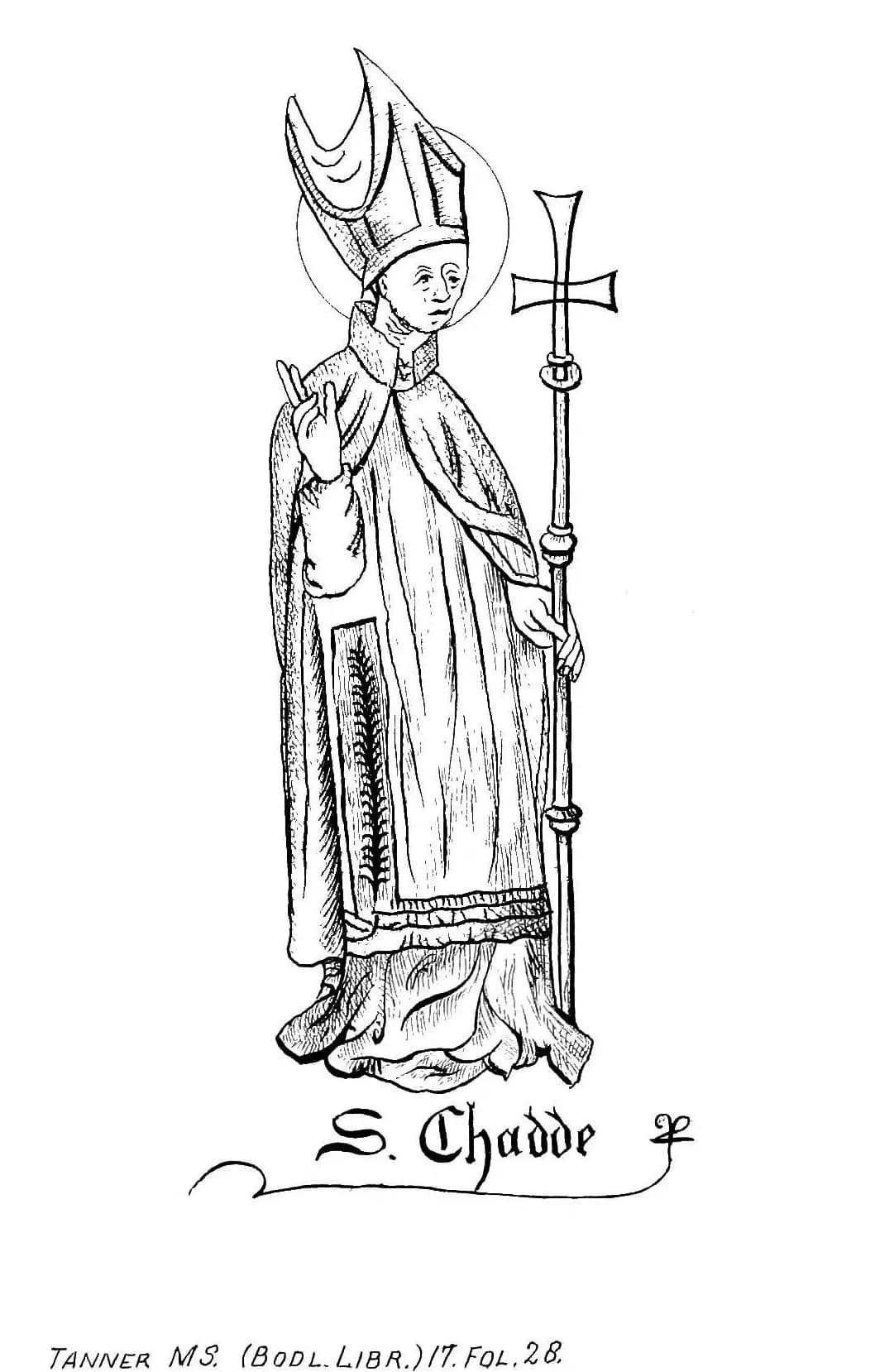
- Feast day
- March 2 38; kept with his brother Cedd on October 26 in the national calendar for England 5
- Born
- Probably in Northumbria, according to the Catholic Encyclopedia 3; in Northumbria, according to the Archdiocese of Birmingham 6. The date is not known. 3
Saint Chad was a Northumbrian monk, a disciple of Aidan, who was made a bishop twice: first at York, by a consecration that Archbishop Theodore told him had not been duly done, and then of the Mercians, with his see at Lichfield, where he died on March 2, 672. 123 Bede, who learned about him from a monk trained in his monastery, describes a bishop who walked rather than rode until the archbishop lifted him onto a horse with his own hands. 2 His feast is kept on March 2, and in England also on October 26 with his brother Cedd. 358
Four brothers and a monastery in the hills
Bede writes his name Ceadda, and remarks that it was "a rare thing to be met with" that all four brothers, Cedd, Cynebil, Celin and Chad, became priests, and two of them bishops. 1 The Catholic Encyclopedia says he was probably Northumbrian by birth; the Archdiocese of Birmingham says simply that he was born in Northumbria. 36
He was educated at Lindisfarne under Aidan, the encyclopedia says, and afterward went to Ireland, where he studied with Egbert. 3 Bede says Egbert "long led a monastic life with the same Chad, when both were youths, in Ireland, praying, observing continency, and meditating on the Holy Scriptures." 2
Their brother Cedd, bishop of the East Saxons, was given land in Deira for a monastery and chose a site "among craggy and distant mountains." 1 That was Lastingham, and it kept "the religious customs of Lindisfarne, where they had been educated." 1 When Cedd died there in an epidemic in 664, he left it to be governed by Chad. 13
Bishop of York, and the question of his consecration
The see of the Northumbrians fell vacant. Wilfrid was sent to Gaul to be consecrated, and "made some stay in the parts beyond the sea" afterward. 1 King Oswy did not wait. He sent Chad, whom Bede calls "a holy man, of modest behavior, well read in the Scripture," to be ordained bishop of the church of York. 1
Archbishop Deusdedit of Canterbury had died, and no one had been appointed in his place. 1 So Chad went on to the West Saxons, and was consecrated by their bishop Wini, with two British bishops assisting; Bede adds that Wini was at that time the only canonically ordained bishop in all Britain. 1 The encyclopedia calls him "Wini of Worcester." 3
As bishop, Bede says, Chad gave himself to humility, continence and study, and traveled "not on horseback, but after the manner of the apostles, on foot," preaching in towns, open country, cottages, villages and castles, "for he was one of the disciples of Aidan." 1
Then Theodore arrived as archbishop of Canterbury and visited the whole island. 2 He upbraided Chad for not having been duly consecrated. Chad answered, "with great humility": "If you know I have not duly received episcopal ordination, I willingly resign the office, for I never thought myself worthy of it; but, though unworthy, in obedience submitted to undertake it." 2 Theodore said he should not resign the bishopric, "and he himself completed his ordination after the Catholic manner." 23
When Bede next mentions him, Chad is living retired at Lastingham and Wilfrid holds the see of York. 2 The encyclopedia says Theodore decided Chad must give up the diocese to Wilfrid, who had come back; the Liturgy Office of England and Wales says his ordination was contested by Wilfrid, "and he humbly withdrew." 35
Lichfield
Around 669 King Wulfhere of the Mercians asked Theodore for a bishop, and Theodore asked King Oswy for Chad. 23 Theodore knew how Chad liked to travel, and ordered him to ride when he had a long journey. Finding him unwilling, Bede says, "he himself, with his hands, lifted him on the horse; for he thought him a holy man." 2
Wulfhere gave him land of fifty families for a monastery in the province of Lindsey, at a place called Ad Barve. 2 His see was at Lichfield. 24 He built a house near the church and prayed and read there with seven or eight of the brothers whenever the work of preaching left him time. 23 The Liturgy Office credits him with founding the see of Lichfield. 5
Bede had some of this from a monk named, in this translation, Trumhere, who had been trained in Chad's monastery and later taught Bede; the encyclopedia gives the name as Trumberct. 23 He told Bede that if a strong wind blew while Chad was reading, Chad would call on God for mercy for all mankind; if it grew stronger he shut the book and lay on the ground to pray; and in a real storm he went to the church and said psalms until it was calm. 2 Asked why, Chad said God thunders to remind people of the judgment, so that "as often as He lifts his hand through the trembling sky, as it were to strike, but does not yet let it fall, we may immediately implore his mercy." 2
The song over the oratory
After two and a half years an epidemic came, and many of Chad's clergy died. 2 One day he was alone in the oratory except for Owini, a former steward of Queen Etheldrid who had come to Lastingham carrying an axe, to show that he came to work and not to live idle. 2 Owini, working outside, heard what he later described as joyful singing come down from the sky to the roof of the oratory, stay about half an hour, and go back up. 2
Chad sent him for the seven brothers, told them to keep peace among themselves and the rules of the life he had taught them, and said that the day of his death was at hand. 2 When Owini came back alone and asked about the singing, Chad told him the singers were angels who had come to call him and would return in seven days, and ordered him to tell no one before his death. 2 He fell ill, and on the seventh day, having received the body and blood of Christ, he died. 2 The Archdiocese of Birmingham says he died of the plague, on March 2, 672. 6
Bede adds that Egbert, in Ireland, spoke of a man who saw Cedd come down with angels at that hour to take his brother's soul; Bede did not know whether Egbert meant himself. 2
His shrine, from Lichfield to Birmingham
Chad was buried beside Saint Mary's church at Lichfield and later moved into the new church of Saint Peter. 2 Bede describes the tomb as a wooden monument "made like a little house," with a hole in the side through which visitors took out dust to mix with water for sick people and cattle, and he reports cures at both burial places. 2
The encyclopedia says the shrine was moved to the cathedral in the twelfth century, and that the cathedral was dedicated to Our Lady and to Chad; its article on Lichfield says Bishop Roger de Clinton rebuilt the cathedral and enshrined the relics there, and that at the Reformation the shrine was "violated and stripped." 34
The Archdiocese of Birmingham tells what happened next. When the shrine was dismantled in 1538, Prebendary Arthur Dudley saved a box of bones, and they passed through Catholic families until Henry Hodgetts, dying in 1651, was heard adding "St Chad, pray for me" to the Litany of the Saints, and gave them to his Jesuit confessor. 7 Found again in 1839, they were enshrined above the high altar of the new cathedral in Birmingham at its consecration on June 21, 1841. 7 An Oxford examination in 1995 dated five of the six bones to the mid-seventh century and one to the eighth, and the archdiocese concludes that at least one, and possibly three, are Chad's. 7
What is Saint Chad the patron saint of?
Chad is the patron of the Archdiocese of Birmingham, whose feast Mass in his honor Independent Catholic News reported. 8 Its cathedral is dedicated to him and holds his relics, and the medieval cathedral at Lichfield was dedicated to Our Lady and to him. 347 None of the sources used here names him patron of a cause or a trade.
Saint Chad's feast day
The feast of Saint Chad is March 2, the day Bede gives for his death. 2 The Catholic Encyclopedia says "his festival is kept on the 2nd of March," and the Archdiocese of Birmingham marks the feast of its patron on that day. 38 The national calendar for England keeps Chad together with his brother Cedd on October 26, the day Cedd died. 5
Praying with Saint Chad
The first words Bede preserves from Chad are his answer to Theodore, and they offer to give everything up: he would resign, he said, because he had never thought himself worthy, and he had taken the office only in obedience. 2 Bede records that Theodore heard the answer and kept him a bishop. 2 The sources disagree on exactly how Chad came to leave York, but none of them describes him resisting it. 235
He walked because Aidan had walked, and Bede makes the link himself. 1 The archbishop who lifted him onto a horse did it, Bede says, because he thought him a holy man, and so obliged him to ride wherever he had need to go. 2
In Trumhere's account, a strong wind sent Chad to prayer for mercy on all mankind, and a storm sent him to the church until it passed. 2 When he explained it, he spoke of searching the recesses of the heart and cleansing it, and of a hand lifted to strike that "does not yet let it fall." 2
At the end he spoke to the brothers about the same things he had taught them: peace among themselves and toward everyone else, and the discipline of the life they had learned from him and from the fathers before him. 2 He asked them to pray for his passing and to prepare for their own, "the hour whereof is uncertain." 2
Saint Chad, pray for us.
Sources
- 1.Bede, The Ecclesiastical History of the English Nation, Book III, chapters 23 and 28 (731), translation apparently L. C. Jane's (London: J. M. Dent, 1910), in the Internet Medieval Sourcebook (Fordham University).
- 2.Bede, The Ecclesiastical History of the English Nation, Book IV, chapters 2 and 3 (731), translation apparently L. C. Jane's (London: J. M. Dent, 1910), in the Internet Medieval Sourcebook (Fordham University).
- 3.Edwin Burton, "St. Ceadda," The Catholic Encyclopedia, Vol. 3 (New York: Robert Appleton Company, 1908).
- 4."Lichfield," The Catholic Encyclopedia, Vol. 9 (New York: Robert Appleton Company, 1910).
- 5."National Calendar for England," Liturgy Office of England and Wales, Catholic Bishops' Conference of England and Wales (entry for October 26, Saint Chad and Saint Cedd).
- 6."St Chad - Fast Facts," Saint Chad's Cathedral, Archdiocese of Birmingham.
- 7."The Relics of St Chad," Saint Chad's Cathedral, Archdiocese of Birmingham.
- 8."Relics of St Chad venerated in Birmingham," Independent Catholic News (undated).
Saints to turn to next
Others in this collection who are turned to for some of the same things.
- Saint Benedict Joseph Labre1748 - April 16, 1783Poverty and simplicityPrayerDiscernment
- Saint ColetteJanuary 13, 1381 - March 6, 1447Poverty and simplicityPrayerDiscernment
- Saint Francis of PaolaMarch 27, 1416 - April 2, 1507PrayerPoverty and simplicityDiscernment
- Saint Peter of Alcantara1499 - October 18, 1562PrayerPoverty and simplicityDiscernment