Saint Peter of Alcantara
1499 - October 18, 1562
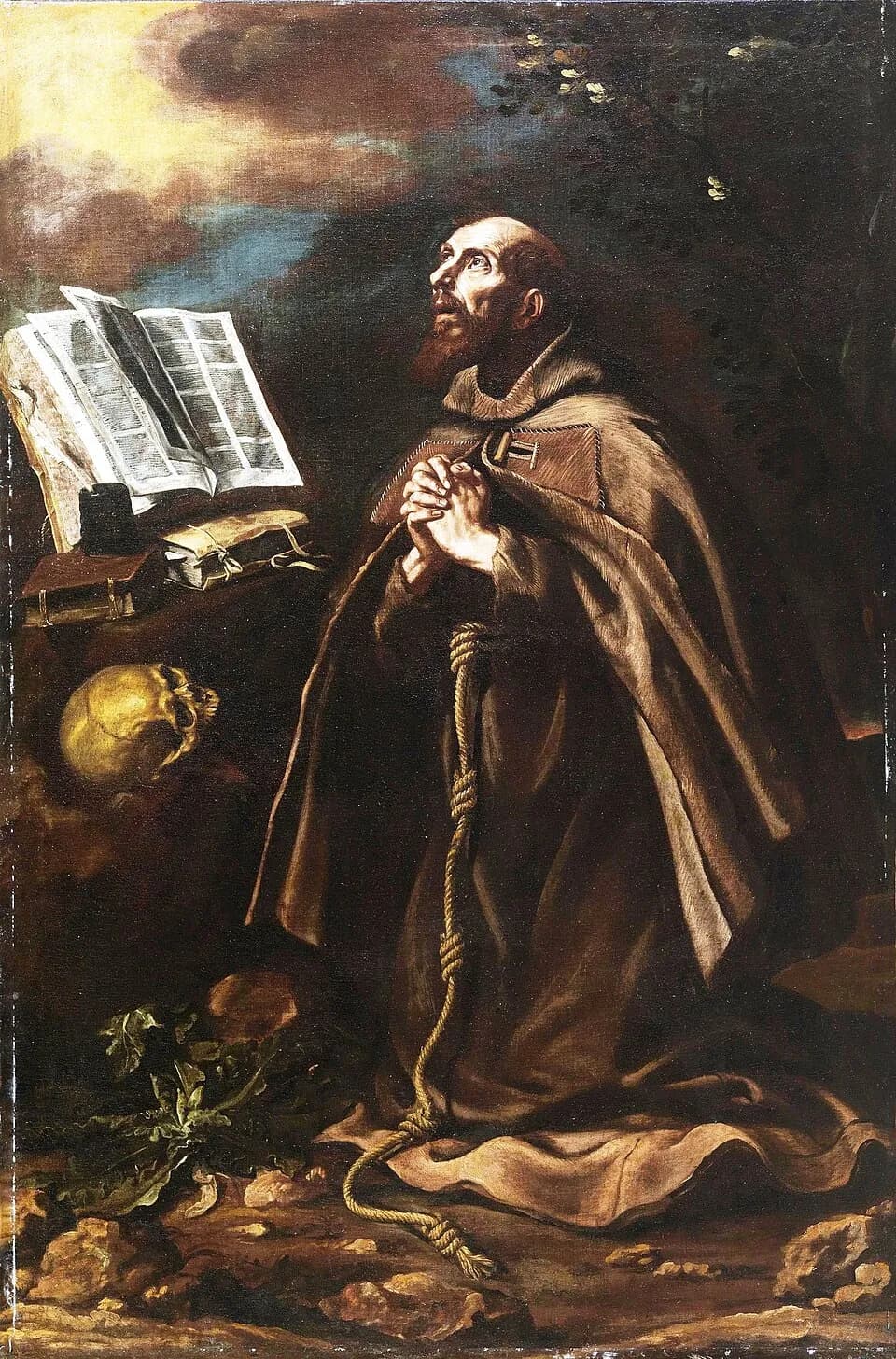
- Patron saint of
- Brazil, named in 1826, and Extremadura, named in 1962, according to a note New Advent adds to the 1911 encyclopedia article 1
Saint Peter of Alcantara was a Spanish Franciscan who spent his life trying to make his order poorer, and who, in the middle of it, told Teresa of Avila to go ahead with hers. 123 A letter from him in April 1562 encouraged her to found her first reformed convent at Avila that August, and he died two months later, on October 18, 1562. 1 His feast is kept on October 19. 13
Alcantara and Salamanca
He was born in 1499 at Alcantara, in the Spanish region of Extremadura, into a family of standing. 13 The 1911 Catholic Encyclopedia names his father as Peter Garavita, governor of the town, and his mother as a member of the noble Sanabia family. 1 The Order of Friars Minor gives his baptismal name as Giovanni Garavita and his parents as Alfonso and Maria Vilela de Sanabria, and says he took the name Peter when he received the habit. 3
He went to the University of Salamanca, at fourteen according to the encyclopedia, after studying grammar and philosophy at home. 1 Franciscan Media says he studied law there. 2 At about sixteen he joined the friars of the Stricter Observance, sometimes called the discalced friars, at a friary the encyclopedia calls Manxaretes and the Friars Minor call Los Majaretes. 123
A young superior
His superiors gave him responsibility early. At twenty-two he was sent to found a new community at Badajoz, and Franciscan Media notes that he was made the superior of a new house before he was a priest. 12 He was ordained in 1524 and the next year became guardian of the friary of Saint Mary of the Angels at Robredillo. 1 The Friars Minor add that a few years later he was allowed to live in seclusion at the friary of Saint Onofrio. 3
He also became known as a preacher. The encyclopedia says he preferred to preach to the poor, drew his sermons largely from the Prophets and the Wisdom books, and that they "breathe the tenderest human sympathy." 1 Franciscan Media credits his preaching with bringing many people into religious life, among the friars, the Poor Clares and the Secular Franciscans. 2 It also says he was not above washing dishes and cutting wood for the community. 2
The first attempt at reform
In 1538 he was elected minister of the province of Saint Gabriel, at thirty-nine. 123 He drew up constitutions for the stricter friars, which the Friars Minor title "Constitutions for the Members of the Most Strict Observance," and had them approved at the chapter of Plasencia in 1540. 13 They did not take. The encyclopedia says "his severe ideas met with such opposition that he renounced the office of provincial," and the Friars Minor say he "was forced to abandon his idea of reform." 13
He withdrew to Portugal to live as a hermit. 13 The encyclopedia places him in the mountains of Arabida, says he went there with John of Avila, and has him joining a Father Martin of Saint Mary who was already living there in solitude. 1 Other friars came to join them, small communities formed, and Peter became their guardian and novice master. 13 In 1560 those communities became the province of Arabida. 1
Barefoot to Rome, and the second attempt
He came back to Spain in 1553, spent another stretch in solitude, and then, in the words of the Friars Minor, "decided to go barefoot to Rome," to ask Pope Julius III for leave to found small, poor friaries. 13 Franciscan Media dates the permission to 1554. 2 The new houses, at Pedrosa, Plasencia and elsewhere, became a commissariat in 1556 with Peter in charge, and in 1561 the province of Saint Joseph. 13
He wrote its constitutions with "even greater severity" than the first ones, the encyclopedia says. 1 This time the reform spread quickly through Spain and Portugal, and the Friars Minor record that in 1562 it was approved by the papal bull In suprema militantis Ecclesiae. 13 His followers became known as Alcantarines. Franciscan Media notes that some of the Spanish friars who came to North and South America over the next three centuries belonged to them, and that at the end of the nineteenth century they were united with other Observant friars in the Order of Friars Minor. 2
Teresa of Avila
The Friars Minor say that in 1560, passing through Avila, he visited the Carmelite Convent of the Incarnation and met Teresa, who told him she was going through a deep spiritual crisis, and that he reassured her. 3 She chose him as her spiritual director and adviser in the reform of Carmel. 23 The encyclopedia says that her success "was in great measure due to his counsel, encouragement, and defence," and that it was his letter of April 14, 1562, that encouraged her to found her first convent at Avila, on August 24 that year. 1
Much of what is known about him comes from her. Her autobiography, the encyclopedia says, "is the source of much of our information regarding Peter's life, work, and gifts of miracles and prophecy." 1 The Friars Minor quote her: "What a model of virtue was Brother Peter of Alcantara! The world today is no longer capable of such perfection! What courage the Lord gave this Saint to undertake forty-seven years of such harsh penance." 3
He had other friends among the Spanish saints of his century. The encyclopedia names Francis Borgia, John of Avila and Louis of Granada as associates. 1 Benedict XVI, proclaiming John of Avila a Doctor of the Church in 2012, listed among Avila's friends "Saint Peter of Alcántara, Provincial of the Franciscans and reformer of the Order." 4
Penance and patience
The sources agree that he lived hard. The encyclopedia counts contemplation and penance as his most remarkable graces, and says the poverty he kept "was as cheerful as it was real, and often let the want of even the necessaries of life be felt." 1 Franciscan Media says his penances showed in food and clothing, and that "it is said that he slept only 90 minutes each night." 2 It adds that he preferred solitude, and that his patience became a proverb: "To bear such an insult one must have the patience of Peter of Alcantara." 2
Franciscan Media also makes a point about where his reform started: "While others talked about Church reform, Peter's reform began with himself." 2 The Roman Martyrology, as the Friars Minor quote it, remembers him as "distinguished for the gift of counsel and for his life of penance and austerity." 3
His writing, death and canonization
Besides the constitutions and many letters, a good number of them to Teresa, he wrote a short treatise on prayer. 1 The Friars Minor date it to 1556-57 and call it the Treatise on Prayer and Meditation; the encyclopedia says it was "translated into all the languages of Europe." 13
He died on October 18, 1562, at Arenas de San Pedro, in the Diocese of Avila. 13 Franciscan Media points out that it was the year before the Council of Trent closed. 2 Gregory XV beatified him on April 18, 1622, and Clement IX canonized him on April 28, 1669. 13
What is Saint Peter of Alcantara the patron saint of?
According to a note New Advent adds to the 1911 encyclopedia article, he was named patron of Brazil in 1826 and, in 1962, the fourth centenary of his death, patron of Extremadura, the Spanish region where he was born. 1 Neither Franciscan Media's page nor the Friars Minor's names a patronage. 23 He is often called the patron of night watchmen, but none of the sources consulted for this page says so, and it is not repeated here.
Saint Peter of Alcantara's feast day
The 1911 Catholic Encyclopedia gives his feast as October 19, the day after his death, and the Order of Friars Minor heads its page on him "19th October." 13 Franciscan Media's page gives a different date: "His liturgical feast is celebrated on September 22." 2 Both are recorded here.
He is not on the general calendar of the whole Church. New Advent's note says that since the 1969 reform of the general Roman calendar, his October 19 feast "is observed only in local and particular liturgical calendars." 1 Vatican News's Saint of the Day page for October 19 features Saints John de Brébeuf, Isaac Jogues and their companions, the Jesuit martyrs of North America, together with Saint Paul of the Cross. 5
Praying with Saint Peter of Alcantara
His first reform failed. He wrote constitutions, had them approved, met opposition he could not overcome, and gave up the office. 13 What followed was years in the Portuguese hills and then another try, stricter than the first, which this time took hold. 13 The record does not say what he made of the failure. It shows only that he went back to the same work.
Part of his place in history is a letter. The encyclopedia credits his letter of April 1562 with encouraging Teresa to found her first convent, and he did not live to see much of what followed. 1 Most of what we know of him comes from her account, so the friendship is remembered mainly from her side, and what she remembered was his penance and his virtue. 13
His austerity is hard to read about, and the sources do not soften it. The encyclopedia calls his poverty cheerful, and also says it often meant going without what was necessary. 1 Franciscan Media's reflection treats poverty as a means for him rather than a goal, a way of following Christ "in ever greater purity of heart." 2
Alongside the penance there is the short treatise on prayer and meditation, which the encyclopedia says went into all the languages of Europe. 13 The friar whose penances are the first thing the sources describe also took the time to set down, in a short book, how to pray. 12
Saint Peter of Alcantara, pray for us.
Sources
- 1.Nicholas Reagan, "St. Peter of Alcántara," The Catholic Encyclopedia, Vol. 11 (New York: Robert Appleton Company, 1911), with an editorial note added by New Advent.
- 2."Saint Peter of Alcantara," Saint of the Day, Franciscan Media.
- 3."St Peter of Alcantara," Order of Friars Minor, October 19, 2023.
- 4.Benedict XVI, Apostolic Letter proclaiming John of Ávila as a Doctor of the Church, October 7, 2012.
- 5."19 October," Saint of the Day, Vatican News.
Saints to turn to next
Others in this collection who are turned to for some of the same things.
- Saint Benedict Joseph Labre1748 - April 16, 1783Poverty and simplicityPrayerDiscernment
- Saint ColetteJanuary 13, 1381 - March 6, 1447Poverty and simplicityPrayerDiscernment
- Saint Francis of PaolaMarch 27, 1416 - April 2, 1507PrayerPoverty and simplicityDiscernment
- Saint Teresa of CalcuttaAugust 26, 1910 - September 5, 1997Poverty and simplicityDiscernmentPrayer