Saint Benedict the Moor
1524 or 1526 - April 4, 1589
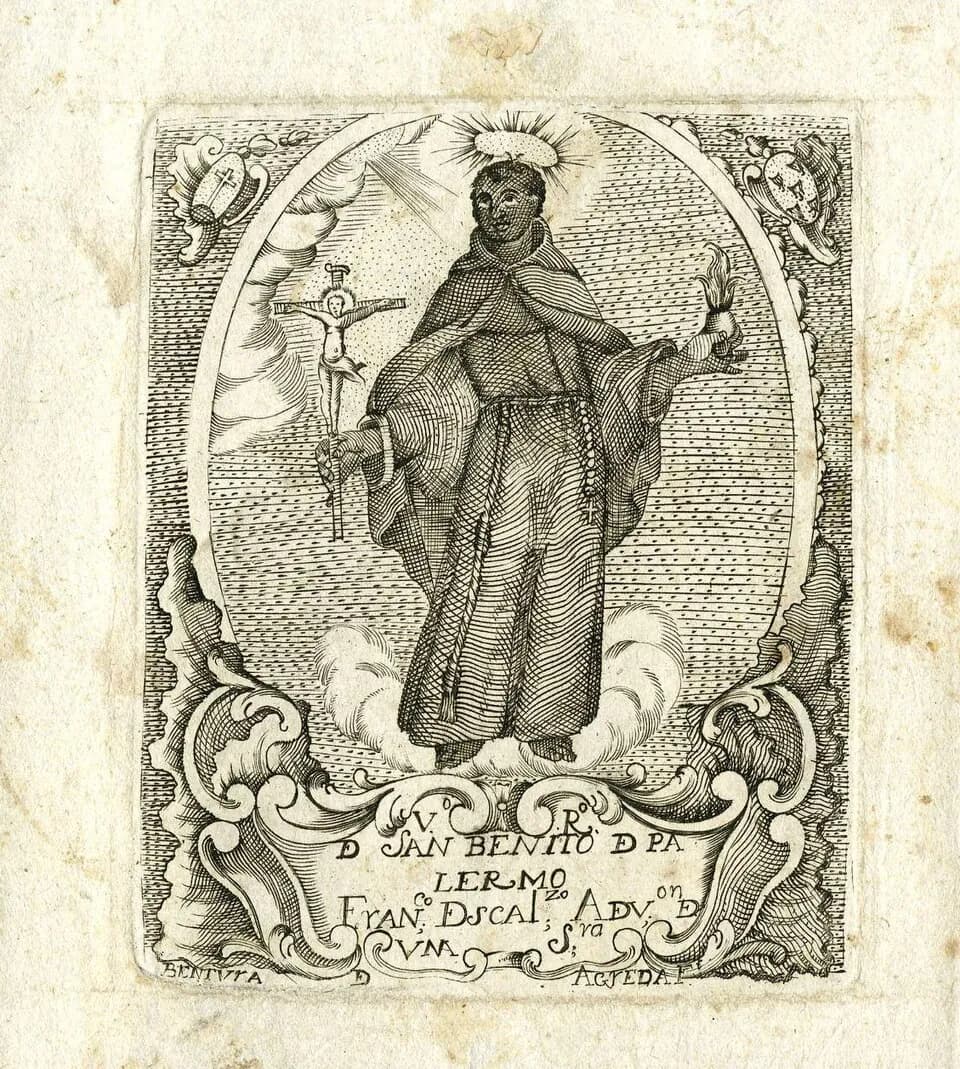
- Patron saint of
- African Americans 2
- Co-patron of
- Palermo, chosen by the city's Senate in 1712 4
- Also called
- Benedict the African 2; Benedict of San Philadelphio 3; Benedetto da Palermo, São Benedito Preto 4
- Canonized
- May 24, 1807, by Pope Pius VII 4
Saint Benedict the Moor was a Sicilian Franciscan, the son of enslaved Africans, who spent much of his religious life as the friary cook and was made guardian of his house in Palermo, though he was a lay brother who could not read. 1234 Vatican News says he became known as "the holy Moor" for his dark skin and his many virtues; Franciscan Media calls him Benedict the African, and the 1907 Catholic Encyclopedia files him under his birthplace, as Benedict of San Philadelphio. 123 He died in Palermo in 1589 and was canonized in 1807. 34
Born free to parents who were not
He was born at San Fratello, a village of the Diocese of Messina in Sicily, in 1524 according to Vatican News and the Order of Friars Minor, or 1526 according to the Catholic Encyclopedia and Franciscan Media. 1234
His parents were enslaved. The encyclopedia calls them "slaves from Ethiopia who were, nevertheless, pious Christians." 3 The Friars Minor name them as Giuseppe Cristoforo and Diana Larcari, descendants of slaves deported from Ethiopia, and say the family took the surname Manassari from the landowner who held them. 4 Franciscan Media says only that they were brought from Africa to Messina. 2
How Benedict came to be free is told three ways. The encyclopedia says the master freed him, the first-born child, on account of his parents' faithfulness. 3 The Friars Minor say the couple had decided to have no children rather than bring more slaves into the world, and that the master promised them their firstborn would be free. 4 Franciscan Media says he was freed at 18. 2 The Minister General, Br. Massimo Fusarelli, puts it as "born free by permission of a slave master." 5
The Friars Minor say he tended his master's flock; Franciscan Media says that once free he worked a farm for wages and saved enough to buy a pair of oxen, of which he was very proud. 24 He was, the Friars Minor record, "often mocked for the brown color of the skin and the servile extraction of his family." 4
"Sell the oxen and come"
At 21, according to the Friars Minor, he met Girolamo Lanza, a nobleman who had left his family and his wealth to live as a hermit at Santa Domenica, near San Fratello. Lanza said to him: "Blessed, what are you doing? Sell the oxen and come." Benedict told his parents, sold the oxen, gave the money to the poor and went. 4
The hermits followed the Rule of Saint Francis, with a fourth vow, the Friars Minor say, binding them to fast three times a week. 24 Franciscan Media places the group around Palermo and says Benedict was eventually recognized as its leader. Vatican News names it as the hermit community on Monte Pellegrino. 12
The sources disagree about how the community ended. The Catholic Encyclopedia says Pope Pius IV dissolved the association; Franciscan Media says Pius IV ordered the hermits to join the First Order. 23 The Friars Minor tell it as Benedict's own decision: the hermitage was unstable, and after 17 years of hermit life, careful discernment and long prayer to the Virgin Mary, he asked to be received at the friary of Santa Maria di Gesù in Palermo. 4 The encyclopedia names the branch he entered as the Reformed Recollects of the Franciscan Order. 3
Cook, guardian and novice master
He entered as a lay brother, and the friars gave him the humblest work. 34 Vatican News says he started as a cook, and the Friars Minor say he kept the kitchen for a long time. 14 He was illiterate. 45 Br. Massimo writes that "according to the canon law and culture of the time," the son of slaves could not have belonged to a religious order, and that the friars saw past it. 5
They made him their superior, and here the sources differ on the order and the length of his offices. The Catholic Encyclopedia says he was made superior of Santa Maria di Gesù three years after entering, "although he was only a lay brother," and that he reformed the house and governed it until his death. 3 The Friars Minor date his appointment as guardian to 1578 and say he was later made master of novices, thanks to "that instinctive and almost infused knowledge of Scripture and theological issues." 4 Franciscan Media reverses the order, novice master first and then guardian, says he was forced to accept his election, and says that when his term ended he happily went back to the kitchen. 2 Vatican News says only that he advanced from cook to novice master. 1
Franciscan Media tells two small stories of how he used that authority. He once corrected a novice and gave him a penance, then learned that the novice was not the guilty party, and knelt before him at once to ask his pardon. 2 And he never spoke of the few things he used as "mine," only as "ours." 2 Priests and friars came to him for guidance, and Br. Massimo writes that the viceroy himself treated him as a trusted advisor. 45
A reputation across Sicily
His fame as a saint and a worker of miracles spread through the whole island, and the Friars Minor say the canonization processes record numerous healings. 4 Br. Massimo writes that while he was cook his fame grew "among the people and the Black slaves," and that he was soon considered a living saint. 5
The Minister General's letter tells one story at length. A heavy snowfall had kept the friars from going out to beg, and there was no food in the house. Benedict had tubs filled with water and prayed, trusting in "Divine Providence," and the next morning, the letter says, "the tanks were full of darting fish!" 5 The encyclopedia and Franciscan Media do not tell it. 23
Death, and what happened to his body
He fell ill in February 1589 and died on April 4 34, Easter Tuesday, at seven in the evening. 4 Even before any word came from Rome, Br. Massimo writes, the faithful of Palermo moved his body from the friary cemetery into the church, as is done for canonized saints. 5 Franciscan Media says King Philip III of Spain paid for a special tomb. 2
Pope Benedict XIV recognized his cult on May 15, 1743, and Pope Pius VII canonized him on May 24, 1807. 4 The encyclopedia gives the same two years, calling the first his beatification. 3 In 1712, according to the Friars Minor, the Senate of Palermo had already chosen him as co-patron of the city. 4
The Minister General's letter speaks of his incorrupt body, and records that it was severely damaged by the wildfires of July 29, 2023. 5
Devotion to him traveled far from Sicily. The Friars Minor say it spread through Italy, Spain, the rest of Europe and the Americas, and recently to Africa, that he is known as "Benedetto da Palermo" or "São Benedito Preto," and that a church was built in his honor in the center of Manhattan. 4 Br. Massimo has seen the devotion above all in Brazil and other Latin American countries, and still feels that Benedict "is not sufficiently well known." 5
What is Saint Benedict the Moor the patron saint of?
Franciscan Media lists Saint Benedict the Moor as patron of African Americans, and says that since his canonization he has been honored as a patron saint by African Americans. 2 He is also co-patron of Palermo, chosen by the Senate of that city in 1712, according to the Friars Minor. 4
The Minister General gives his own reason for looking to Benedict first of all as he was. "It is as a Black man that Benedict firstly speaks to us of the Gospel," he writes, and in himself Benedict is a reminder that "there is neither slave nor free" in Christ. 5
Saint Benedict the Moor's feast day
Praying with Saint Benedict the Moor
Much of Benedict's religious life was spent in a kitchen. Vatican News and the Friars Minor both begin his years as a friar at the stove, and Franciscan Media ends his term as guardian there, saying he went back to the kitchen happily once it was over. 124 Franciscan Media draws a lesson for its own order from that: leadership among Franciscans is limited in time, and the Church needs people who will put their best energies into leading and then go gracefully on to other work. 2
His origins were held against him. Br. Massimo writes that he was "vilified and mistreated by his peers because of the colour of his skin and his goodness, especially towards the poor," and that he came to see that socially disadvantaged condition as the place where he could follow Christ. 5 The letter also acknowledges "with sorrow" that for many centuries the conscience of Christians about slavery was ambivalent, and says that enslaved Africans made up between 1.5 and 4 percent of the population of Sicily. 5
The story of the wrongly punished novice is a small one, and Franciscan Media tells it without comment: the superior found he had been wrong, and knelt. 2 It is told of a man who, by the same account, had to be made to accept the office. 2
Br. Massimo closes his letter by asking that the memory of Benedict open the eyes of the friars to "the new forms of harsh slavery common throughout the world," and that it help them come out of "our houses, which are often too far removed from the little ones." 5 He wrote it for the World Day of the Poor, a year after the fire. 5
Saint Benedict the Moor, pray for us.
Sources
- 1."St. Benedict the Moor, Franciscan," Saint of the Day, 4 April, Vatican News (Dicastery for Communication).
- 2."Saint Benedict the African," Saint of the Day, Franciscan Media.
- 3.J. P. Kirsch, "St. Benedict of San Philadelphio," The Catholic Encyclopedia, vol. 2 (New York: Robert Appleton Company, 1907). New Advent.
- 4."Saint Benedict the Moor: A life dedicated to the Gospel and the poor," Order of Friars Minor, 4 April 2025.
- 5.Br. Massimo Fusarelli, OFM, Minister General, "Benedict, a Gospel Reminder": Letter on the VIII World Day of the Poor and for the 5th Centenary of the Birth of St Benedict the Moor, Rome, 17 November 2024. Order of Friars Minor.
Saints to turn to next
Others in this collection who are turned to for some of the same things.
- Saint André BessetteAugust 9, 1845 - January 6, 1937PrayerWork and vocationPoverty and simplicity
- Saint Isidore the Farmerc. 1070 - May 15, 1130Work and vocationPrayerPoverty and simplicity
- Saint Katharine DrexelNovember 26, 1858 - March 3, 1955Poverty and simplicityWork and vocationPrayer
- Saint LukeFirst centuryWork and vocationPrayerPoverty and simplicity