Saint John the Baptist
First century
- Patron saint of
- Baptism 3
- Died
- Beheaded on the order of Herod Antipas; Josephus places his imprisonment at the fortress of Machaerus 1
- Buried
- At Sebaste in Samaria, according to an old tradition 1
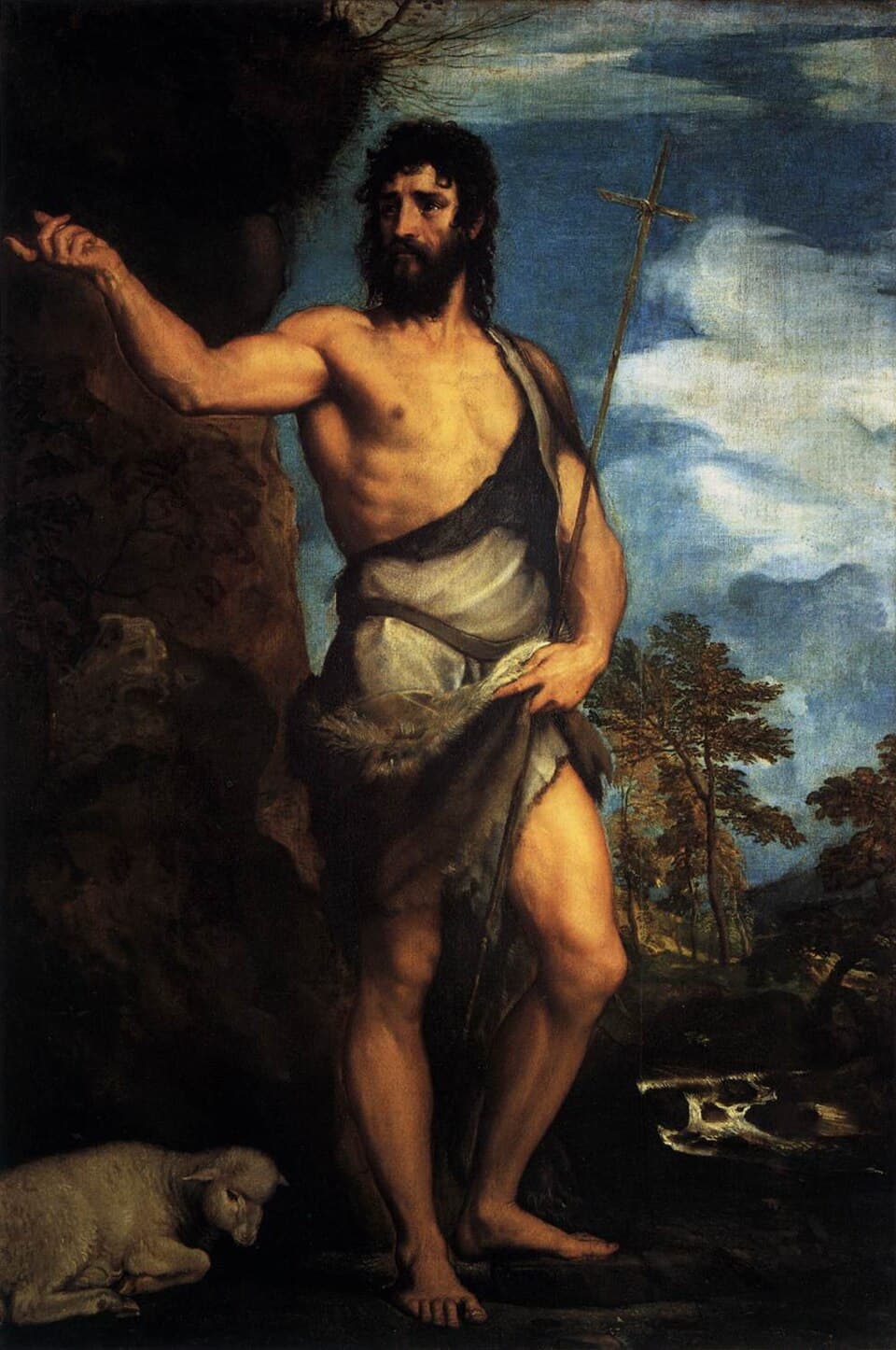
John the Baptist was the preacher in camel hair who baptized crowds in the Jordan, pointed at Jesus and called him the Lamb of God, and was beheaded in prison for telling a king that his marriage was a sin. 12 The Church keeps both ends of his life: his birth on June 24 and his death on August 29. 134 Jesus said of him that no one born of women was greater, and in the same breath that the least in the kingdom of God is greater than he. 3
A son for an old priest
His father, called Zachary in the 1910 Catholic Encyclopedia and Zechariah by Benedict XVI, was a priest of the course of Abia; his mother Elizabeth was "of the daughters of Aaron," and Luke also calls her the cousin of Mary. 12 They had prayed for a child for years, and both were old. 12 The announcement came in the Temple, while Zachary was offering incense at the altar, and Benedict XVI points out that it came "precisely in the place of prayer." 2 Zachary was slow to believe the angel and was struck dumb until the promise was kept. 1
When Mary, newly pregnant herself, came to visit, the child leaped in Elizabeth's womb, and the encyclopedia concludes that John was cleansed of original sin at that moment, before he was born. 1
At the circumcision the relatives wanted to name him after his father. Elizabeth refused, and Zachary, still mute, asked for a tablet and wrote, "John is his name." 1 His speech came back, and the hymn he sang, the Benedictus, is still prayed every morning at Lauds. 12
The desert years
Almost nothing is known of his youth. Luke says only that the child grew strong in spirit and lived in the desert until the day he appeared to Israel. 1 The year of his birth cannot be fixed; the Gospel implies he was about six months older than Jesus, whose own birth year is uncertain. 1
Later writers filled the gap. One story had Herod hunting the infant John and killing Zachary between the temple and the altar. The encyclopedia calls these "worthless legends," and notes that Saint Jerome had already dismissed them as the dreams of the apocrypha. 1
Preaching at the Jordan
Luke dates the start of his preaching to the fifteenth year of the emperor Tiberius, which Benedict XVI puts at about A.D. 27 or 28. 12 He dressed in camel hair with a leather belt and lived on locusts and wild honey, and people came out to him from Jerusalem, all Judea and the whole Jordan valley. 1 His message was short: repent, because the kingdom of heaven is at hand. 1
To the Pharisees and Sadducees who came to watch, he was ferocious, calling them a brood of vipers and warning them not to lean on being children of Abraham. 1 To ordinary people who asked what they should do, his answers were plain. Whoever had two coats should give one away. Tax collectors should take no more than the law allowed. Soldiers should not extort, should not make false accusations, and should be content with their pay. 1 The encyclopedia notices that he never told anyone to abandon their state of life, only to do their duties honestly. 1
The baptism itself drew so much attention that he was called the Baptist while he was still alive. 1 Disciples gathered around him, and he taught them to fast and to pray; Luke records Jesus' own disciples asking to be taught to pray "just as John taught his own disciples." 12
"Behold the Lamb of God"
When Jesus came to be baptized, John tried to stop him: "I ought to be baptized by thee, and comest thou to me?" 1 Franciscan Media describes him as humbled to find, among a crowd of sinners, the one he already knew to be the Messiah. 3 Jesus insisted, and John baptized him. 13
Priests and Levites came from Jerusalem to ask who he was. He told them he was not the Christ, not Elijah, and not the prophet, only "the voice of one crying in the wilderness." 1 Some time later he saw Jesus passing and said again, "Behold the Lamb of God," and two of his own disciples, one of them Andrew, left him and followed Jesus. 14
His remaining disciples were troubled when they heard that Jesus was now baptizing too and that everyone was going to him. John answered that he was only the friend of the bridegroom, glad to hear the bridegroom's voice: "He must increase, but I must decrease." 13
Prison and death
Herod Antipas had married the daughter of the Nabataean king Aretas, then took Herodias, the wife of his half-brother Philip. 1 John rebuked him for it, and Herod had him arrested. 1 Josephus gives another motive, which the encyclopedia thinks may also hold some truth: Herod feared that John's following might be turned to rebellion, and imprisoned him in the fortress of Machaerus. 1 Herodias wanted him dead; Herod hesitated, fearing the people, and for a time even listened to him willingly. 1
From prison John sent disciples to ask Jesus, "Art thou he that art to come; or look we for another?" Jesus sent back a list of what was happening: the blind see, the lame walk, the poor have the gospel preached to them. 1 The sources read the question differently. The encyclopedia holds that John's own faith could not have wavered and that he sent the question for the sake of disciples who were not yet convinced. 1 Franciscan Media allows that his idea of the Kingdom may not have been matching what he saw in Jesus' ministry. 3 Either way, Jesus then praised him to the crowd as more than a prophet. 1
The end came at Herod's birthday banquet. The daughter of Herodias, whom Josephus names Salome, danced; Herod swore to give her anything; and at her mother's prompting she asked for John's head on a dish. 1 The king was saddened, but because of his oath and his guests, he sent the executioner. 1 Benedict XVI quotes Saint Bede on what the death meant: "He was not ordered to deny Jesus Christ, but was ordered to keep silent about the truth." 2
Relics and an old devotion
An old tradition puts his grave at Sebaste in Samaria, which the encyclopedia finds hard to square with a death at Machaerus, though the remains may have been moved. 1 The tomb was honored by the middle of the fourth century and desecrated under Julian the Apostate around 362. 1
The head is harder. Benedict XVI says it had been venerated at Sebaste since the middle of the fourth century, and that the Roman Martyrology records a second discovery of it, with the relic brought to the church of San Silvestro in Campo Marzio in Rome. 2 The encyclopedia is more cautious: the accounts of the head are "many and discordant," and several churches claim it, among them Amiens and San Silvestro in Capite in Rome. 1
What is Saint John the Baptist the patron saint of?
Franciscan Media lists Saint John the Baptist as the patron saint of Baptism. 3 The 1910 Catholic Encyclopedia names no single patronage. It points instead to "the numberless churches, abbeys, towns, and religious families placed under his patronage" as evidence of how old and how widespread his cult is. 1
Patronages of particular countries and cities are often attached to him. Neither source names any, so this page does not either.
Saint John the Baptist's feast day
Saint John the Baptist has two feasts. The Nativity of Saint John the Baptist is kept on June 24, and the Martyrdom of Saint John the Baptist, also known as the Beheading, on August 29. 134 Benedict XVI notes that the August memorial goes back to the dedication of a crypt at Sebaste. 2 The encyclopedia adds that August 29 "can hardly be relied upon" as the historical date of his death. 1
The birthday is the older and greater feast. The encyclopedia calls it one of the oldest feasts, perhaps the oldest, kept in honor of a saint in both the Greek and Latin liturgies, and explains why his birth is kept when other saints are remembered on the day they died: he was filled with the Holy Spirit before he was born. 1 It was once preceded by a fast and in many places celebrated with three Masses, like Christmas, and in 841 two armies that met on June 23 agreed to put off their battle until after the feast. 1
Praying with Saint John the Baptist
Crowds came out to the desert for him, and he spent them on someone else. He pointed his own disciples at Jesus and let them go, and when the rest complained that the crowds were drifting away he said he was glad. 13 "He must increase, but I must decrease" is easy to admire and very hard to mean about one's own work. 1
His advice to the people who came to him was surprisingly ordinary. Soldiers were to stay soldiers and tax collectors were to stay tax collectors, and both were to stop cheating. 1 The man who lived on locusts asked nobody else to.
Benedict XVI traced his courage back to prayer: the desert, the Temple where his birth was announced, the prayers he taught his disciples. 2 Bede, quoted by Benedict, puts the cost precisely: nobody asked John to deny Christ, only to keep quiet about the truth. 2 He would not keep quiet, and he died for it at a party, as a favor to a dancer. 1
In prison he sent a question to Jesus, and the sources still disagree about what lay behind it. 13 The answer he got back was not a yes. It was a list of what Jesus was doing, sent to a man who would not be let out to see it. 1 None of the sources says how John took it.
Saint John the Baptist, pray for us.
Sources
- 1.Charles Souvay, "St. John the Baptist," The Catholic Encyclopedia, Vol. 8 (New York: Robert Appleton Company, 1910).
- 2.Pope Benedict XVI, General Audience of 29 August 2012: The Martyrdom of St. John the Baptist. The Holy See.
- 3."Nativity of Saint John the Baptist," Saint of the Day, Franciscan Media.
- 4."Martyrdom of Saint John the Baptist," Saint of the Day, Franciscan Media.
Saints to turn to next
Others in this collection who are turned to for some of the same things.