Saint Joan of Arc
January 6, 1412 - May 30, 1431
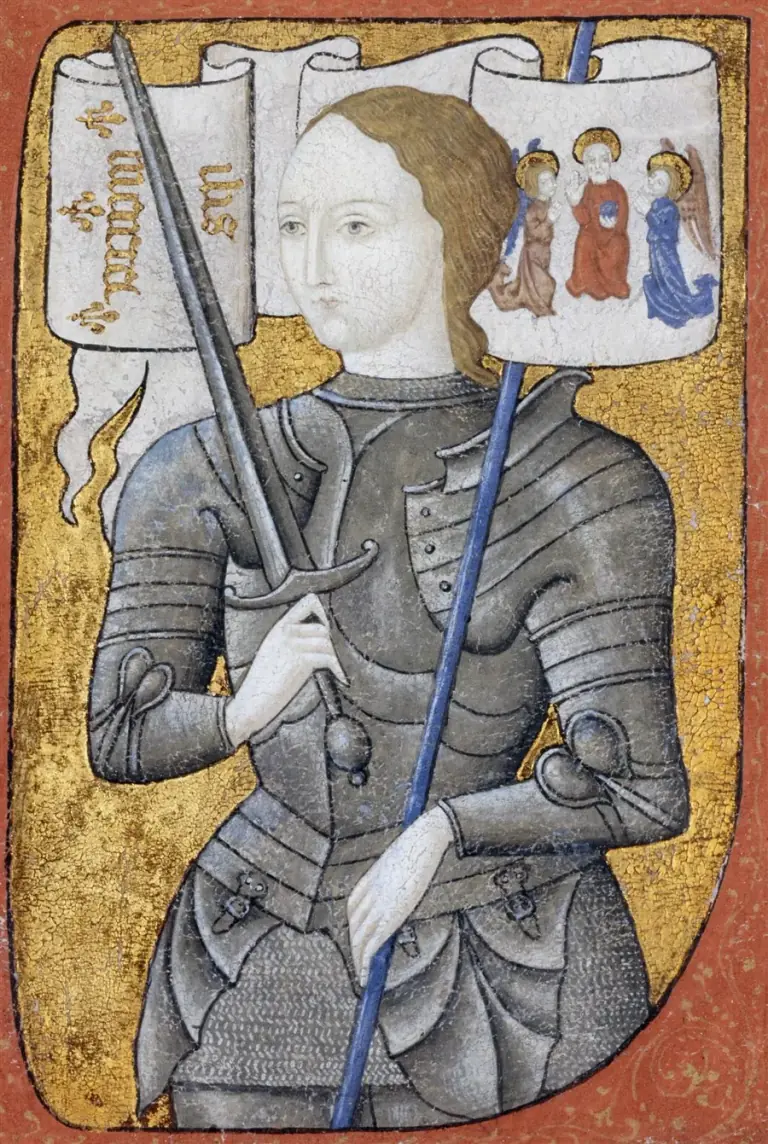
- Patron saint of
- France and military members 2
- Born
- Domremy in Champagne, probably January 6, 1412 1
- Father
- Jacques d'Arc, a small peasant farmer, poor but not needy 1
- Condemned
- For heresy, in a trial run by Bishop Pierre Cauchon 1
- Conviction annulled
- By a rehabilitation trial twenty-four years later 1
- Canonized
- 1920, having been beatified in 1909 2
Saint Joan of Arc was a farmer's daughter who told the King of France that God had sent her to save his kingdom, and then did it. She lifted the siege of Orleans at seventeen and was burned as a heretic at nineteen by a court that convicted her, in the end, for wearing men's clothes. Twenty-four years later the Church annulled the verdict. Nearly five hundred years after that, it canonized her.
Domremy
Joan was born at Domremy in Champagne, probably on 6 January 1412, to Jacques d'Arc, "a small peasant farmer, poor but not needy." 1 She could not read or write.
In the summer of 1425, at about thirteen and a half, she became aware of what she called her voices, or her counsel, which she identified as Saint Michael, Saint Margaret and Saint Catherine. 12 Of them she said simply: "I saw them with these very eyes, as well as I see you." 1
Getting to the king
By May 1428 she was certain she was called to help the king. She went to Robert Baudricourt at Vaucouleurs, who dismissed her. She persisted, and after she predicted a French defeat that then happened, he let her go. 1
She reached Chinon on 6 March 1429 and was admitted to Charles VII two days later, picking him out although he was disguised among his courtiers, and telling him something private that convinced him. 1
Orleans and Reims
Joan entered Orleans on 30 April 1429. By 8 May the English forts had been taken and the siege was lifted; she had been wounded by an arrow on the 7th and returned to the fighting. 1 On Sunday 17 July 1429 Charles VII was solemnly crowned at Reims, with Joan standing by holding her standard. 12
She was seventeen. In under four months she had reversed the strategic position of a war that had run for ninety years.
Rouen
On 24 May 1430 she was captured at Compiegne when a drawbridge was raised and left her outside. 1 Her trial opened at Rouen on 21 February 1431, on charges of heresy and witchcraft, orchestrated by Bishop Pierre Cauchon. She was held illegally in a secular castle rather than an ecclesiastical prison. 1
She was burned at Rouen on 30 May 1431 and her ashes were thrown into the Seine. 12 She was nineteen. The charge she was finally condemned on was wearing men's clothing. 2
Twenty-four years later a rehabilitation trial opened with papal consent and reversed and annulled the conviction entirely. 1 She was beatified in 1909 and canonized in 1920. 2
What is Saint Joan the patron saint of?
Joan of Arc is the patron saint of France and of military members. 2 She is also, unavoidably, the patron of anyone condemned by a process that was rigged.
Saint Joan's feast day
Praying with Saint Joan
Before Orleans there was a year of being refused. Baudricourt sent her away, and she went back. 1 Most accounts skip that year, which is unfortunate, because it is the part most people are living in.
She said of her voices that she saw them with these very eyes, as well as I see you. 1 She never argued anyone into believing her and never took a word of it back, including in front of a court that killed her for it.
The court was a Church court, the process was rigged, and the Church itself annulled the verdict twenty-four years later and canonized her five centuries after that. 12 Being failed by churchmen is not the same as being failed by God, though it takes a long time to feel like a distinction.
She was seventeen at Orleans and nineteen when they burned her. 1 Her vindication arrived far too late to do her any good, and it still arrived.
Saint Joan of Arc, pray for us.
Sources
Saints to turn to next
Others in this collection who are turned to for some of the same things.