Saint Anicetus
Died about 166 to 168
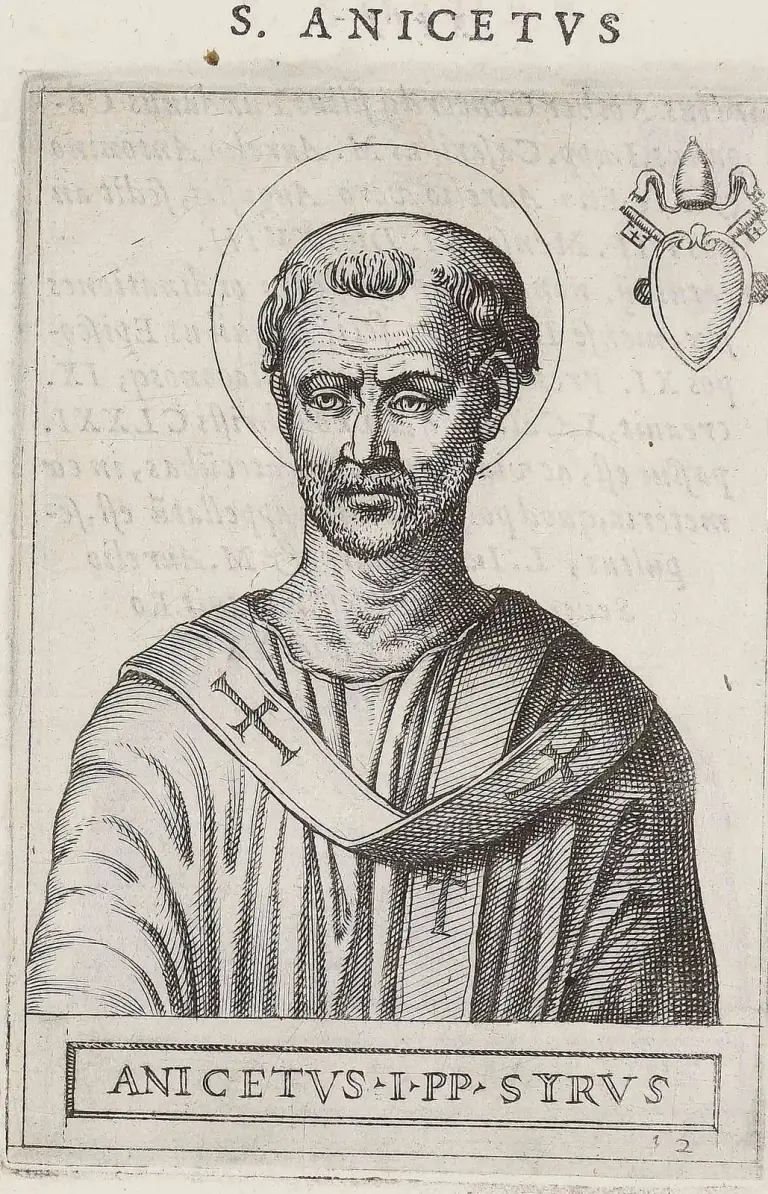
- Pope
- About 157 to about 168, says Campbell 1; already pope by about 154, by Kirsch's reckoning 9; eleven years, says Eusebius 5
- Known for
- Receiving Saint Polycarp of Smyrna, disagreeing with him over the date of Easter, and keeping communion with him 136
- Deacon
- Eleutherus, later pope, according to Hegesippus 5
Saint Anicetus was bishop of Rome in the middle of the second century, a Syrian by birth according to the Liber Pontificalis. 8 He is remembered for one visitor: Saint Polycarp of Smyrna, a disciple of the apostle John, who came to Rome in his old age to discuss the date of Easter with him. 16 They could not agree, and they parted in peace, Anicetus having let Polycarp celebrate the Eucharist in his own church. 6 His feast is April 20. 3
A Syrian in the see of Rome
Irenaeus of Lyons, writing within a generation, lists the bishops of Rome in order: "then Hyginus; after him, Pius; then after him, Anicetus. Soter having succeeded Anicetus, Eleutherius does now, in the twelfth place from the apostles, hold the inheritance of the episcopate." 4 Elsewhere he calls Anicetus the bishop "who held the tenth place of the episcopate." 7 Eusebius says that Anicetus "assumed the leadership of the Christians" at Rome when Pius died in the fifteenth year of his episcopate. 5
The Liber Pontificalis, compiled much later, says he was "by nationality a Syrian, son of John, from the town of Humisa," which its translator, Louise Ropes Loomis, identifies as Emesa, an important city of northern Syria. 8 The Norwegian bishops' saints database (katolsk.no) gives the modern name, Homs. 2
His dates are a tangle. Thomas Campbell, in the 1907 Catholic Encyclopedia, has him succeed Pius "towards the year 157" and reign "till about 168," and quotes Louis Duchesne that "more exact verification is impossible." 1 Johann Peter Kirsch, in the encyclopedia's later article on Pius I, reasons from Polycarp's death, which he dates "with great certainty to 155-6," and concludes that Anicetus was already bishop by the year before. 9 The Liber Pontificalis gives consular years from 150 to 153 and two different lengths of reign; Loomis calls the chronology mistaken and puts the pontificate probably from 154 or 155 to 166 or 167. 8 Eusebius gives him eleven years in all. 5
Polycarp comes to Rome
The question that brought Polycarp was Easter. Campbell explains it simply: "Polycarp and others in the East" celebrated the feast "on the fourteenth of the month of Nisan, no matter on what day of the week it fell; whereas in Rome it was always observed on Sunday." 1 katolsk.no adds that the Eastern Christians appealed to the tradition of the apostles John and Philip, the Western to that of Peter and Paul, and that Polycarp, then in his eighties, would keep the custom he had learned from John. 2
Campbell dates the visit to 160-162. 1 On Kirsch's reckoning it fell in the year before Polycarp's martyrdom, that is, about 154 or 155. 9 katolsk.no places it soon after Anicetus was elected. 2
The account of what happened comes from Irenaeus, who had known Polycarp as a boy, in a letter written decades later to Pope Victor, who had tried to cut off the churches of Asia over the same question. 46 "When the blessed Polycarp was at Rome in the time of Anicetus, and they disagreed a little about certain other things, they immediately made peace with one another, not caring to quarrel over this matter." 6 Neither could move the other. Anicetus could not persuade Polycarp to drop what "he had always observed with John the disciple of our Lord, and the other apostles with whom he had associated"; nor could Polycarp persuade Anicetus, "as he said that he ought to follow the customs of the presbyters that had preceded him." 6
Then Irenaeus gives the ending. "But though matters were in this shape, they communed together, and Anicetus conceded the administration of the eucharist in the church to Polycarp, manifestly as a mark of respect. And they parted from each other in peace, both those who observed, and those who did not, maintaining the peace of the whole church." 6 The current Roman Martyrology remembers the visit in the same spirit: Anicetus is the pope whose fraternity the distinguished guest Polycarp enjoyed when he came to discuss the date of Easter with him. 3
Polycarp did more in Rome than talk about Easter. Irenaeus says that he "caused many to turn away from the aforesaid heretics to the Church of God, proclaiming that he had received this one and sole truth from the apostles." 4
Heretics and a historian
Those heretics were active in Rome under Anicetus. Irenaeus writes that Valentinus "remained until Anicetus," and that Marcion "flourished under Anicetus." 7 Campbell names them too, among the men who were "disturbing the Church" in Rome at the time. 1
Another visitor left a record of his own. Hegesippus, whom Campbell calls "the first Christian historian whose writings are of great value," came to Rome in these years. 1 Eusebius quotes him: "when I had come to Rome I remained there until Anicetus, whose deacon was Eleutherus. And Anicetus was succeeded by Soter, and he by Eleutherus." 5 And he says what he found: "In every succession, and in every city that is held which is preached by the law and the prophets and the Lord." 5 Campbell reads the visit as a sign that "many illustrious men repaired to Rome at that period." 1
What the later sources add
The Liber Pontificalis credits Anicetus with forbidding the clergy to grow long hair, "following thus the precept of the apostle." 8 Loomis notes that Saint Jerome alludes to a rule of that kind, and points to Paul's words in First Corinthians. 8 katolsk.no thinks it was probably Anicetus, and not Anacletus as the Liber Pontificalis claims, who raised a small memorial over the tomb of Saint Peter on the Vatican Hill. 2
Whether he died a martyr is uncertain. The Liber Pontificalis says that "he also died a martyr," and the 1897 English Roman Martyrology entered him as "pope and martyr, who, in the persecution of Marcus Aurelius Antoninus and Lucius Verus, received the palm of martyrdom." 810 Campbell writes that he "suffered martyrdom in 161," a year that sits awkwardly with his own statement that Anicetus reigned until about 168. 1 katolsk.no says plainly that the martyrdom is not historically proven. 2 The current Martyrology does not call him a martyr. 3
He was buried, says the Liber Pontificalis, "near the body of the blessed Peter in the Vatican"; one version of the text says the cemetery of Callistus instead, which Loomis rejects, since the cemetery took its name from Callistus, the fifth pope after Anicetus. 8 katolsk.no also has him buried at the Vatican. 2
What is Saint Anicetus the patron saint of?
Saint Anicetus's feast day
Saint Anicetus's feast day is April 20 in the current Roman Martyrology, which enters him on that day as the pope whose fraternity Polycarp enjoyed. 3 April 20 is also the day the Liber Pontificalis gives for his burial. 8
Older calendars kept him on April 17. The 1897 Martyrology has him there, and katolsk.no says that his memorial on April 17 stood in the Roman calendar until 1969. 210 Campbell, writing in 1907, notes that the dates given vary between April 16, 17 and 20. 1
Praying with Saint Anicetus
Almost everything certain about Anicetus comes from one meeting with an old bishop from Asia. 6 The two men held different customs on the greatest feast of the year, each believed he had his custom from the apostles, and neither gave way. 6
Anicetus had his own predecessors to answer to, and he said so. 6 He also had a guest who had known the apostle John. What he did was give that guest the altar of his own church. 6 Irenaeus told the story decades later to a pope who had tried to break communion over the same question, and he told it as an example of how the Church keeps peace without pretending to agree. 6
katolsk.no observes that the pope and Polycarp did not excommunicate each other, but parted as friends, because the question was one of discipline and not of doctrine. 2 The quarrel itself went on long after both of them were dead. 2
Saint Anicetus, pray for us.
Sources
- 1.Thomas Campbell, "Pope St. Anicetus," The Catholic Encyclopedia, vol. 1 (New York: Robert Appleton Company, 1907).
- 2."Den hellige pave Anicetus," Den katolske kirke (katolsk.no), Catholic Diocese of Oslo (in Norwegian).
- 3.Roman Martyrology, entry for April 20, "Sant'Aniceto, papa," Santo del giorno, Conferenza Episcopale Italiana (in Italian).
- 4.Saint Irenaeus, Against Heresies, Book III, chapter 3, translated by Alexander Roberts and William Rambaut, Ante-Nicene Fathers, vol. 1 (Buffalo: Christian Literature Publishing Co., 1885), as hosted by New Advent.
- 5.Eusebius, Church History, Book IV, chapters 11, 19 and 22, translated by Arthur Cushman McGiffert, Nicene and Post-Nicene Fathers, Second Series, vol. 1 (Buffalo: Christian Literature Publishing Co., 1890), as hosted by New Advent.
- 6.Eusebius, Church History, Book V, chapter 24, quoting Irenaeus's letter to Pope Victor, translated by Arthur Cushman McGiffert, Nicene and Post-Nicene Fathers, Second Series, vol. 1 (Buffalo: Christian Literature Publishing Co., 1890), as hosted by New Advent.
- 7.Saint Irenaeus, Against Heresies, Book III, chapter 4, translated by Alexander Roberts and William Rambaut, Ante-Nicene Fathers, vol. 1 (Buffalo: Christian Literature Publishing Co., 1885), as hosted by New Advent.
- 8.The Book of the Popes (Liber Pontificalis), I: To the Pontificate of Gregory I, translated by Louise Ropes Loomis (New York: Columbia University Press, 1916), life of Anicetus, with the translator's notes.
- 9.Johann Peter Kirsch, "Pope St. Pius I," The Catholic Encyclopedia, vol. 12 (New York: Robert Appleton Company, 1911).
- 10.The Roman Martyrology, April 17 (Baltimore: John Murphy Company, 1897).
Saints to turn to next
Others in this collection who are turned to for some of the same things.