Saint Berard and Companions
d. January 16, 1220
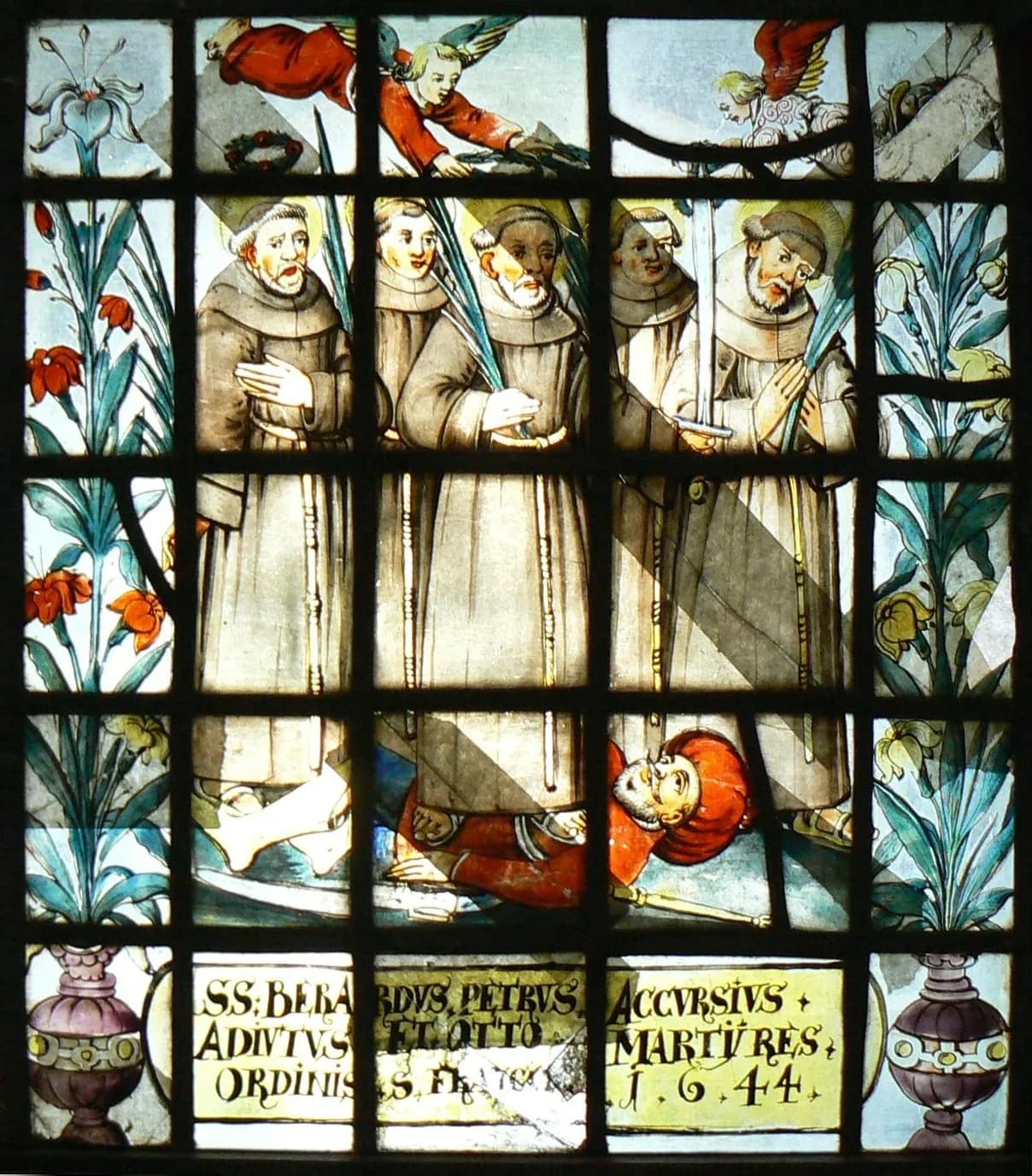
- Berard born
- At Carbio in Umbria, says the 1907 Catholic Encyclopedia 1; at Calvi (Narni), say the Irish Franciscans 4
- Patron saint of
- No patronage is stated by the sources consulted
Saint Berard and his four companions were the first martyrs of the Franciscan order: five friars sent by Saint Francis of Assisi to preach to the Muslims of the West, and killed at Marrakesh on January 16, 1220. 123 Their bodies were carried back to Coimbra in Portugal, where a young canon named Fernando saw them and decided to become a friar himself. 56 The Church knows him as Saint Anthony of Padua. 56
Five friars from Umbria
Berard came of the noble family of the Leopardi. The Catholic Encyclopedia says he was a native of Carbio in Umbria; the Irish Franciscans say he was born in Calvi, near Narni. 14 Francis received him into the order himself in 1213. 12 He spoke Arabic well and was an eloquent preacher, which is presumably why he was chosen. 12
His companions were two priests, Peter and Otto, and two lay brothers, Accursius and Adjutus. 13 The Irish Franciscans say that all five were Umbrians: Peter came from San Gemini and had been a friar since 1211, and Otto came from Stroncone. 4 katolsk.no adds a sixth, a priest named Vitalis who led the group at the start. 2
Sent by Francis
The mission was decided at the order's general chapter of 1219. Stephen Donovan, who wrote the encyclopedia entry, says Francis "believed that the time had then come for the religious of his order to extend their apostolic labours beyond the Italian peninsula and Northern Europe." 1 Francis took the greater part of Syria and Egypt for himself and twelve others, and gave Berard and his companions Morocco. 12 katolsk.no adds that Francis had become convinced there must be a better way than the crusades to bring Muslims to the faith. 2
katolsk.no follows them closely. They set out on foot for Aragon, where Vitalis fell ill; the other five went on under Berard. 2 At Coimbra they were received by Queen Urraca, the wife of King Afonso II. 24 At Alenquer the king's sister, the Infanta Sancha, gave them ordinary clothes to make their work among the Muslims easier. 2
Seville and Marrakesh
Their first mission was to Seville, then a Muslim city, and it ended at once in prison. 234 katolsk.no says the ruler there was unwilling to execute them, and when he learned that they would rather go on to Morocco than home to Italy, he sent them to Marrakesh. 2 There, by its account, they served as chaplains to the Christian soldiers in the sultan's pay and preached in the streets, although Berard was the only one of them who knew any Arabic. 2
The encyclopedia puts the rest in a sentence: "Their open preaching of the Gospel there and their bold denunciation of the religion of Mahomet soon caused them to be apprehended and cast into prison." 1 katolsk.no says the people at first tolerated them as madmen. 2 The Irish Franciscans add that the king had them expelled, and that the friars slipped away from their guard at Ceuta and came back to their mission. 4 katolsk.no says they were beaten and brought before the ruler, who ordered them either to keep silent or to go back to Spain, and they refused both. 2
The accounts differ on how they died. Donovan writes that the "Moorish king in a fit of rage opened their heads with his scimitar," and katolsk.no tells it the same way. 12 The Roman Martyrology says they were run through with the sword at the order of the leader of the Moors, and the Irish Franciscans that the king had them put to death by the sword. 34 The Christian Media Center of the Custody of the Holy Land says they were questioned about the faith, arrested, flogged and killed. 7 All agree on the date: January 16, 1220. 1247
The relics in Coimbra, and Saint Anthony
katolsk.no says their remains were brought to Coimbra by Dom Pedro of Portugal, who had traveled with the missionaries on a visit to the Moroccan court. 2 They were laid in the church of Santa Cruz, which belonged to the Canons Regular of Saint Augustine, and one of the canons there was Fernando, the future Saint Anthony of Padua. 45 The Christian Media Center says the cloister of Santa Cruz had already seen him meet the five on their way south, and quotes a Franciscan there: "The example of this martyrdom motivated the Franciscan vocation of St. Anthony, who lived here in this convent and certainly knew these 5 friars." 7
The encyclopedia's article on Anthony says that having seen the bodies brought into the church, "he too was inflamed with the desire of martyrdom," and resolved to become a Friar Minor so that he might preach to the Saracens. 5 Benedict XVI, in his catechesis on Anthony, called this the event "that represented a decisive turning point on his life." 6 Anthony took the habit and set out for Morocco himself, but illness turned him back, and he spent the rest of his life preaching in Italy and France. 56
"Five Friars Minor"
When Francis heard of their deaths, katolsk.no says, he is supposed to have exclaimed that now he could truly say he had five Friars Minor. 2 The Christian Media Center gives the phrase as the five "true Friars Minor." 7 katolsk.no adds that their deaths, together with Francis's own preaching in Egypt, lie behind the chapter on going among the Saracens in the Franciscan rule of 1221. 2
They were the first of three such groups in the order's early years. Saint Daniel and six companions were killed at Ceuta in October 1227, and Blessed John of Perugia and Peter of Sassoferrato at Valencia in 1228. 2 Pope Sixtus IV, himself a Franciscan, canonized Berard and his companions in 1481. 12 Their relics are kept at Santa Cruz in Coimbra, and the church also keeps a chasuble and a bell that by tradition belonged to them. 27 For the eight hundredth anniversary of their deaths, a jubilee year was opened at Santa Cruz, with a holy door and a decree signed by Pope Francis granting a plenary indulgence. 7
What is Saint Berard the patron saint of?
None of the sources consulted names a patronage for Saint Berard or his companions, so this page does not give one. They are honored above all by the Franciscans as the order's protomartyrs, and the Irish Franciscans keep their day with readings from 1 Corinthians 4:9-13 and Matthew 10:16-22, the passage in which Christ sends the disciples out and warns them of what is coming. 4
Saint Berard's feast day
The feast of Saint Berard and his companions is January 16, the day of their deaths. 123 The encyclopedia notes that the feast of the martyrs of Morocco is kept by the Franciscan order on that day, and the Roman Martyrology enters their martyrdom on January 16. 13 The Irish Franciscans keep it on the same date. 4
Praying with Saint Berard and Companions
The five went where they were sent, and kept going after every warning. They were imprisoned in Seville and went on to Marrakesh; they were told to stop or leave, and they did neither. 124 The sources do not soften this, and neither should a reader. It is a hard story about men who believed the Gospel was worth their lives, and who were killed for saying so in public.
They may have met Fernando on their way through Coimbra, as the Christian Media Center says, but they could not have known what their deaths would do to him. 7 A canon saw their bodies come home and changed his life. 56 His own plan to die in Morocco came to nothing, and he became instead the preacher and teacher Benedict XVI describes. 6
Francis, by katolsk.no's account, said that now he truly had five Friars Minor. 2 Praying with them is a way of asking for the same steadiness: to do what has been asked, with whatever gifts one has, and to leave what comes of it to God.
Saint Berard and Companions, pray for us.
Sources
- 1.Stephen Donovan, "St. Berard of Carbio," The Catholic Encyclopedia, Vol. 2 (New York: Robert Appleton Company, 1907).
- 2."Den hellige Berard av Marrakesh og hans fire ledsagere (d. 1220)," Den katolske kirke (katolsk.no), Catholic Diocese of Oslo (in Norwegian).
- 3.Roman Martyrology, entry for January 16, "Santi martiri Berardo, Ottone, Pietro, Accorsio e Adiuto," as printed in "Santo del giorno," Conferenza Episcopale Italiana (in Italian).
- 4."Ss. Berard & Companions," Franciscan Saints, Irish Franciscans (Franciscan Province of Ireland).
- 5.Niccolò Dal-Gal, "St. Anthony of Padua," The Catholic Encyclopedia, Vol. 1 (New York: Robert Appleton Company, 1907).
- 6.Benedict XVI, General Audience on Saint Anthony of Padua, February 10, 2010.
- 7."The first five Franciscan martyrs of Morocco," Christian Media Center, Custody of the Holy Land.
Saints to turn to next
Others in this collection who are turned to for some of the same things.