Saint Albert Chmielowski
August 20, 1845 - December 25, 1916
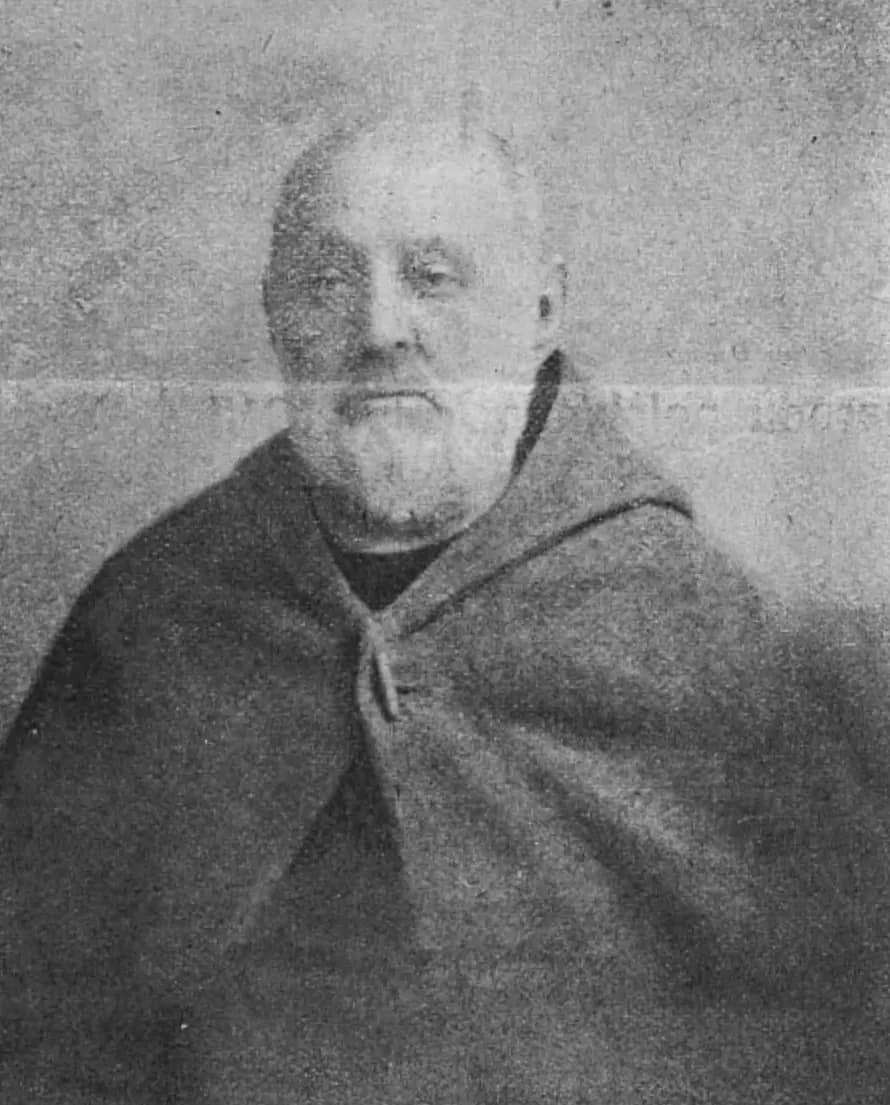
Saint Albert Chmielowski was a Polish painter who lost a leg as an eighteen-year-old insurgent in 1863, gave up a promising career in art, and spent the rest of his life living among the homeless of Kraków, founding two congregations to serve them. 23 He died on Christmas Day 1916 in one of his own shelters, and the Holy See biography says Kraków and all of Poland know him as the Father of the Poor. 2 John Paul II, who once wrote a play about him, beatified him in 1983 and canonized him in 1989. 145
Adam Chmielowski, insurgent
He was born Adam Chmielowski at Igołomia, near Kraków, on August 20, 1845, the eldest of four children. 23 The Holy See biography says the family was of noble descent, and Franciscan Media calls it wealthy. 12 He spent his childhood in Warsaw. 2 The Albertine Brothers say his father died in 1853 and his mother when he was fourteen, and the Holy See biography says he was then entrusted to an aunt on his father's side. 23
In 1863 Poland rose against the czar. Adam was a student at the agricultural institute at Puławy, and the Holy See biography says he joined the insurrection with enthusiasm. 23 On September 30, 1863, in a battle near Mełchów, he was badly wounded and taken prisoner, and his left leg was amputated; the biography adds that it was done without anesthesia. 2 Franciscan Media places the revolt in 1864, but agrees that his wounds cost him his left leg. 1
With help from relatives he escaped from captivity and had to leave the country. 23 The sources map the next years differently. The Holy See biography has him studying painting in Paris, then engineering at Ghent in Belgium, then painting again at the Academy of Fine Arts in Munich. 2 The Albertine Brothers say he went to Paris, came back to Warsaw after the amnesty of 1865 to begin studying painting, and continued in Munich. 3 Franciscan Media lists Warsaw, Munich and Paris. 1
The painter and "Ecce Homo"
He came home to Poland in 1874. 23 His work up to then was mostly on secular subjects, and the Holy See biography says he began to ask himself whether serving art could also be a way of serving God. 2 Religious themes came into his painting more and more often. 3 In the 1880s he painted "Ecce Homo," the suffering Christ, which the Albertine Brothers call "a symbol of the changes beginning in Adam." 3 The Holy See biography counts it among his best religious paintings and says it grew from a deep experience of Christ's merciful love and led to a spiritual transformation in him. 2 It now gives its name to the sanctuary in Kraków where his relics are kept. 3
In 1880, convinced that art and talent had to be dedicated to God, he entered the Society of Jesus as a lay brother. 2 He left the novitiate after six months; the Holy See biography gives poor health as the reason, and the Albertine Brothers say he went to his brother Stanislaus in Podolia, then a part of Poland ruled by Russia. 23 There, after what the biography calls a deep spiritual crisis, he came to know the Third Order of Saint Francis, and went around the parishes of the district restoring paintings and spreading the tertiary spirit among country people. 23
Forced out of Podolia, he moved to Kraków, which the Albertine Brothers date to 1884, kept painting, and gave what his pictures earned to the poor. 23
The warming houses of Kraków
Kraków kept public night shelters, called warming houses, where the city's homeless crowded in out of the cold. 23 The Holy See biography says he learned of the conditions inside by chance and decided to help, and that he then gave up success in art, material comfort and aristocratic company to live among the people there. 2 In their trampled dignity, it says, he discovered the disfigured face of Christ, and wanted to restore it in them. 2 The Albertine Brothers write that he lived in the shelter to learn the needs of the homeless "through direct contact with them." 3
On August 25, 1887 he put on a gray habit and took the name Brother Albert, and a year later, with the consent of Cardinal Albin Dunajewski, he made his vows as a Franciscan tertiary. 23 That began the Brothers of the Third Order of Saint Francis, Servants of the Poor, in 1888, who took charge of the men's shelter. 2 The Albertine page also gives August 25, 1889 as the day of his tertiary vows and the date usually counted as the congregation's beginning, and Franciscan Media dates both the founding and the name Albert to 1888. 13 When he took on the women's shelter too, the women working with him became the Albertine Sisters in 1891, whom he entrusted to Sister Bernardyna Jabłońska. 23
The brothers and sisters lived in the shelters with the people they served, and depended entirely on alms. 12 He turned the shelters into houses of material and moral help, where residents could do craft work alongside the brothers and sisters and earn their own keep. 23 He gradually stopped painting. 3 The houses, the Holy See biography says, were open to everyone without distinction of nationality or religion; Franciscan Media adds age and politics. 12 He went on to found homes for orphans and young people, for the old and the incurably ill, and kitchens for the poor. 23 During the First World War he sent the sisters into military hospitals and isolation wards. 2
He did all of this on a rudimentary artificial leg, the Holy See biography notes, and still traveled widely to open shelters in other Polish cities and visit his communities. 2 By his death there were twenty-one religious houses, with forty brothers and 120 sisters. 2 John Paul II recalled in 2002 that when Blessed Jan Beyzym built a hospital for people with leprosy in Madagascar, with money raised from Kraków and Poland, "One of those who promoted this help was Saint Brother Albert." 8
Death, and John Paul II
He had stomach cancer, and he died on Christmas Day 1916 in the shelter for the poor in Kraków. 23 The Holy See biography records that before he died he pointed to an image of Our Lady of Częstochowa and told the brothers and sisters that she was their foundress, and urged them to keep poverty above everything. 2 The Albertine Brothers say that in his reputation for holiness he was called "the most beautiful man of his generation." 3
Karol Wojtyła grew up in the Kraków that remembered him. Franciscan Media quotes John Paul II's 1996 memoir Gift and Mystery, where he wrote that Brother Albert had a part in his own vocation "because I found in him a real spiritual support and example in leaving behind the world of art, literature, and the theater, and in making the radical choice of a vocation to the priesthood." 1 As a young priest, Franciscan Media says, he repaid that debt by writing The Brother of Our God, a play about Brother Albert's life. 1
As pope he beatified Brother Albert in Kraków on June 22, 1983, together with Raphael Kalinowski, and canonized him in the Vatican Basilica on November 12, 1989, together with Agnes of Bohemia. 245 Back in Kraków in 1999, he named among the city's works of mercy those inspired by "the humble example of Saint Brother Albert." 7
What is Saint Albert Chmielowski the patron saint of?
None of the sources consulted for this profile names a formal patronage for Saint Albert, so this page does not claim one. 123 The Holy See biography says that in Kraków and throughout Poland he is known as the Father of the Poor, and that for his evangelical poverty he has been called the Polish Saint Francis of the twentieth century. 2 Those are the titles the sources give him, and they are reported here as titles.
Saint Albert Chmielowski's feast day
His feast is June 17. Franciscan Media says his liturgical feast is celebrated on that day, and John Paul II, saying Mass at Wawel Cathedral in Kraków on June 17, 1999, spoke of "today's memorial of St Brother Albert." 16
He died on December 25, 1916. 23 No source consulted here gives that day as his feast, so this page gives it only as the day he died.
Praying with Saint Albert Chmielowski
John Paul II opened that 1999 Mass for Brother Albert's memorial with a verse from Matthew: "Truly I say to you, as you did it to one of the least of these my brethren, you did it to me." 6 The sources describe a man who took that literally. The Holy See biography says he saw the face of Christ in the people of the warming houses, and the Albertine Brothers say he wanted to learn their needs by living with them. 23 So he moved in.
His vocation took a long time to find, and it went through a failure. He entered the Jesuits and left after six months, and the biography speaks of a deep spiritual crisis before he came to the Franciscan tertiaries in Podolia. 2 The work for which he is remembered began when he was past forty. 23 John Paul II found in that story support for leaving his own world of art and theater; the life shows that such a choice can be slow, and that a false start is not the end of it. 1
The Albertine Brothers say that in giving up painting he renewed "the beauty of Christ's defiled face" in people at the margins of society. 3 Much of that work was ordinary and practical: beds, soup, work for people with none, homes for children and the old, an artificial leg carried from city to city to open the next shelter. 23 He died among the people he served, on Christmas Day, in one of the shelters he had made. 2
Saint Albert Chmielowski, pray for us.
Sources
- 1."Saint Albert Chmielowski," Saint of the Day, Franciscan Media.
- 2."Alberto Adamo Chmielowski di Cracovia (1845-1916)," biography published by the Holy See for the canonization of November 12, 1989 (Italian).
- 3."History of the founding of the Albertine Congregation," Congregation of the Albertine Brothers (Zgromadzenie Braci Albertynów), Kraków.
- 4."Saints proclaimed during the Pontificate of John Paul II," Office for the Liturgical Celebrations of the Supreme Pontiff, the Holy See (November 12, 1989, Vatican Basilica).
- 5."List of Blesseds proclaimed during the Pontificate of John Paul II," the Holy See (1983).
- 6.John Paul II, Homily at Mass in the St Stanislaus Chapel, Wawel Cathedral, Kraków, June 17, 1999.
- 7.John Paul II, Homily at Mass, Kraków, June 15, 1999.
- 8.John Paul II, Homily at the Mass and Beatification of Four Servants of God, Błonie Park, Kraków, August 18, 2002.
Saints to turn to next
Others in this collection who are turned to for some of the same things.
- Saint Eugene de MazenodAugust 1, 1782 - May 21, 1861Poverty and simplicityDiscernmentWork and vocation
- Saint José Gregorio HernándezOctober 26, 1864 - June 29, 1919Work and vocationDiscernmentPoverty and simplicity
- Saint Louis of ToulouseFebruary 1274 - August 19, 1297Poverty and simplicityWork and vocationDiscernment
- Saint Louise de MarillacAugust 12, 1591 - March 15, 1660Poverty and simplicityWork and vocationDiscernment