Saint Eugene de Mazenod
August 1, 1782 - May 21, 1861
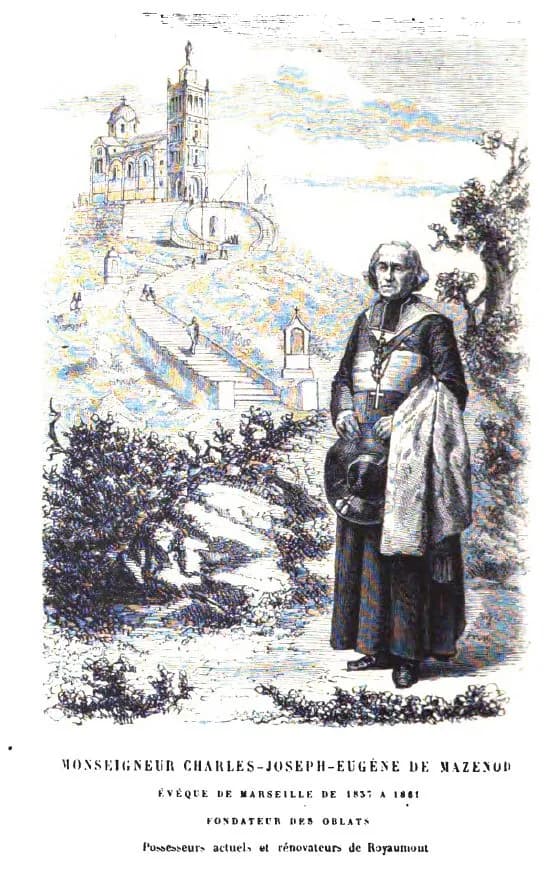
- Founded
- The Missionary Oblates of Mary Immaculate, begun January 25, 1816, and approved by Leo XII on February 17, 1826 12
- Patron saint of
- No patronage is named in the sources consulted
- Feast day
- May 21 3
Saint Eugene de Mazenod was a nobleman from Provence who lost everything in the French Revolution, came home from eleven years of exile in Italy aimless and depressed, and became a priest who preached to the rural poor in their own Provençal dialect. 1 He founded the Missionary Oblates of Mary Immaculate, served as Bishop of Marseilles for almost a quarter of a century, and sent his missionaries to Canada, the United States, Ceylon and southern Africa. 12 John Paul II canonized him in 1995, and his feast is kept on May 21. 13
Exile
Charles Joseph Eugene de Mazenod was born at Aix-en-Provence on August 1, 1782, into a family of the minor nobility. 12 His father was president of the Court of Accounts, Aids and Finances at Aix. 1 When Eugene was eight, the Revolution drove the family out of France, and they left their property behind. 1
The exile lasted eleven years and moved from one Italian city to the next. 1 His father tried his hand at trade to support them, did badly at it, and the family came close to destitution. 1 Eugene studied briefly at the College of Nobles in Turin, but a move to Venice ended his formal schooling. 1 There a priest who lived nearby, Don Bartolo Zinelli, took on the boy's education and gave him, the Vatican biography says, "a lasting sense of God and a regimen of piety which was to stay with him always." 1
Money troubles took the family on to Naples and then to Palermo. 1 In Palermo the Duke and Duchess of Cannizzaro took him up, and the young man, the biography says, "had his first taste of noble living and found it very much to his liking," calling himself Count de Mazenod and dreaming of a bright future. 1
Home, and a vocation
He returned to France in 1802, at twenty, and his illusions did not last. 1 He was plain "Citizen" de Mazenod now, his parents had separated, and his mother, fighting to recover the family property, wanted him married to the richest heiress she could find. 1 The Vatican biography says he sank into depression and saw little future for himself. 1
What pulled him out was the state of the Church, which the Revolution had ridiculed, attacked and decimated. 1 Pope Francis, speaking to the Oblates in 2016, said their congregation "was born from an experience of mercy which the young Eugène had experienced on a Good Friday before Jesus crucified." 4 Over his mother's opposition he entered the seminary of Saint-Sulpice in Paris. 1 The 1913 Catholic Encyclopedia notes that he did this although he was the last of his family line. 2
He was ordained on December 21, 1811, at Amiens. 12 The encyclopedia says he went there to avoid receiving orders from Cardinal Maury, who was then governing the Archdiocese of Paris against the pope's wishes. 2
The Missionaries of Provence
Back in Aix, he did not take an ordinary parish. 1 He worked among the people the Vatican biography calls "the truly spiritually needy": prisoners, young people, servants and country villagers, often against the wishes of the local clergy. 1 Soon he gathered other priests willing to step outside the old structures, and on January 25, 1816, according to the encyclopedia, his institute began. 12
They went from village to village preaching in Provençal, the language of the common people, rather than in educated French, and spent long hours in the confessional. 1 Between missions they lived together in prayer and study, and called themselves the Missionaries of Provence. 1 Pope Francis said they set out to rekindle a faith the Revolution was putting out "in the hearts of the poor of the countryside of Provence." 4
To make the work last, Eugene went to Rome himself and asked for recognition as a religious congregation. 1 Pope Leo XII approved it on February 17, 1826, as the Oblates of Mary Immaculate, and Eugene was elected superior general, an office he held for thirty-five years. 12 Francis recalls that Eugene described the name as "a passport to Heaven." 4
Bishop of Marseilles
The Diocese of Marseilles had been suppressed after the Concordat of 1802. 1 When it was restored, his elderly uncle, Fortuné de Mazenod, was named bishop, and made Eugene his vicar general; most of the work of rebuilding the diocese fell to the nephew. 12 In 1832 Eugene was made a bishop himself, consecrated in Rome on October 14 as titular Bishop of Icosium. 12
The consecration in Rome defied the French government's claim to approve all such appointments, and the Vatican biography says it set off "a bitter diplomatic battle" in which he was caught in the middle. 1 The same years brought growing pains in his congregation, and the biography calls it a devastating time for him. 1 Early in 1837 he succeeded his uncle as Bishop of Marseilles. 12
As bishop he trained his priests, founded parishes, built the cathedral and the Shrine of Notre-Dame de la Garde above the city, and brought many religious congregations into the diocese. 1 The encyclopedia says he was the first to introduce the moral theology of Alphonsus Liguori into France, defended the rights of the Holy See against the Gallican tradition, supported papal infallibility, and took an active part in the definition of the Immaculate Conception in 1854. 2 Pius IX gave him the pallium in 1851. 2 The Vatican biography says Napoleon III appointed him a senator in 1856; the encyclopedia says he was made a Peer of the French Empire. 12
A heart as big as the world
He had founded the Oblates for the French countryside, but they soon went further: to Switzerland, England and Ireland. 1 Bishops from mission territories came asking for men, and though his numbers were small he sent them to Canada, to the United States, to Ceylon, to South Africa and to Basutoland, now Lesotho. 1 They opened up uncharted country and staffed new dioceses, and the biography says they "left nothing undared that the Kingdom of Christ might be advanced." 1
Pope Francis told the Oblates in 2016 that Pius XI had called them "specialists of difficult missions." 4 Three years after the canonization, John Paul II reminded the Oblates that he had described their founder on that day as "marked by a heroic degree of faith, hope and apostolic charity." 5
His death
He died at Marseilles on May 21, 1861, the senior bishop of France. 12 The Vatican biography gives his age as seventy-nine; the encyclopedia, more exactly, says almost seventy-nine. 12 The encyclopedia says the pope had meant to make him a cardinal. 2 On his deathbed he left the Oblates a last instruction: "Among yourselves-charity, charity, charity: in the world-zeal for souls." 1 John Paul II canonized him on December 3, 1995, and in the homily called him "a man of Advent," according to Pope Francis. 14
What is Saint Eugene de Mazenod the patron saint of?
Saint Eugene de Mazenod's feast day
Praying with Saint Eugene de Mazenod
His story includes a long stretch of drift. He enjoyed the title of count in Palermo, came home to find it meant nothing, and spent some time depressed and without direction while his mother looked for an heiress for him to marry. 1 The vocation that followed came out of that, and Pope Francis traces the whole congregation to an experience of mercy before the crucifix on a Good Friday. 14
He chose to preach in the language the villagers actually spoke. 1 The biography sets Provençal, "the language of the common people," against "educated" French, and says the missionaries taught people at their own level. 1 The same instinct sent him to prisoners, servants and young people before he had any parish at all. 1
He was known for speaking his mind. The encyclopedia mentions his "well-known outspokenness" and compares the freedom of his public speech to that of Ambrose, and his consecration in Rome drew him into years of conflict with his own government. 12 The biography says simply that he was "battered" and kept going. 1
What he asked of the Oblates at the end came in two parts: charity among themselves, three times over, and zeal for souls in the world. 1 Francis told them in 2016 to keep charity among themselves as their "first rule of life," with zeal for souls following from it. 4
Saint Eugene de Mazenod, pray for us.
Sources
- 1."Eugene de Mazenod (1782-1861), biography," Office of the Liturgical Celebrations of the Supreme Pontiff, the Holy See, for the canonization of December 3, 1995.
- 2."Charles Joseph Eugene de Mazenod," The Catholic Encyclopedia, Vol. 10 (New York: Robert Appleton Company, 1911), as published by Catholic Answers.
- 3.Saint of the Day, Calendar of Saints, May 21, Vatican News.
- 4.Pope Francis, Address to Participants in the General Chapter of the Missionary Oblates of Mary Immaculate, October 7, 2016.
- 5.Pope John Paul II, Address to the Missionary Oblates of Mary Immaculate, September 24, 1998.
Saints to turn to next
Others in this collection who are turned to for some of the same things.
- Saint Albert ChmielowskiAugust 20, 1845 - December 25, 1916Poverty and simplicityDiscernmentWork and vocation
- Saint José Gregorio HernándezOctober 26, 1864 - June 29, 1919Work and vocationDiscernmentPoverty and simplicity
- Saint Louis of ToulouseFebruary 1274 - August 19, 1297Poverty and simplicityWork and vocationDiscernment
- Saint Louise de MarillacAugust 12, 1591 - March 15, 1660Poverty and simplicityWork and vocationDiscernment