Saint Louis of Toulouse
February 1274 - August 19, 1297
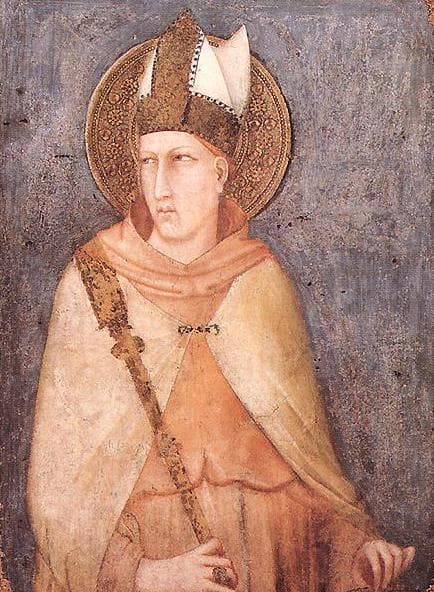
- Gave away
- Three quarters of his episcopal income, and fed twenty-five people daily 2
Saint Louis of Toulouse was the second son of the king of Naples, handed to Aragon as a hostage at fourteen to buy his captured father's freedom, and held for seven years. 12 The Franciscans assigned to educate him in captivity changed what he wanted. He came out at twenty-one, signed away his claim to the throne, made his brother take it, and was a bishop for seven months before dying at twenty-three. 12 While he held the office he paid a friar to correct him in public. 2
Handed over
His family connections are a list of saints: son of Charles II of Anjou, "called the Lame", king of Naples; nephew of Louis IX of France; and his mother Mary of Hungary was the great-niece of Elizabeth of Hungary. 1 Franciscan Media notes both lines. 2
What that got him was a hostage's cell. His father had been defeated and captured in a naval battle off Naples in 1284, and in 1288 Louis was sent with two of his brothers to Aragon in his place. 1 Franciscan Media dates it by his age: "When he was 14, Louis and two of his brothers were taken as hostages to the king of Aragon's court as part of a political deal involving Louis's father." 2
The captivity ran from 1288 to 1295 - seven years, in the castle of Sciurana and partly at Barcelona. 1 The education of the three princes was given to Franciscan friars, and Oliger names them. 1 Peter John Olivi, "the great Franciscan Spiritual", was among the friends who wrote to them. 1
Franciscan Media records what took: "At the court, Louis was tutored by Franciscan friars under whom he made great progress both in his studies and in the spiritual life. Like Saint Francis he developed a special love for those afflicted with leprosy." 2
Oliger is blunt about how he compared with his brothers: "Louis outstripped his brothers both in holiness and learning, and, during a severe illness, made the vow to become a Friar Minor." 1 He decided in captivity, while ill, and Franciscan Media agrees the decision was made before his release: "While he was still a hostage, Louis decided to renounce his royal title and become a priest." 2
Two papal orders that went nowhere
While he was still locked up, Rome tried to give him things. Celestine V "entrusted to him the administration of the Archbishopric of Lyons, on 7 Oct., 1294", and had earlier authorized his confessor to give him the tonsure and minor orders. 1
Oliger records the result in five words: "Neither Bull seems to have been carried out." 1 A pope appointed a fourteen-year-old hostage to administer an archdiocese and nothing happened, because he was in a castle in Tarragona and no bull was going to get him out of it.
The tonsure came only on November 1, 1295, after his release. 1
Signing it away
His elder brother had died in 1295, which made Louis the heir. Oliger notes that some early sources call him "primogenitus", the firstborn, "only because he succeeded to the rights of his eldest brother." 1
He gave them up. "After renouncing all the rights of succession in favour of his brother Robert, he was ordained subdeacon in Rome by Boniface VIII, and in 1296 deacon and priest at Naples." 1 Franciscan Media: "He renounced his title in favor of his brother Robert and was ordained the next year." 2
Then Boniface VIII made him bishop of Toulouse, and Louis made a condition. He wanted to be a Franciscan first. 12 He received the habit in Rome from the minister general on December 24, 1296, "and immediately made solemn profession" - and was consecrated bishop five or six days later. 1 Franciscan Media: "the pope agreed to Louis's request to become a Franciscan first." 2
He appeared publicly in the Franciscan habit for the first time on the feast of Saint Agatha, February 5, 1297, and went to Toulouse. 1
Seven months
Oliger's summary of the episcopate is two clauses and they are both about competence: "his mild figure and his virtues were admired by everybody. He was the father of the poor and a model of administration." 1
Franciscan Media has the numbers. "Louis set aside 75 percent of his income as bishop to feed the poor and maintain churches. Each day he fed 25 poor people at his table." 2 Three quarters of the revenue of a major see, given away by a man in his early twenties who had been entitled to a throne.
He kept wearing the habit and, Franciscan Media says, "sometimes begged." 2 The line he repeated: "Jesus Christ is all my riches; he alone is sufficient for me." 2
And then the arrangement that says most about him. "He assigned a friar to offer him correction - in public if necessary - and the friar did his job." 2 He knew what a young bishop of royal blood was likely to become, and hired somebody to stop it.
It lasted months. "But his episcopate was very brief, for on his return journey from a visit to his sister, the Queen of Aragon, he was seized by fever and died at Brignoles" - the town he had been born in, on August 19, 1297. 1
Almost nothing he wrote survives. Oliger notes one recovered item: a small treatise on music, published in 1909, from which it appears he also wrote a "Liber de Musicae Commendatione". 1
What is Saint Louis of Toulouse the patron saint of?
Neither source states a thematic patronage. 12 Oliger records a civic one that arrived by way of his bones: his relics were in the Franciscan church at Marseilles until 1423, "when they were taken by Alfonso V of Aragon to the cathedral church of Valencia, of which town Louis became patron saint." 1 The king of Aragon whose predecessor had held him hostage took his body to Valencia.
He was canonized in 1317 by John XXII - who, Franciscan Media notes, was "one of his former teachers." 2 A man who had taught him as a boy lived to declare him a saint twenty years after his death.
Saint Louis of Toulouse's feast day
The feast of Saint Louis of Toulouse is August 19, the day he died. Franciscan Media states it: "His liturgical feast is celebrated on August 19." 2
Oliger gives its origin: the feast, "celebrated in the Franciscan Order on 19 Aug., was decreed by the general chapter held at Marseilles in 1319." 1 He also records something that has since been lost - an office for the day beginning "Tecum", composed by the saint's own brother, King Robert of Naples, and inserted in the Franciscan Breviary in 1343 before being dropped in the reform of 1568. 1
The brother he handed the kingdom to wrote the music for his feast.
Praying with Saint Louis of Toulouse
He is the saint for a life decided by other people. He did not choose to be a hostage; he was handed over at fourteen to settle a debt his father had incurred by losing a battle. 12 Seven years, in someone else's castle, on someone else's terms. What he did with that time was learn from the men who happened to be put in the room with him, and by the end of it he knew what he wanted.
The renunciation is easy to romanticize and worth stating plainly: he signed away the throne of Naples and made his younger brother take it. 12 Robert got a kingdom he had not expected, and later wrote the office for Louis's feast day. 1 Whatever passed between them, it does not read as resentment.
The friar with the license to correct him in public is the most practical thing in either source. 2 He was twenty-three, royal, a bishop, and universally admired - the precise conditions under which nobody tells you anything true. So he appointed somebody whose job it was, and Franciscan Media's dry closing clause is that the man actually did it.
Then seven months, three quarters of his income given away, twenty-five people fed at his table every day, and a fever on the road home from seeing his sister. 12 He was dead at twenty-three. It is not much time, and the accounting of what he did with it is unusually exact.
Saint Louis of Toulouse, pray for us.
Sources
Saints to turn to next
Others in this collection who are turned to for some of the same things.
- Saint Angela MericiMarch 21, 1474 - January 27, 1540Work and vocationDiscernment
- Saint Augustine of CanterburyBirth unknown - 604 or 605Work and vocationDiscernment
- Saint BarnabasFirst centuryWork and vocationPoverty and simplicity
- Saint Benedict Joseph Labre1748 - April 16, 1783Poverty and simplicityDiscernment