Saint Louise de Marillac
August 12, 1591 - March 15, 1660
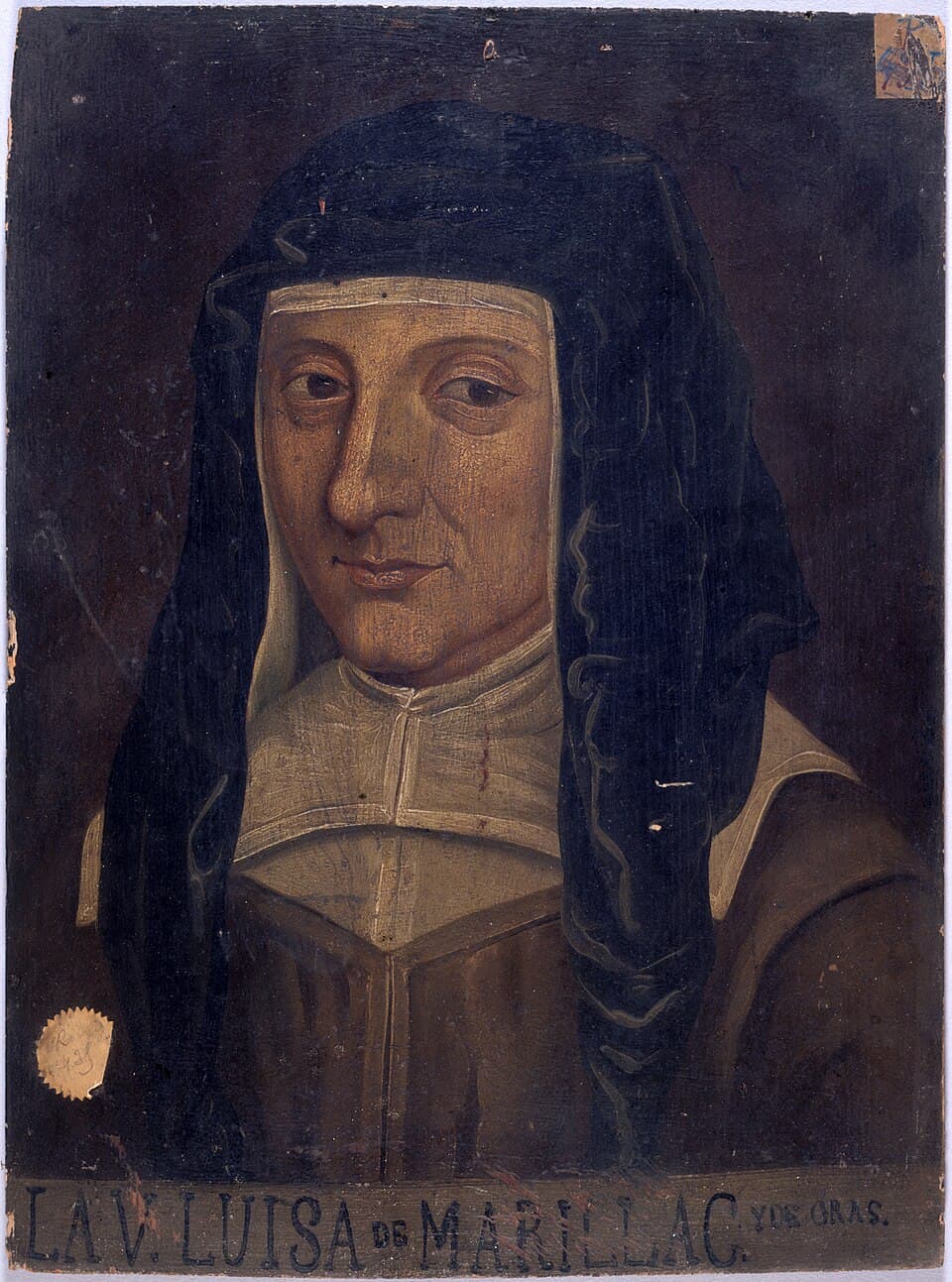
- Patron saint of
- Social workers, declared in 1960 3
- Born
- August 12, 1591, at Paris according to the encyclopedia; near Meux according to Franciscan Media 13
- Married
- Antoine Le Gras, secretary to Maria de' Medici; widowed December 21, 1625 1
- Founded
- The Daughters of Charity, with Saint Vincent de Paul; the community dates its foundation to November 29, 1633 25
- Canonized
- 1934 3
Saint Louise de Marillac was a Paris widow who wanted to be a Capuchin nun as a girl, was talked out of it, and ended up founding something nobody had thought possible: a community of women who nursed the sick poor in their own homes and in the hospitals instead of behind a convent grille. 12 With Saint Vincent de Paul she trained the first Daughters of Charity in her own house from 1633, and when she died in 1660 they had more than forty houses in France. 23
A vocation refused
She was born on August 12, 1591, the daughter of Louis de Marillac and Marguerite Le Camus. The 1910 encyclopedia puts her birth in Paris; Franciscan Media says near Meux. 13 Her mother died early - soon after the birth, in the encyclopedia's account, while Franciscan Media says only that Louise lost her mother as a child - and she was raised by her father, "a man of blameless life," whose serious disposition the encyclopedia sees reflected in her taste for philosophy. 13 As a small girl she was put in the care of an aunt who was a nun at Poissy, and later studied under a governess, with a good deal of time given to the arts. 1
At about sixteen she wanted to enter the Capuchin nuns, the Daughters of the Passion. Her spiritual director dissuaded her. Her father died, the question of her future had to be settled, and she accepted, as the encyclopedia puts it, "interpreting her director's advice," the hand of Antoine Le Gras, a young secretary in the service of Maria de' Medici. 1 Franciscan Media is plainer: her desire to become a nun was discouraged by her confessor, "and a marriage was arranged." 3 Their son was born on October 13, 1613, and she gave herself to his education. 1
Pentecost, 1623
In 1619 she met Saint Francis de Sales, who was then in Paris, and his friend the bishop of Belley became her spiritual adviser. 13 Franciscan Media notes that both men were available to her only now and then. 3 She was still troubled by the thought that she had turned down a call to religious life, and in 1623 she vowed that if her husband died first she would not remarry. 1
The same year brought what is known as the "Lumière." On Pentecost, June 4, 1623, she went to Mass at the church of Saint-Nicolas-des-Champs in Paris, worried about her future as a wife and mother and, Vatican News says, with doubts about the faith. She came away clear that she should stay with her husband, and that one day she would take vows of poverty, chastity and obedience in a small community serving others. 5 What she did not know was how. Franciscan Media's account speaks of an interior illumination in which she understood that she would undertake a great work under the guidance of someone she had not yet met. 3
Antoine Le Gras died on December 21, 1625, after a long illness through which she nursed him. 13
Monsieur Vincent
The person she had not yet met was Vincent de Paul. She put herself under his direction, probably early in 1625. 1 He was not eager to take her on. He was busy with his Confraternities of Charity, aristocratic women who were helping him nurse the poor and look after neglected children, and Franciscan Media says only gradually, as he came to know her, did he see that she was the answer to his prayers. 3 It describes her as intelligent and self-effacing, with a physical endurance that belied her continuing poor health. 3
The Ladies of Charity had a problem that Vincent saw clearly. Noblewomen found it hard to give the poor personal care, so many of them sent their servants, and the work was often skimped. 2 He began bringing young women in from the country to serve the poor of Paris under the ladies' direction, and Louise, who had taken charge of the confraternities at his request, had charge of the young women too. 2 Franciscan Media gives the reason: they were peasants themselves, close to the poor, and they needed someone to teach and organize them. 3
The Daughters of Charity
After three or four years of this, she took a few of the most promising young women into her own house, and on November 29, 1633, began training them systematically in the care of the sick and in the spiritual life. The encyclopedia calls this "the real foundation of the community"; Vincent called it the little snowball. 2 Vatican News dates the founding of the Company to the same year. 5 On March 25, 1634, after a few months living with the sisters, Louise bound herself irrevocably by vow to the work. 2
What made the community new was where it lived. Women who consecrated their lives to God publicly had done it in enclosed convents. Vincent's rule gave these sisters, in the encyclopedia's summary, no monastery but the homes of the sick, "having," as he wrote, "no grate but the fear of God, no veil but holy modesty." 2 Franciscan Media quotes him directly: "Your convent will be the house of the sick; your cell, a hired room; your chapel, the parish church; your cloister, the streets of the city or the wards of the hospital." 3 They dressed as the peasant women around Paris dressed. 23
The work grew outward from the sick poor at home. The sisters took up hospital work at the Hôtel-Dieu in Paris, helping the ladies who supported the nuns in charge there. In 1636 Louise moved the community to La Chapelle, near Saint-Lazare, and they began teaching poor children; the care of foundlings followed, and in 1640 a whole hospital at Angers. 2 Four sisters were allowed simple vows for one year on March 25, 1642. 2 During the Fronde they fed and sheltered thousands in Paris, and they went on to nurse soldiers in Poland and to care for the aged and for the insane. 2 Franciscan Media notes that the community took on neglected children with reluctance, since many of the sisters could not read, and that Louise traveled throughout France, setting them up in hospitals, orphanages and other institutions, despite her health. 3
The sources tell the community's formal standing differently. Franciscan Media says Louise herself drew up its rule under Vincent's guidance, and that it was eventually "formally approved by Rome." 3 The encyclopedia says Vincent guided the sisters for more than twelve years without a written rule, that the Archbishop of Paris granted approval in 1655, and that no approbation was ever asked of the Holy See, because Vincent wanted a lay community bound by private vows. 2 On one point they agree. Vincent used to say that neither he nor Louise had founded it at all. 23
Death
Louise de Marillac died at Paris on March 15, 1660. 13 The community then had more than forty houses in France, and its sisters were caring for the sick poor in their own homes in twenty-six Paris parishes. 23 Vincent died the same year, about six months later. 13 She was canonized in 1934. 3
In 2025 Pope Leo XIV, writing on the Church's care of the sick in his exhortation on love for the poor, quoted a letter she wrote to two of her sisters in 1657, reminding them that "they have been singularly blessed by God for the service of the sick poor of the hospitals." 6
What is Saint Louise de Marillac the patron saint of?
Saint Louise de Marillac is the patron saint of social workers. Franciscan Media says she was declared patroness of social workers in 1960, and observes that many Daughters of Charity working today as social workers do so under her patronage. 3 The sources consulted here do not say who made the declaration.
Saint Louise de Marillac's feast day
Praying with Saint Louise
For years she believed she had made the wrong choice. She wanted the cloister at sixteen, married on her director's advice, and was still troubled long afterward by the thought that she had refused a call. 1 The answer that came at Pentecost in 1623 did not tell her to leave her marriage. It told her to stay with her husband and that the vows would come later, without telling her how. 5 It was nearly two more years before she put herself under the direction of the priest who would help her find out. 1
Much of what she did was ordinary and practical. She nursed a husband through a long last illness, educated a son, took young countrywomen into her house and taught them, and then went around France settling them in hospitals and orphanages. 123 Franciscan Media remarks on her endurance and, in the same sentence, on her poor health. 3 The sources do not record a moment where the difficulty was lifted.
Neither of them set out to found a community. Vincent said they had never meant to; the work kept asking for more hands, and they kept supplying them. 23 What they made instead was a way for women to give their lives to God in the hired room, the hospital ward and the street.
The sisters she trained were mostly peasant women, many of them unable to read, sent to the poor whom the Ladies of Charity found it hard to serve in person. 23 In her day, Franciscan Media observes, serving the poor was usually a luxury only fine ladies could afford, and Vincent saw that women of peasant stock could reach poor people more effectively. 3 Louise was not of peasant stock. She spent the second half of her life teaching those who were, and living with them. 12
Saint Louise de Marillac, pray for us.
Sources
- 1.Joseph Glass, "Ven. Louise de Marillac Le Gras," The Catholic Encyclopedia, Vol. 9 (New York: Robert Appleton Company, 1910).
- 2.Bartholomew Randolph, "Sisters of Charity of St. Vincent de Paul," The Catholic Encyclopedia, Vol. 3 (New York: Robert Appleton Company, 1908).
- 3."Saint Louise de Marillac," Saint of the Day, Franciscan Media.
- 4."St. Louise de Marillac, Co-foundress of the Daughters of Charity," Saint of the Day, 9 May, Vatican News.
- 5.A. Oliveira, P. Almeida and M.E. Alves, "Brazil: A minibus offering dignity to the homeless," Vatican News, January 23, 2024.
- 6.Pope Leo XIV, Apostolic Exhortation Dilexi Te, on love for the poor, no. 51 (October 4, 2025).
Saints to turn to next
Others in this collection who are turned to for some of the same things.
- Saint Louis of ToulouseFebruary 1274 - August 19, 1297Poverty and simplicityWork and vocationDiscernment
- Saint André BessetteAugust 9, 1845 - January 6, 1937Work and vocationPoverty and simplicity
- Saint Angela MericiMarch 21, 1474 - January 27, 1540Work and vocationDiscernment
- Saint Augustine of CanterburyBirth unknown - 604 or 605Work and vocationDiscernment