Saint Zenobius of Florence
Fourth century - c. 417
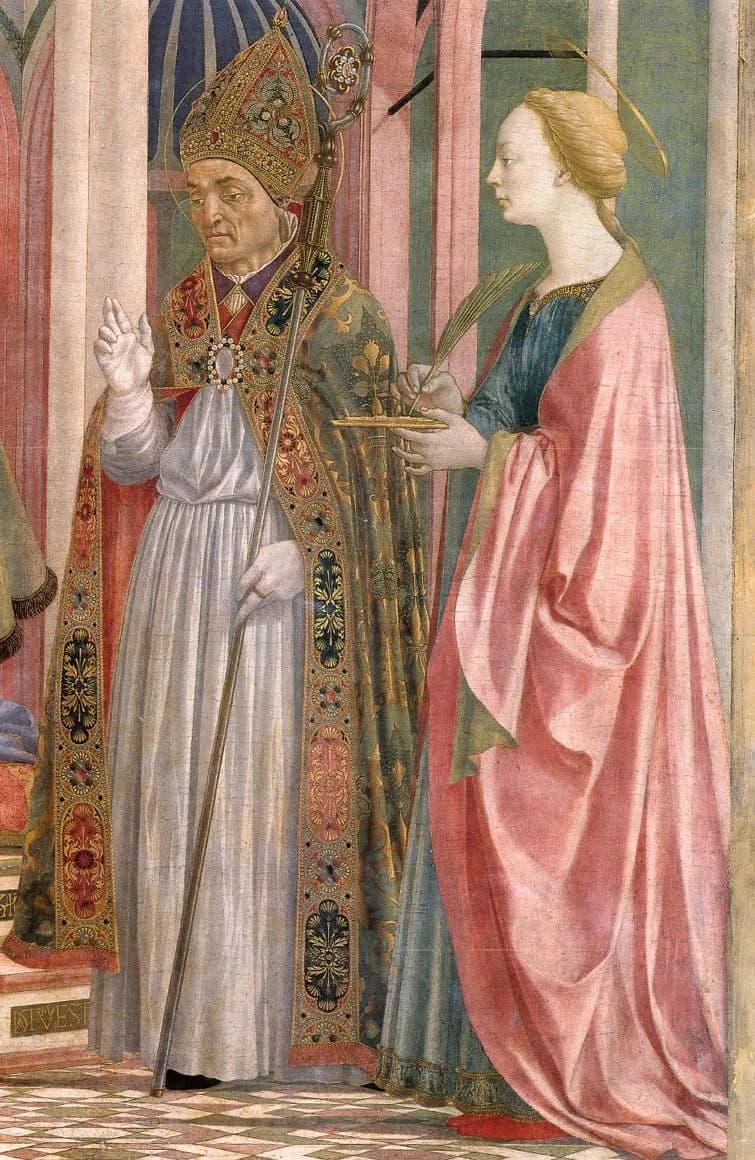
- Born
- Florence, late in the reign of Constantine I, to pagan parents 1
- Died
- Probably May 25, 417; his early biographer says 424 1
Saint Zenobius, San Zanobi to the Florentines, was bishop of Florence around the year 400. He grew up in a pagan household, was baptized as a young man, brought his own parents to the faith, and worked for Pope Damasus in Rome and Constantinople before his native city made him its bishop. 125 The Archbishop of Florence calls him the foundation stone of the Florentine church. 3 He is the principal patron of that archdiocese together with Saint Antoninus, and the Roman Martyrology enters him on May 25. 78
A pagan household in Florence
The 1913 Catholic Encyclopedia places his birth in Florence, in the latter part of the reign of Constantine I, which ended in 337. 1 Katolsk.no, the website of the Catholic Church in Norway, adds that he is said to have belonged to a family called Geronimo. 2 His parents were pagans and saw to it that he was well taught. The encyclopedia's account of him opens with the words "Carefully educated by pagan parents," and the Norwegian one specifies philosophy. 12
That education is where the Norwegian account locates his conversion. Looking for wisdom, he began to turn away from the worship of idols and became open to the Christian message. 2 The encyclopedia tells it through a person: he "came early under the influence of the holy bishop Theodore" and was baptized by him. 1 Katolsk.no gives his age as twenty-one. 2
His parents took it badly. 2 The encyclopedia does not dwell on the quarrel, but it does not hide it either: he succeeded, it says, "after much opposition, in bringing his father and mother to the Christian Faith." 1 The Norwegian page remembers the outcome more cheerfully, saying it did not take the son long to convert them as well. 2
Ambrose, Damasus and Constantinople
He became a cleric, and Theodore, who had baptized him, ordained him and made him archdeacon. 12 Both accounts single out his preaching. The encyclopedia says his "virtues and notable powers as a preacher" brought him to the notice of Saint Ambrose, the bishop of Milan, and that it was at Ambrose's urging that Pope Damasus called him to Rome. 12
Damasus, the encyclopedia continues, "employed him in various important missions, including a legation to Constantinople." 1 Katolsk.no connects that errand with the Arian controversy, the dispute over the divinity of Christ that troubled the Church through the fourth century. 234
Cardinal Giuseppe Betori, the Archbishop of Florence, is careful about how he tells this part. Preaching on the patrons' feast in 2010, he said that history attests a bond between Zenobius and Ambrose, that tradition holds Ambrose vouched for him to the pope, and that Zenobius seems to have served the Roman See in the East. 3 The friendship is offered as history. The details are offered as tradition.
When Damasus died, Zenobius went home and took up his work again. Then the bishop of Florence died too, and Zenobius, in the encyclopedia's words, "to the great joy of the people, was appointed to succeed him." 1 According to katolsk.no the bishop he succeeded was Theodore himself. 2
Bishop of a city still largely pagan
He was not the first Christian in Florence, nor its first bishop. The cardinal says the Gospel had probably reached the banks of the Arno earlier, carried by people of eastern origin who moved around the empire for trade, and that the community had a pastor of its own from at least the beginning of the fourth century. 34 The encyclopedia's list of bishops bears him out: a Bishop Felix of Florence attended a synod at Rome in 313, and only then, about the year 400, does it come to "St. Zanobius." 5
What changed with Zenobius, according to the cardinal, is that the Christian presence took on historical and social weight in a setting that was still largely pagan. He cannot be called the first evangelizer of Florence, the cardinal says, but he is the foundation stone of the identity of its church. 3
Ambrose came to Florence in those years. The encyclopedia records that the basilica of San Lorenzo was "dedicated in 393 under the holy bishop Zanobius by St. Ambrose, with a sermon yet preserved." 5 The cardinal adds that Ambrose brought relics of the martyrs Vitalis and Agricola from Bologna for the occasion, and that his visit belonged to his campaign against Arianism, which had probably touched Florence as well. 34
So the cardinal presents Zenobius as a defender of the faith as much as a missionary, and says tradition has him doing both at once: keeping his church within the truth by carrying the Gospel across the territory, where many places in the diocese still keep the memory of his passing. 34 Katolsk.no names the two companions who shared his household, the deacon Saint Eugenius and the subdeacon Saint Crescentius. 2
The miracles, and what can be known
The encyclopedia is frank about its material. The old lives of Zenobius carry "many interpolations of a later date," it says, though they are "unanimous in their description of his saintly life and supernatural gifts." 1 The Norwegian page goes further: hardly anything is known of him for certain, and legend is hard to separate from fact. 2
With that warning, both report what the lives say. "Extraordinary miracles, including several instances of the restoration of the dead to life, are attributed to him." 1 Katolsk.no counts five people raised from the dead, among them a child who had been playing in front of the cathedral and was run over by a cart. 2 The cardinal, listing what Florence has remembered him as, includes a wonder-worker close to the weak and the poor. 3
Those stories went onto his shrine. Three of its sides, the encyclopedia's article on Ghiberti says, carry "scenes descriptive of the miracles of the saint." 6
His death and his shrine
The year he died is disputed. His biographer Antonius, a later bishop of Florence, says he died in his ninetieth year, in 424, and also says that Innocent I was pope at the time. Innocent died in 417, so, the encyclopedia concludes, "the date is uncertain." 1 Its own judgment follows: "There is ground for believing that he actually died in 417, on 25 May." 1 Katolsk.no says he was eighty. 2
He was buried first in San Lorenzo, the basilica Ambrose had consecrated, and his body was later moved to the church that stood where the cathedral stands now. 12 There it remains. Beneath the high altar, Hunter-Blair wrote in the encyclopedia, is the shrine of the saint, "designed by Ghiberti about 1440," in the style of the sculptor's famous bronze doors. 1 The Ghiberti article describes the same reliquary: miracles on three sides, and on the fourth a wreath and angels. 6
Florence kept smaller memorials too. The encyclopedia mentions a statue of him in San Marco, and an ancient tower near the Ponte Vecchio "where he is supposed to have lived," which was decorated with flowers every year on May 25. 1
What is Saint Zenobius of Florence the patron saint of?
Saint Zenobius of Florence is a patron of places. The encyclopedia calls him "one of the patrons" of the city of Florence. 1 Vatican News describes him as principal patron of the Archdiocese of Florence together with Saint Antoninus, the Dominican archbishop who died in 1459, and Cardinal Betori calls the two of them the patrons of the Florentine church. 38
He is also the patron of Scandicci, a town in the province of Florence, where the archbishop celebrated his feast in May 2024. 9 None of the sources read for this page assigns him a trade, an illness or a cause.
Saint Zenobius of Florence's feast day
Saint Zenobius of Florence's feast day is May 25. Katolsk.no gives that as his memorial day, and the Roman Martyrology enters him on it in a single line: at Florence, Saint Zenobius, bishop. 27 It is the day the encyclopedia thinks he probably died. 1
Florence itself keeps him earlier in the month. May 10 is the diocesan feast of Saints Zenobius and Antoninus, celebrated in the cathedral. 48 One more date is on record: the heading of the katolsk.no page prints October 30, above a text that says May 25. 2
Praying with Saint Zenobius of Florence
Very little about him is certain, and the sources say so. 12 What they agree on is modest and durable: a young man from a pagan family who was baptized, a cleric whose preaching was noticed, a bishop his city was glad to get. 12
The first people he had to persuade were his mother and father. The encyclopedia's phrase for it is "after much opposition," and nothing more is told. 1 It is the least miraculous story about him and the one most readers will recognize, since it is about a household divided over the faith and a son who stayed in the argument until it ended. 12
Cardinal Betori, who succeeded him sixteen centuries later, reads his life through the Gospel appointed for the feast, where Jesus tells the disciples he calls them friends. Before Zenobius was a missionary, a pastor or a worker of wonders, the cardinal says, he was a friend of Christ, chosen to bear witness to him. 3 On another feast of the saint the cardinal described a bishop serving as the Roman Empire was coming to its end, who made himself a neighbor to everyone, believers and unbelievers alike. 9
Florence has kept faith with him in its own way, with a tower hung with flowers in May and a bishop's relics under the high altar of its cathedral, in a shrine that shows his miracles. 16
Saint Zenobius of Florence, pray for us.
Sources
- 1.Oswald Hunter-Blair, "St. Zenobius," The Catholic Encyclopedia, Vol. 15 (New York: Robert Appleton Company, 1912).
- 2."Den hellige Zenobius av Firenze," Den katolske kirke (the Catholic Church in Norway), last updated August 18, 1998 (in Norwegian).
- 3.Giuseppe Betori, Archbishop of Florence, "Festa dei Santi Zanobi e Antonino. Omelia," May 10, 2010, Arcidiocesi di Firenze (in Italian).
- 4.Giuseppe Betori, Archbishop of Florence, "Festa dei Santi Zanobi e Antonino. Omelia," Cathedral of Santa Maria del Fiore, May 10, 2019, Arcidiocesi di Firenze (in Italian).
- 5.Umberto Benigni, "Florence," The Catholic Encyclopedia, Vol. 6 (New York: Robert Appleton Company, 1909).
- 6.Gerhard Gietmann, "Lorenzo di Cione Ghiberti," The Catholic Encyclopedia, Vol. 6 (New York: Robert Appleton Company, 1909).
- 7.Roman Martyrology, entry for May 25, "San Zenobio, vescovo," as printed in "Santo del giorno," Conferenza Episcopale Italiana (in Italian).
- 8."Un convegno e la riapertura di Santa Maria Novella. I festeggiamenti dei Domenicani per i santi patroni di Firenze Antonino e Zanobi," Vatican News, May 6, 2021 (in Italian).
- 9.Giuseppe Betori, Archbishop of Florence, homily for the feast of San Zanobi at Santa Maria a Scandicci, printed as "Festa di San Zanobi: Betori, 'vegliare, scrivere, conoscere,'" Toscana Oggi, May 10, 2024 (in Italian).
Saints to turn to next
Others in this collection who are turned to for some of the same things.
- Saint Clotildec. 474 - June 3, 545ConversionMarriage and family
- Saint Elizabeth Ann SetonAugust 28, 1774 - January 4, 1821Marriage and familyConversion
- Saint EustaceMartyred at Rome, in 118 by tradition; other accounts give 140 or 188ConversionMarriage and family
- Saint HelenaMid-third century - c. 329 or 330ConversionMarriage and family