Saint Elizabeth Ann Seton
August 28, 1774 - January 4, 1821
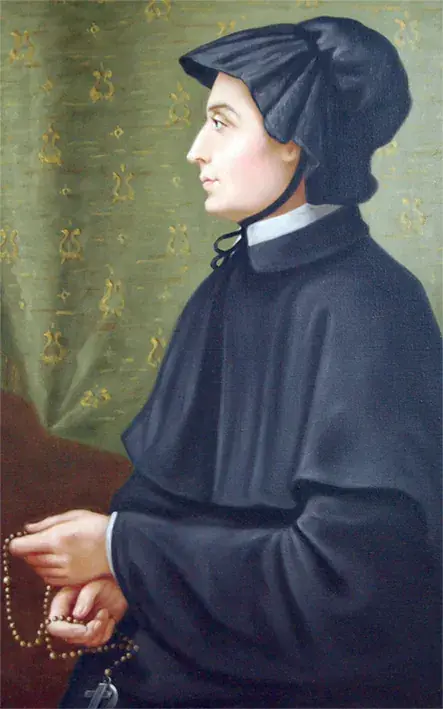
- Patron saint of
- Catholic schools, educators and teachers, loss of parents, and widows 3
- Received into the Church
- Ash Wednesday, March 14, 1805, at St Peter's, Barclay Street, New York 1
Saint Elizabeth Ann Seton was a well-connected New York wife and mother who was widowed at thirty with five children and almost no money, became a Catholic the following year, and lost most of her family's support for doing it. 13 She then founded the first American religious congregation of women and the first American parish school. Paul VI canonized her in 1975 with the words: "She is the first daughter of the United States of America to be glorified with this incomparable attribute!" 2
A daughter of the American Revolution
She was born Elizabeth Ann Bayley in New York City on 28 August 1774, two years before the Declaration of Independence, of "non-Catholic parents of high position." 13 Her father, Dr Richard Bayley, was the first professor of anatomy at Columbia College and health officer of the Port of New York. Her mother died when Elizabeth was three. 1
Her education was mostly her father's doing - a brilliant man "of great natural virtue," who trained her to self-restraint as much as to learning. 1 She read hard, wore a small crucifix, and kept up a lifelong habit of reading the Psalms. 1 Franciscan Media notes that she was raised "a staunch Episcopalian" and learned there "the value of prayer, Scripture and a nightly examination of conscience." 3
At nineteen she married William Magee Seton in St Paul's Church. 13 In her sister-in-law Rebecca she found what she called "the friend of her soul," and the two of them went about on errands of mercy until people called them "the Protestant Sisters of Charity." 1
Leghorn
The family business failed and William's health failed with it. In 1803 he needed a sea voyage, and they sailed for Leghorn with their eldest daughter to stay with the Filicchi brothers, business friends of the firm. 1 Her journal from the voyage records what the encyclopedia calls "her heroic effort to sustain the drooping spirits of her husband," through the crossing and then a long detention in quarantine. He died at Pisa on 27 December 1803. 1
She stayed on with the Filicchi families, and it was there, the article says, that "Mrs. Seton first began to see the beauty of the Catholic Faith." 1 Franciscan Media names the three things that decided her: belief in the Real Presence, devotion to the Blessed Mother, and the conviction that the Catholic Church led back to the apostles and to Christ. 3
She reached New York again on 3 June 1804. Her sister-in-law Rebecca died the following month. 1 She was thirty years old, widowed, effectively penniless, with five children.
What it cost her
What followed was a period the encyclopedia calls "great spiritual perplexity," during which Elizabeth added fasting to her prayers and wrote a line worth keeping: "If I am right Thy grace impart still in the right to stay. If I am wrong Oh, teach my heart to find the better way." 1 She was received into the Church on Ash Wednesday, 14 March 1805, and made her first Communion on 25 March. 1
The encyclopedia is exact about the consequences, and they are worse than the usual summary. She understood in advance "the storm that her conversion would raise among her Protestant relatives and friends at the time she most needed their help." Little of her husband's fortune was left, and numerous relatives "would have provided amply for her and her children had not this barrier been raised." 1
She joined an English Catholic couple opening a school for boys, and the school was destroyed by a widely circulated report that it was a proselytizing scheme. 1 When her young sister-in-law Cecilia decided to become a Catholic, "threats were made to have Mrs. Seton expelled from the state by the Legislature." 1 Franciscan Media puts it more briefly: "Many of her family and friends rejected her when she became a Catholic." 3
Paul VI, canonizing her, went out of his way to be generous about the church she left, thanking the Episcopal communion "for having awakened and fostered the religious sense and Christian sentiment which in the young Elizabeth were naturally predisposed to the most spontaneous and lively manifestations" - and adding that he knew "how much it cost Elizabeth to pass over to the Catholic Church." 2
Emmitsburg
Father Dubourg suggested she open a school for girls in Baltimore, and she and her daughters reached the city on Corpus Christi 1808. She opened a school beside the chapel of St Mary's Seminary, and was delighted, after New York, simply to be able to get to daily Mass. 1 Postulants began arriving. A Virginian convert named Cooper offered $10,000 to found an institution for teaching poor children; a farm was bought near Emmitsburg; and in June 1809 the community moved there. 1
The rule of the Daughters of Charity of St Vincent de Paul was obtained from France, modified, and approved by Archbishop Carroll in January 1812. Elizabeth was elected superior against her will, "despite the fact that she had also to care for her children." On 19 July 1813 she and eighteen sisters made their vows. 1
Franciscan Media counts what came of it: "She founded the first American religious community for women, the Sisters of Charity. She opened the first American parish school and established the first American Catholic orphanage. All this she did in the span of 46 years while raising her five children." 3 By 1814 the sisters had charge of an orphan asylum in Philadelphia; in 1817 they were sent to New York. 1
Paul VI traced the whole apostolate of parochial schools in America back to that farm: "The apostolate of helping the poor and the running of parochial schools in America had this humble, poor, courageous and glorious beginning." 2
The children
The losses inside the community were her own. Her daughter Anna died during her novitiate on 12 March 1812, permitted to pronounce her vows on her deathbed. Her daughter Rebecca died at Emmitsburg in 1816 after long suffering. Her son Richard died a few years after his mother. 1 Franciscan Media adds "the heartache of a wayward son" to the list of her trials. 3
The encyclopedia records that Elizabeth had "great facility in writing" and left copious diaries and correspondence "that show a soul all on fire with the love of God" - and then, in the next sentence, that "great spiritual desolation purified her soul during a great portion of her religious life." 1 The letters and the desolation are the same years.
Elected mother for the third time in 1819, she protested that it was "the election of the dead." She lived two more years, with a pulmonary illness, and died on 4 January 1821. 1 Her last exhortation to her sisters, on 2 January, was three words: "Be children of the Church." 2
What is Saint Elizabeth Ann Seton the patron saint of?
Franciscan Media names her patron of Catholic schools, of educators and teachers, of those who have lost parents, and of widows. 3 Each of the four is drawn straight from her life: she ran the first parish school in the country, taught in it, lost her mother at three and her father at twenty-six, and was a widow from thirty until she died.
Saint Elizabeth Ann Seton's feast day
The feast of Saint Elizabeth Ann Seton is January 4, the day she died at Emmitsburg in 1821. 13 She was beatified in 1963 and canonized by Paul VI on 14 September 1975. 12
Paul VI noted that the canonization fell in the United Nations' International Women's Year, and said he was pleased by the coincidence: the Church "extols her personal and extraordinary contribution as a woman - a wife, a mother, a widow, and a religious." 2
Praying with Saint Elizabeth Ann Seton
She became a Catholic at the precise moment she could least afford to. Her husband was dead, the money was gone, there were five children, and the relatives who would have supported her withdrew because of it. 1 She knew that was coming and did it anyway. Conversions are usually told as gains; the encyclopedia is careful to itemize the losses.
The prayer she made while she was deciding is the most useful thing she left: if I am right, keep me here; if I am wrong, teach my heart to find the better way. 1 It is a prayer for people who genuinely do not know yet, and it does not pretend to.
Her diaries are on fire with the love of God and she spent much of her religious life in spiritual desolation. 1 Both are in the same article, a sentence apart, and neither cancels the other. If your prayer has gone dry while you are running something that depends on you, this is the American saint for it.
Three of her children died before her or shortly after, one of them making her vows on her deathbed in her mother's own community. 1 She was foundress, superior and bereaved parent in the same building. What she said at the end was not about any of that: be children of the Church. 2
Saint Elizabeth Ann Seton, pray for us.
Sources
Saints to turn to next
Others in this collection who are turned to for some of the same things.