Saint Olga of Kiev
d. July 11, 969
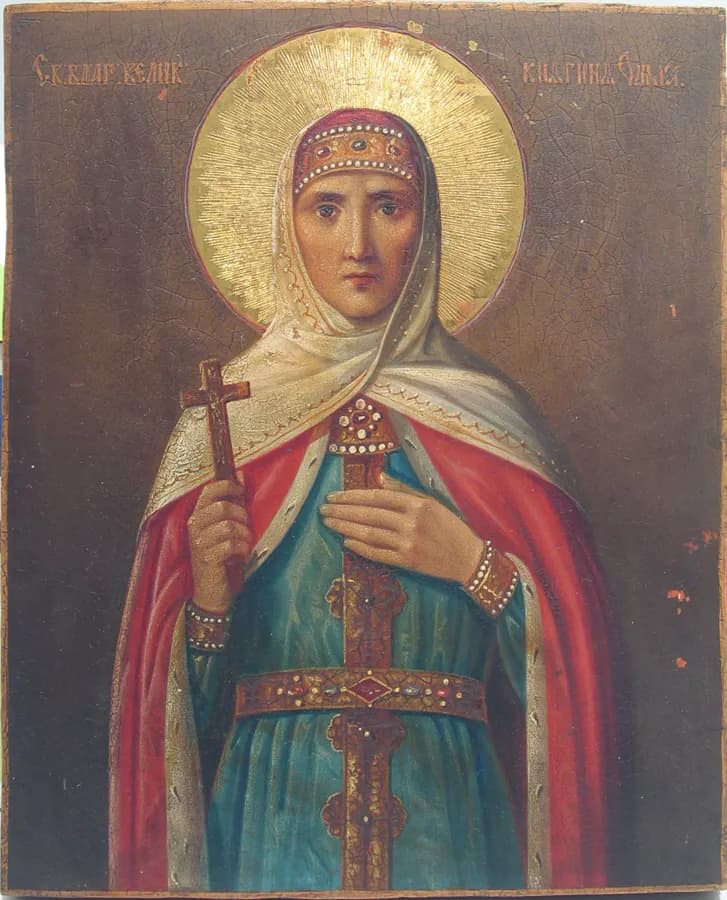
Saint Olga of Kiev was the widow of Prince Igor, regent of Kievan Rus' for their young son, and the first of its ruling house to be baptized, taking the name Helen. 157 She tried for the rest of her life to bring her people to Christ and failed with the one person she most wanted to reach, her son Sviatoslav. 12 Her grandson Vladimir finished what she started, and John Paul II, writing for the thousandth anniversary of that baptism, said the people of Kiev came to Christ "in the footsteps of Princess Olga and of Prince Vladimir." 3
A widow on the throne
Almost everything known about her comes from the Russian chronicle traditionally ascribed to the monk Nestor, written in Kiev early in the twelfth century, and its dates do not agree with each other. 56 Katolsk.no, the website of the Catholic Diocese of Oslo, gives her birth as about 879, perhaps 890, in the village of Vybuty near Pskov, and then points out the difficulty: the chronicle marries her to Igor in 903 and gives her a son in 942. 5 Emily Woodham, writing for the Diocese of Boise, says only that many historians suggest a birth around 925. 6 Her family was Scandinavian, of the Varangians who ruled Kiev. 56
In 945 Igor went to collect tribute from the Drevlians, a Slavic people northwest of Kiev, came back to demand more, and was killed. 56 Sviatoslav was three years old, and Olga governed in his name. 56 Her first act was revenge, and none of the sources softens it. The Drevlian prince sent envoys asking for her hand; she received them with flattery, had them carried through the city in their own boat, and buried them alive in a trench dug overnight. 6 Katolsk.no adds that she had her husband's killers scalded to death and several hundred of their followers killed. 5 The Spanish Catholic.net, following Butler's Lives of the Saints, says flatly that she and Vladimir alike were barbarous and cruel before their conversion. 8
Then she governed well. Katolsk.no describes the first known legal reform in Eastern Europe: she replaced the annual tribute round on which Igor had been killed with a network of local centers, the pogosti, that collected fixed dues for Kiev, and after her conversion churches began to rise in them. 5 Woodham credits her with centralizing the government and making the nobility answer for what they did. 6
Baptism at Constantinople
There were already Christians in Kiev. Palmieri, writing the 1912 Catholic Encyclopedia's article on the religion of Russia, notes from the chronicle that there was a church of Saint Elias in the city in 945, and John Paul II dates it to 944. 13 Olga went to Constantinople, and the sources do not agree on when or on what happened there. Palmieri has her baptized in the imperial city in 955 by Patriarch Polyeuctus, though he dates that patriarch's reign from 956. 1 John Paul II says she "freely and publicly had herself baptized about the year 955," and places her visit to Constantinople in 957. 3 Butler, as Catholic.net gives him, has the baptism at Constantinople around 957. 8
Katolsk.no sets out why. The chronicle puts her baptism in 954 or 955; Emperor Constantine VII described her reception at his court in his book on ceremonies and leaves no doubt that it happened in 957. 5 Either she made two journeys, which the article thinks most likely, or she was baptized at home and went to Constantinople already a Christian. 5 Her godfather, it says, was the emperor himself. 5
The best-known story is the one the sources disagree about most. Woodham tells it as the chronicle does: the emperor proposed marriage, Olga answered that she was a pagan, he taught her the faith and stood as her godfather, and when he proposed again she reminded him that the Church forbids a man to marry his goddaughter. 6 Katolsk.no counts the episode among the apocryphal details the Slavic chronicles added, and observes that the emperor was in any case married. 5 What John Paul II quotes instead is a blessing the patriarch is said to have given her: "Blessed are you among Russian women, because you loved the light and drove away the darkness. For this Russian children will bless you unto the last generation." 3
A mission that failed
She came home, in Palmieri's words, and "devoted herself to the conversion of her fellow-countrymen." 1 Katolsk.no lists churches she built: Saint Nicholas and Saint Sophia in Kiev, and the Holy Trinity at Pskov. 5 It also says that Saint Sophia's chief relic was a piece of the True Cross she brought from Constantinople. 5
Byzantium was in no hurry to give Kiev a bishop, so she looked west. 5 Palmieri reports from Western chroniclers that she sent an embassy to Otto I asking for missionaries, that Bishop Adaldag of Bremen consecrated a monk named Libutius, who died before he set out, and that his successor Adalbert, a monk of Trier, was badly received; several of his companions were killed and he was forced home. 1 Palmieri adds that Assemani and Karamzin do not accept that Latin missionaries reached Russia at all. 1 John Paul II tells it more simply: she obtained Adalbert in 961, "He actually went to Kiev, but the still flourishing paganism there prevented him from carrying out his mission." 3
At home she failed as well. "The efforts of Olga to convert her son Sviatoslaff to Christianity were unsuccessful," Palmieri writes, and Shipman, in the encyclopedia's article on Vladimir, adds that Sviatoslav "lived and died a pagan and brought up his son Vladimir as a pagan chieftain." 12 In Butler's telling the son gave a sensible reason: his men would laugh at him if he took up a foreign religion. 8 Katolsk.no records a pagan reaction in which, on Sviatoslav's orders, a nephew of Olga's named Gleb was killed and some of her churches were destroyed. 5
Her last years
Sviatoslav came of age and went to war, and Olga stayed in Kiev bringing up his sons Yaropolk, Oleg and Vladimir. 5 In 968, katolsk.no says, the Pechenegs besieged the city while Sviatoslav was campaigning on the Danube, and she led its defense until he came back. 5 When he then wanted to move his capital to the Danube, she asked him to wait until he had buried her. 5
She died on July 11, 969. 56 Katolsk.no says she had kept a priest with her in secret in those years, and that before she died she forbade a pagan funeral feast and had herself buried openly by that priest, Gregory. 5 Butler, in Catholic.net, quotes the chronicler on her life after baptism: she clothed the naked, gave drink to the thirsty, and looked after pilgrims, the poor, widows and orphans. 8 Vladimir later moved her body to the Church of the Tithes in Kiev, and both Butler and katolsk.no report that it was found incorrupt. 58
Vladimir was baptized in 988, and with him the people of Kiev. 23 When his envoys came back from Constantinople praising its liturgy, Shipman writes, they "reminded Vladimir that his grandmother Olga had embraced that Faith." 2 An eleventh-century monk called the two of them a new Helen and a new Constantine, equal to the Apostles, and the title has stayed with them. 58
What is Saint Olga the patron saint of?
Saint Olga's feast day
Saint Olga's feast day is July 11, the day of her death. The current Roman Martyrology enters her on that date, as the Italian bishops print it: at Kiev, the grandmother of Saint Vladimir, the first of her dynasty to receive baptism and the name Helen, who opened the way to Christ for the whole people of Rus'. 7 The Diocese of Boise gives the same day. 6 Katolsk.no notes that the Russian and Ukrainian churches also keep July 11, which on their older calendar falls on July 24 of the civil year. 5 She lived before the division of East and West, and Palmieri wrote in 1912 that for that reason she "is venerated as a saint also by the United Ruthenians," the Eastern Catholics of what is now Ukraine. 1
Praying with Saint Olga
There is no way to tell her story that leaves out the trench. She buried men alive and ordered the killing of hundreds more, and the sources that call her a saint record it in the same pages. 568 Her sanctity comes after that, and it does not erase it. What changed was how she used the same power. Katolsk.no observes that she never tried to convert anyone by force. 5
Much of her Christian life was spent failing. The bishop she asked for was driven out, her churches were pulled down, and her son, for whom she had governed, would not hear her on the one thing she most wanted to give him. 135 She kept her faith anyway, kept a priest by her, and raised the grandson who would one day be baptized. 5 John Paul II, writing of her, noted that she never saw her son a Christian, and that it was Vladimir who took up her spiritual inheritance. 3
Widows and converts are her people, and it is easy to see why. She became a Christian as a grown woman with a long record, in a court that did not follow her. 18 In 1988 John Paul II wrote to Ukrainian Catholics that the Lord had chosen Olga and Vladimir as his servants to give their people the grace of baptism, and he closed the letter by asking her prayers for them. 4
Saint Olga of Kiev, pray for us.
Sources
- 1.Aurelio Palmieri, "The Religion of Russia," The Catholic Encyclopedia, Vol. 13 (New York: Robert Appleton Company, 1912).
- 2.Andrew Shipman, "St. Vladimir the Great," The Catholic Encyclopedia, Vol. 15 (New York: Robert Appleton Company, 1912).
- 3.John Paul II, Euntes in mundum, apostolic letter for the millennium of the baptism of Kievan Rus', January 25, 1988, English translation as published by Catholic Culture.
- 4.John Paul II, Magnum baptismi donum, message to Ukrainian Catholics for the millennium of the baptism of Kievan Rus', February 14, 1988, English translation as published by Catholic Culture.
- 5.Per Einar Odden, "Den hellige Olga av Kiev (~879-969)," katolsk.no, the Catholic Diocese of Oslo (in Norwegian).
- 6.Emily Woodham, "Saint Olga of Kyiv," Idaho Catholic Register, Diocese of Boise, July 10, 2022.
- 7.Roman Martyrology, entry for July 11, "Santa Olga," as printed in "Santo del giorno," Conferenza Episcopale Italiana (in Italian).
- 8."Olga de Kiev, Santa," Santoral, Catholic.net, after Alban Butler's Lives of the Saints (in Spanish).
Saints to turn to next
Others in this collection who are turned to for some of the same things.
- Saint Elizabeth Ann SetonAugust 28, 1774 - January 4, 1821Marriage and familyConversion
- Saint HelenaMid-third century - c. 329 or 330ConversionMarriage and family
- Saint HermenegildDied April 13, 585ConversionMarriage and family
- Saint Margaret of Cortona1247 - February 22, 1297ConversionMarriage and family