Saint Margaret of Cortona
1247 - February 22, 1297
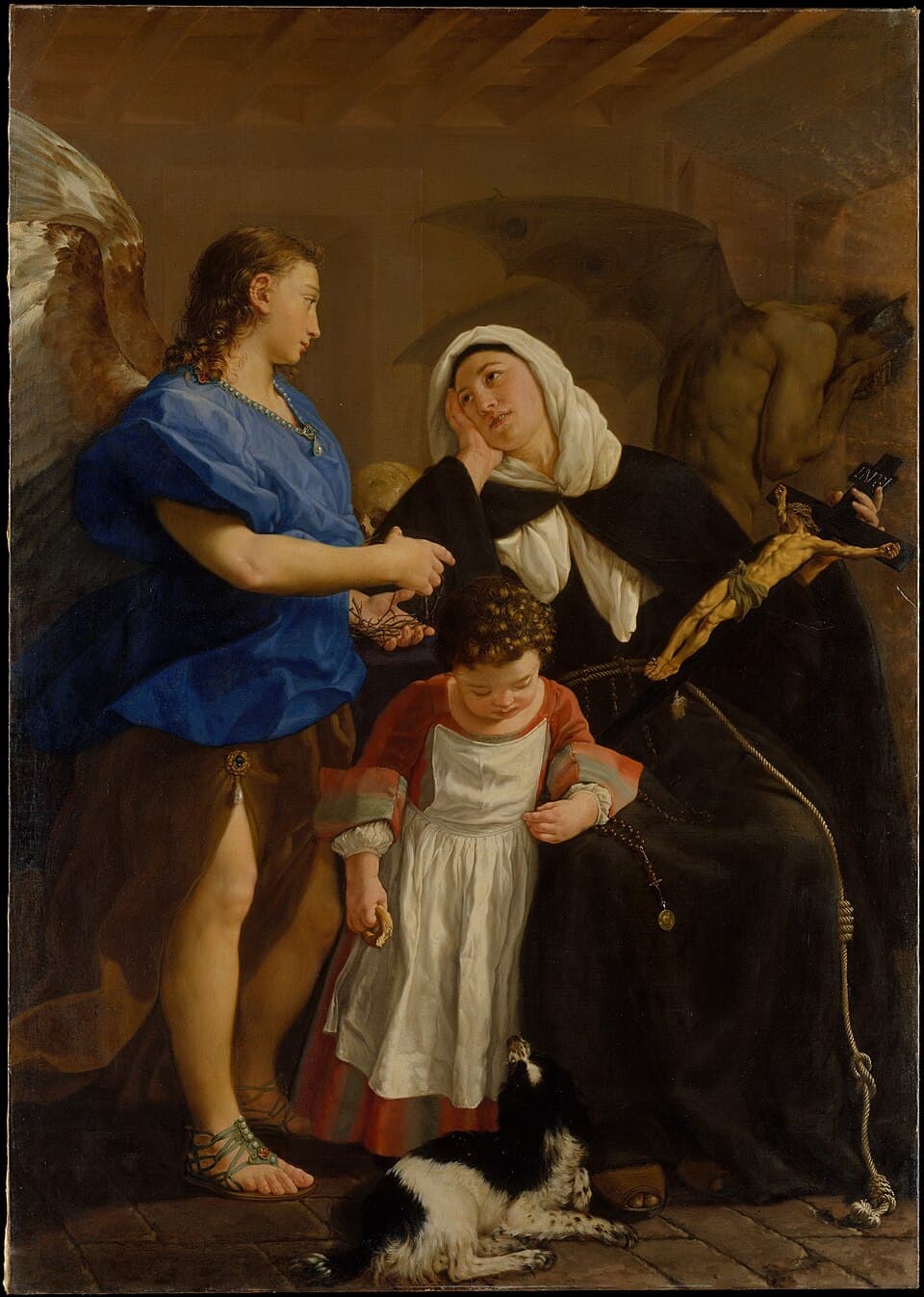
- Patron saint of
- Neither source assigns a patronage. She is invoked by single mothers and by the falsely judged 12
- The nine years
- She lived with a man who would not marry her and bore him a son. Hess says she asked him often 1
- Founded
- A hospital at Cortona, and a congregation of tertiary sisters 2
- Canonized
- In 1728, four hundred and thirty-one years after her death 2
Saint Margaret of Cortona lost her mother at seven, left a home where she was not wanted, and spent nine years with a man who promised to marry her and never did. 12 When his dog came back alone and led her to his body in the woods, she gave back everything he had given her and walked to Cortona with her small son. 12 Her own encyclopedia entry accuses earlier writers of exaggerating her sins to make the conversion look better. 1
A girl nobody wanted
She was born at Laviano in Tuscany in 1247, to farming parents. 12 Her mother died when she was seven, and two years later her father married again. 1
Hess describes what followed in a sentence that explains most of her life: "Between the daughter and her step-mother there seems to have been but little sympathy or affection, and Margaret was one of those natures who crave affection." 1 Franciscan Media: "life with her stepmother was so difficult that Margaret moved out." 2
At about seventeen she met a young nobleman - possibly the son of the lord of Valiano - and one night left her father's house with him. 1 She lived with him for nine years in his castle near Montepulciano, and a son was born. 1
Here Hess does something unusual, and it is the reason this profile exists in the form it does. "Frequently she besought her lover to marry her; he as often promised to do so, but never did. In her confessions she expressly says that she consented to her lover's importunities unwillingly." 1
And then the correction: "Wadding and others who have described her in these early years as an abandoned woman, either had not rightly read her legend, or had deepened the shadows of her early life to make her conversion seem the more wonderful." 1 Writers had made her worse than she was, deliberately, to sharpen the contrast. The Catholic Encyclopedia says so in 1910.
Even in those years, Hess notes, "Margaret was very compassionate towards the poor and relieved their wants; she was also accustomed to seek out quiet places where she would dream of a life given to virtue and the love of God." 1 Franciscan Media compares her to Augustine: she "prayed for purity - but not just yet." 2
When her neighbors told her to look to her soul before it was too late, she answered "that they need have no fear of her, for that she would die a saint and that her critics would come as pilgrims to her shrine." 1 She was twenty-something, unmarried, with a child, and she said that out loud.
The dog
He was murdered on a journey. 12
Hess: "Margaret's first intimation of his death was the return of his favourite hound without its master. The hound led her to his body." 1 Franciscan Media tells it the same way: she was waiting for him and "was instead met by his dog. The animal led Margaret into the forest where she found Arsenio murdered." 2
Franciscan Media gives the man a name; Hess says plainly that "Margaret in her confessions does not mention her lover's name." 12 She did not write it down, and this page will follow her.
What she did next is recorded with a phrase that says a great deal about how Hess read her: "It was characteristic of her generosity that she blamed herself for his irregular life, and began to loathe her beauty which had fascinated him." 1 She held herself responsible for a man who had refused to marry her.
She returned every jewel and every piece of property he had given her to his relatives, left the castle, and set out with her son for her father's house. 1 "Her father would have received her, but his wife refused, and Margaret and her son were turned adrift." 1
And then the moment the older accounts skip. "For a moment she felt tempted to trade upon her beauty; but she prayed earnestly and in her soul she seemed to hear a voice bidding her go to the Franciscan Friars at Cortona." 1 A homeless woman with a child, considering the only asset she had left.
Cortona
What happened at Cortona is small and decisive. "On her arrival at Cortona, two ladies, noticing her loneliness, offered her assistance and took her home with them. They afterwards introduced her to the Franciscan Friars." 1
Two women saw a stranger who looked alone and took her in. Everything else in her life followed from that.
It was not a clean break. "For three years Margaret had to struggle hard with temptations. Naturally of a gay spirit, she felt much drawn to the world." 1 Three years, not three days.
And her penances had to be restrained by other people. "At times remorse for the past would have led her into intemperate self-mortifications, but for the wise advice of her confessors." 1 Franciscan Media says the same: her confessor "sometimes had to order her to moderate her self-denial." 2 She was still punishing herself for a man's conduct, and it took a direct order to stop her.
After three years of probation she was admitted to the Third Order of St. Francis, in 1277, and lived in strict poverty, begging her bread as Francis had. 12 But, Hess adds, "whilst thus living on alms, she gave her services freely to others; especially to the sick-poor whom she nursed." 1
She founded a hospital at Cortona and a congregation of tertiary sisters to staff it. 2 Her son became a friar. 2 Franciscan Media records what she became to the town: "These devotions fueled her great charity and drew sinners to her for advice and inspiration." 2 People with her kind of history came to her, because she was the one person who would not be shocked.
She died at Cortona on 22 February 1297, and was canonized in 1728. 12 Her critics did come as pilgrims to her shrine.
What is Saint Margaret of Cortona the patron saint of?
Neither Hess nor Franciscan Media assigns Saint Margaret of Cortona a formal patronage. 12 What she is asked for follows from what she was.
She is invoked by single mothers, by women who have been abandoned by a man who would not marry them, and by anyone who has been publicly written off. 1 She is also, and this is her particular gift, a patron for people whose reputation is worse than their conduct - which is the exact injustice Hess accuses her own biographers of committing. 1
And she belongs to the homeless. She and her small son were turned away from her father's door and had nowhere at all to go. 1 What saved her was two women in a strange town who noticed that she was by herself.
Saint Margaret of Cortona's feast day
The feast of Saint Margaret of Cortona is February 22, the day she died in 1297. Franciscan Media states it outright, and Hess gives the death date exactly. 12
A reader may find her on other days in older or local calendars; the Franciscan family has commemorated her variously. Both sources here give February 22 and this page follows them.
She should not be confused with Saint Margaret of Antioch, the legendary virgin martyr, nor with Saint Margaret of Scotland, the queen who died in 1093. Three Margarets, three centuries apart.
Praying with Saint Margaret of Cortona
The most important sentence about her was written by a historian defending her. Earlier writers had called her an abandoned woman; Hess says they either misread the record or darkened it on purpose, and then quotes her own account - that she asked to be married, repeatedly, and consented unwillingly. 1 A great many people are remembered as worse than they were, usually by someone who found the contrast edifying. She is the patron of everyone that has happened to.
Her self-blame is worth noticing and not imitating. She held herself responsible for the life of a man who would not marry her, came to hate her own face, and had to be ordered by her confessor to stop hurting herself. 12 That is not the sign of a soul making good progress; it is a wound. The Church canonized her anyway, and the sources record the confessors telling her to eat.
What actually turned her life was not the murder in the woods. It was two women in Cortona who saw somebody alone and took her home. 1 Everything - the hospital, the sisters, the shrine - came out of an ordinary kindness from strangers who had no idea who she would turn out to be.
And she said it first. Told to look to her soul, she replied that she would die a saint and that the people criticizing her would come as pilgrims. 1 It reads as defiance, which it probably was. It was also true, and there is something bracing about a young woman with nothing, being lectured by her neighbors, answering back like that.
Saint Margaret of Cortona, pray for us.
Sources
Saints to turn to next
Others in this collection who are turned to for some of the same things.
- Saint Bridget of Swedenc. 1303 - July 23, 1373Marriage and familySuffering and illness
- Saint Joachima de Vedruna1783 - 1854Marriage and familySuffering and illness
- Saint Josephine Bakhitac. 1869 - February 8, 1947Suffering and illnessConversion
- Saint Aloysius GonzagaMarch 9, 1568 - June 21, 1591Suffering and illnessConversion