Saint Hermenegild
Died April 13, 585
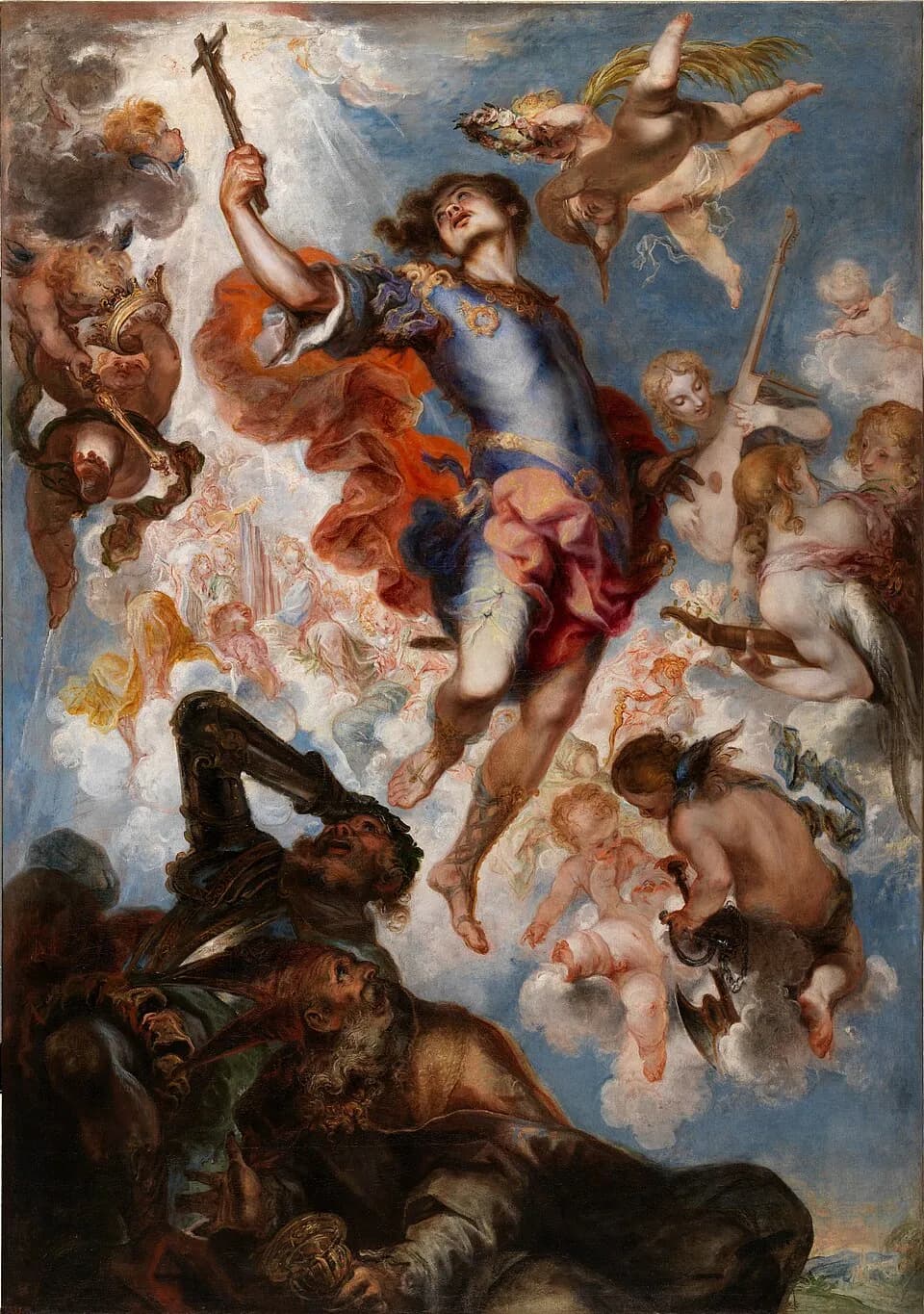
- Born
- Date unknown; son of Leovigild, Arian king of the Visigoths 1
- Married
- Ingundis, a Catholic Frankish princess, in 576 1
- Died
- Beheaded on Easter Day, April 13, 585, by Gregory the Great's account 1
- Historical record
- One encyclopedia article notes that contemporary authorities say nothing of a martyrdom 2
- Patron saint of
- Converts, the Spanish monarchy and Seville; invoked against drought, flood and thunderstorms 5
Saint Hermenegild was a Visigothic prince, the son of the Arian king Leovigild, who became a Catholic, went to war with his father, lost, and was beheaded on Easter Day in 585. 1 Pope Gregory the Great wrote that he died for refusing Communion from an Arian bishop, and the Church has honored him as a martyr on that account. 1 The Catholic Encyclopedia is candid that the early record is thinner than the later story, and one of its own articles says so bluntly. 2 His feast is April 13. 15
A divided royal house
His date of birth is unknown. 1 His father, Leovigild, ruled the Visigoths in Spain until 586 and was an Arian, as the Gothic kings had been for generations. 12 Leovigild had two sons by his first marriage, Hermenegild and Reccared. 1 The account in Little Pictorial Lives of the Saints says both were "reigning conjointly with him," and the Archdiocese of Seville likewise says the king had associated Hermenegild with the throne. 56
The sources do not agree about his mother. Kirsch, in the encyclopedia's article on the saint, calls her "the Catholic Princess Theodosia." 1 The encyclopedia's article on Leander of Seville says it "has been also believed, but wrongly," that a Theodosia of Leander's family married Leovigild. 4 Little Pictorial Lives says simply of the king and his sons that "all were Arians." 5
In 576 Hermenegild married Ingundis, a Frankish princess and a Catholic, the daughter of Sigebert and Brunhilde. 1 Leovigild's second wife, Goswintha, whom Kirsch calls "a fanatical Arian," hated her daughter-in-law and tried by ill-treatment to make her give up her faith. 1 With his father's permission Hermenegild took his wife away from the court to Andalusia. 1 The Archdiocese of Seville says it was to Seville that he came. 6
Conversion and revolt
There he became a Catholic. Kirsch gives three causes together: he was "led by his own inclination, and influenced by his wife as well as by the instructions of St. Leander of Seville." 1 Little Pictorial Lives credits Ingundis and "her holy example." 5 Seville names both the wife and the bishop. 6
When Leovigild learned of it he summoned his son back to Toledo, and Hermenegild did not go. 1 By Kirsch's account his stepmother's Arianism and his father's severe treatment of Catholics "stirred him to take up arms in protection of his oppressed co-religionists and in defence of his own rights," and he made an alliance with the Byzantines, who held part of the coast. 13 Little Pictorial Lives tells it the other way around: the king denounced his son as a traitor and marched to seize him, and Hermenegild tried to rally the Catholics of Spain, who "were too weak to make any stand." 5
The war went badly. Leovigild took the field in 582 and, Kirsch says, paid the Byzantines 30,000 gold solidi to abandon the prince. 1 He besieged him in Seville in 583 and took the city after nearly two years. 1 Hermenegild fled to a church in Cordova. His father drew him out with promises, stripped him of his royal dress in the camp and, in 584, banished him to Valencia. 1 Little Pictorial Lives has him surrender on the promise of a pardon and then be loaded with chains and thrown into a dungeon at Seville. 5
Ingundis escaped to Africa with their son and died there. The boy was handed over, by order of the emperor Maurice, to his grandmother Brunhilde. 1
Easter Day, 585
"We are not fully informed as to Hermengild's subsequent fate," Kirsch writes, and then gives what Gregory the Great relates in his Dialogues. 1 On the eve of Easter in 585 Leovigild sent an Arian bishop to the prison with a promise to forgive everything if his son would receive Holy Communion from the bishop's hands. Hermenegild "firmly refused thus to abjure his Catholic belief," and was beheaded on Easter Day. 1 The Archdiocese of Seville tells the same story in its calendar. 6
Little Pictorial Lives fills in the scene with details the encyclopedia does not carry: tortures and bribes, a letter to his father saying he held the crown as nothing, and a light streaming from the cell that told the Christians keeping vigil nearby that he was dead. 5
What the encyclopedia doubts
The Catholic Encyclopedia does not speak with one voice about him. Kirsch follows Gregory. 1 So does its article on Spain, which says he put himself "at the head of the Catholics," was defeated and taken prisoner, "and suffered martyrdom for rejecting communion with the Arians." 3
Its article on the Visigoths, by Klemens Löffler, is cooler. Hermenegild "revolted against him but was defeated and beheaded," it says of the prince and his father, and then: "Later narratives represent Hermenigild as a martyr for Catholicism, his wife, a Frankish princess, having converted him, but contemporary authorities say nothing of it." 2
So the outline is common ground: a prince, a rebellion against an Arian father, a defeat and a beheading. 12 What rests on Gregory is the scene in the prison and the reason for the death. 1 The Church accepted his account. Hermenegild "was later venerated as a martyr," Kirsch says, and the Roman Martyrology carries his name. 15
After his death
His brother Reccared succeeded their father, became a Catholic, and the Visigoths soon followed him. 2 Little Pictorial Lives adds a deathbed scene in which Leovigild tells Reccared to seek out Leander and follow his brother's example, and it quotes Gregory's verdict on the new king. "Nor is it to be wondered," Gregory says there, "that he came thus to be a preacher of the true faith, since he was the brother of a martyr, whose merits helped him to bring so many into the haven of God's Church." 5
A thousand years after the execution, in 1585, Pope Sixtus V extended the celebration of his feast to the whole of Spain at the suggestion of King Philip II. 1 Benedict XVI, speaking of Isidore of Seville in 2008, described a people rediscovering its political and religious unity "with the providential conversion of Hermenegild, the heir to the Visigoth throne, from Arianism to the Catholic faith." 7
What is Saint Hermenegild the patron saint of?
Saint Hermenegild's feast day
Praying with Saint Hermenegild
This is an uncomfortable saint to hold up as a model, and the sources do not hide why. He took up arms against his own father, in part, Kirsch says, "in defence of his own rights," and he lost. 1 One of the encyclopedia's own writers saw a rebel in him before he saw a martyr. 2
What Gregory's account honors is a single refusal. In it Hermenegild is offered everything back, his father's forgiveness included, for one Communion from an Arian bishop, and he says no. 1 By then the war was over and he had nothing left to bargain with. Gregory places it on the night before Easter. 1
His conversion came through the people nearest him. A wife who had been mistreated for her faith and a bishop who taught him are the two names the sources give. 16 He did not live to see what followed, when his brother and then the whole Gothic people took the same step. 2
The family did not mend in his lifetime. Ingundis died in Africa and their son was sent to his grandmother among the Franks. 1 Whatever Leovigild felt at the end, only one later account describes it. 5
Saint Hermenegild, pray for us.
Sources
- 1.Johann Peter Kirsch, "St. Hermengild," The Catholic Encyclopedia, vol. 7 (New York: Robert Appleton Company, 1910).
- 2.Klemens Löffler, "Visigoths," The Catholic Encyclopedia, vol. 15 (New York: Robert Appleton Company, 1912).
- 3.Ramón Ruiz Amadó, "Spain," The Catholic Encyclopedia, vol. 14 (New York: Robert Appleton Company, 1912).
- 4.Pierre Suau, "St. Leander of Seville," The Catholic Encyclopedia, vol. 9 (New York: Robert Appleton Company, 1910).
- 5."St. Hermenegild," from Little Pictorial Lives of the Saints, with calendar notes, CatholicCulture.org, Liturgical Year, April 13, 2026.
- 6."Santoral sevillano," Archidiócesis de Sevilla (in Spanish).
- 7.Benedict XVI, General Audience, June 18, 2008: Saint Isidore of Seville.
- 8."St. Hermenegild, Martyr," Saint of the Day, 13 April, Vatican News.
Saints to turn to next
Others in this collection who are turned to for some of the same things.
- Saint EustaceMartyred at Rome, in 118 by tradition; other accounts give 140 or 188ConversionCourageMarriage and family
- Saint Ludmila of Bohemiac. 860 - September 15, 921Marriage and familyCourageConversion
- Saint Philip HowardJune 28, 1557 - October 19, 1595ConversionCourageMarriage and family
- Saint HelenaMid-third century - c. 329 or 330ConversionMarriage and family