Saint Ludmila of Bohemia
c. 860 - September 15, 921
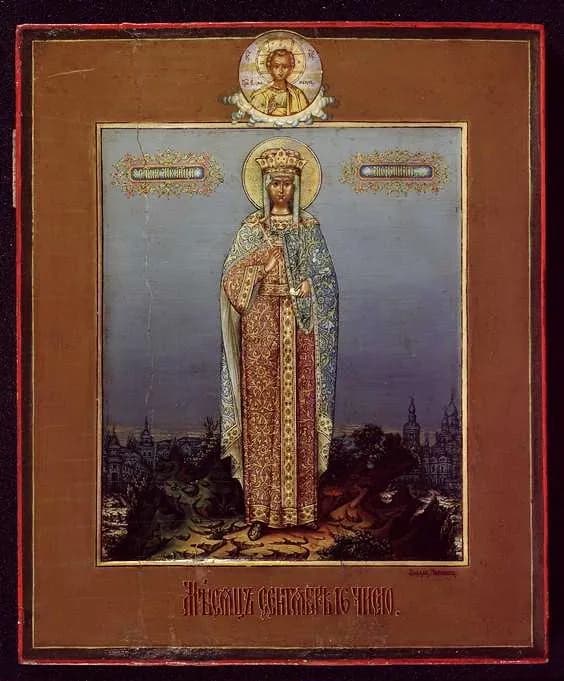
- Patron saint of
- Bohemia, as "one of the patrons" 1; Vatican News says John Paul II proclaimed her patron saint of Eastern Europe 2
- Feast day
- September 16 1
- Born
- At Mielnik, about 860, according to the 1910 Catholic Encyclopedia; about 859 in Lusatia, daughter of the Sorbian prince Slavibor, according to Vatican News 12
- Baptized
- With her husband, probably by Saint Methodius, in 871 according to Ott; after her husband's baptism in 878 according to Klaar 16
Saint Ludmila was the wife of the first Christian duke of Bohemia, the grandmother who raised Saint Wenceslaus, and the first of the two to be killed by their own family. 125 In September 921 two noblemen sent by her daughter-in-law Drahomira murdered her at Tetin, and the 1910 Catholic Encyclopedia says she "is said to have been strangled by them with her veil." 1 Vatican News calls her the first Christian martyr of Bohemia. 2 Her feast is September 16. 1
A duchess baptized with her husband
Michael Ott, writing in the 1910 Catholic Encyclopedia, gives her life in one paragraph. She was born at Mielnik around 860 and married Boriwoi, "the first Christian Duke of Bohemia." 1 Vatican News, writing for the anniversary in 2021, places her birth around 859 in Lusatia, the borderland where Poland, Germany and the Czech Republic now meet, and names her father as the Sorbian prince Slavibor. 2 It adds that she was married "while still an adolescent." 2
The two sources agree that she and her husband were baptized together, and that the man who baptized them was, or probably was, Saint Methodius, the apostle of the Slavs. 12 Ott puts the baptism in 871. 1 Karl Klaar's article on Bohemia in the same encyclopedia tells it differently: Methodius won Boriwoi over at the Moravian court and baptized him at Welehrad in 878, and his wife Ludmilla and most of his relations were baptized "soon after." 6 The dates cannot both be right, and neither source says how it knows.
Becoming Christian did not settle anything. Ott says "pagan fanatics drove them from their country," though they were soon recalled. 1 After reigning seven more years, Boriwoi and Ludmila gave up the throne to their son Spitignev and retired to Tetin, a castle near Beraun. 1 Vatican News adds that she "soon became a leading figure in Christian education and the spread of Christianity in the region." 2
Sons, a daughter-in-law and a grandson
Her sons carried on what their parents had begun. Vatican News credits them with consolidating the country's place in the Christian world by building churches, some still standing: the round Romanesque church of Saints Peter and Paul at Budeč, and the Basilica of St. George in Prague. 2 It also says that Ludmila, widowed early, "donated all her possessions to the poor." 2
The succession is where the sources part company. Ott says Spitignev died two years after taking the throne and was followed by his brother Wratislaw, who married Drahomira, "a pretended Christian, but a secret favourer of paganism." 1 They had twin sons, according to Ott: Wenceslaus, and Boleslaus, later called the Cruel. 1 Wenceslaus lived with his grandmother at Tetin. 1 Ott dates Wratislaw's death to 916, which left an eight-year-old heir. 1
Vatican News tells the same household in a different order. It calls Vratislav her eldest son and dates his death to 921, the year of her own. 2 On its account the nobles then gave the regency of the duchy to his widow Drahomira and the education of the young Wenceslaus to his Christian grandmother. 2 Franciscan Media's life of Wenceslaus says simply that his "saintly grandmother, Ludmilla, raised him and sought to promote him as ruler of Bohemia in place of his mother, who favored the anti-Christian factions." 7
Benedict XVI, preaching at Stara Boleslav on the feast of Wenceslaus in 2009, said the young prince "remained faithful to the Gospel teachings he had learned from his saintly grandmother, the martyr Ludmila." 5 Whatever the exact dates, every source used here agrees that Wenceslaus was formed in her house. 1257
The murder at Tetin
Ott gives the motive in one sentence: "Jealous of the great influence which Ludmilla wielded over Wenceslaus, Drahomira instigated two noblemen to murder her." 1 Vatican News puts it the same way, a "fit of jealousy," and adds an accusation: Drahomira charged Ludmila with "seeking to rule the duchy by influencing Wenceslaus" and forced her to withdraw to the castle of Tetin. 2 Ott, as above, has her already living there in retirement. 1
There, on the night of September 15, 921, she was strangled on Drahomira's order. 12 Ott reports the veil as a tradition rather than a certainty: she "is said to have been strangled by them with her veil." 1 He dates the chief account of her life, written by a Benedictine monk named Christian, to the end of the tenth century, and notes that it was long dismissed as a later forgery before scholars writing in 1905 and 1907 offered "grave reasons for its genuineness." 1
The sources do not present the killing as a quarrel over doctrine. They present it as a struggle over a child and a duchy, inside a family where one side was Christian and the other, on Ott's account, was not really. 12 The Church has nonetheless venerated her as a martyr, and she is in the Roman Martyrology. 2 Benedict XVI, welcoming the Czech nation in 2009, placed her among the "courageous martyrs whose fidelity to Christ spoke far louder and more eloquently than the voice of their executioners." 3
She was buried at Tetin in the church of St. Michael. 12 Her remains were later moved to the church of St. George in Prague: before the year 1100, Ott says, "probably by St. Wenceslaus, her grandson," while Vatican News states plainly that Wenceslaus had the relics transferred once he had come of age. 12 Fourteen years after her death he was murdered too, at Alt-Bunzlau in 935, by his brother Boleslaw, and the 1912 encyclopedia says it was done "at the instigation of Dragomir," their mother. 610
What is Saint Ludmila the patron saint of?
Saint Ludmila is a patron of Bohemia, the Czech lands. 1 Ott says she "is venerated as one of the patrons of Bohemia." 1 Vatican News adds that Pope Saint John Paul II included her in the Roman Martyrology and proclaimed her patron saint of Eastern Europe. 2 It also calls her a symbol of Christianity in the Czech Republic and "the expression of Bohemian unity within the Austro-Hungarian Empire, especially in the second half of the last century." 2
Saint Ludmila's feast day
The feast of Saint Ludmila is September 16, the day after her death, as the 1910 Catholic Encyclopedia records it. 1 Her death is dated September 15, 921, and the two dates are easy to confuse. 12
September 16 is also the memorial of Saints Cornelius and Cyprian, and Vatican News heads the liturgy of that day with them. 9 Its Saint of the Day calendar for September 16 lists Cornelius and Cyprian, Saint Euphemia and Blessed Victor III, and does not list Ludmila. 8 In the Czech Republic the main celebration of the 1,100th anniversary of her martyrdom was held at Tetin on September 18, 2021, with Cardinal Christoph Schönborn attending as Pope Francis's special envoy. 2
Praying with Saint Ludmila
What survives of her is mostly relationship. She was a wife baptized alongside her husband, a mother whose sons built churches, a widow who gave her goods away, and a grandmother who raised a boy in a faith his own mother did not share. 127 Benedict XVI, standing in Prague more than a thousand years later, named her with the other martyrs of that country, and in the cathedral there he named her again among the saints of its history. 34
The household is not a comfortable one to look at. The sources say she was killed because her daughter-in-law was jealous of her hold on a child, and the same mother later instigated the murder of her son Wenceslaus by his brother. 110 Nothing in the record turns that into a lesson about families working out in the end. No source used here says Drahomira repented; it was Boleslaw who did, three years after the killing. 10
What the sources do record is continuity. The faith she received from Methodius went to her grandson, and Benedict says Wenceslaus kept to the Gospel teachings "he had learned from his saintly grandmother." 5 Her body was probably carried to Prague by him, and his own was later moved there by the brother who killed him. 110
Grandparents raising a child in a faith that someone else in the household resists will recognize her position. The sources place what she did in her own house, with a child left in her care, and they say it was that influence over him which got her killed. 12
Saint Ludmila of Bohemia, pray for us.
Sources
- 1.Michael Ott, "St. Ludmilla," The Catholic Encyclopedia, Vol. 9 (New York: Robert Appleton Company, 1910).
- 2."Pope names Cardinal Schönborn envoy to St. Ludmila celebrations," Vatican News, August 2021.
- 3.Benedict XVI, Address at the Welcoming Ceremony, Stará Ruzyně International Airport, Prague, 26 September 2009 (Libreria Editrice Vaticana).
- 4.Benedict XVI, Address at Vespers in the Cathedral of Saints Vitus, Wenceslaus and Adalbert, Prague, 26 September 2009 (Libreria Editrice Vaticana).
- 5.Benedict XVI, Homily at Mass on the liturgical memorial of Saint Wenceslaus, Stara Boleslav, 28 September 2009 (Libreria Editrice Vaticana).
- 6.Karl Klaar, "Bohemia," The Catholic Encyclopedia, Vol. 2 (New York: Robert Appleton Company, 1907).
- 7."Saint Wenceslaus," Saint of the Day, Franciscan Media.
- 8."16 September," Saint of the Day, Vatican News.
- 9."Gospel and Word of the Day, 16 September 2026," Vatican News.
- 10.Francis Mershman, "St. Wenceslaus," The Catholic Encyclopedia, Vol. 15 (New York: Robert Appleton Company, 1912).
Saints to turn to next
Others in this collection who are turned to for some of the same things.