Saint Helena
Mid-third century - c. 329 or 330
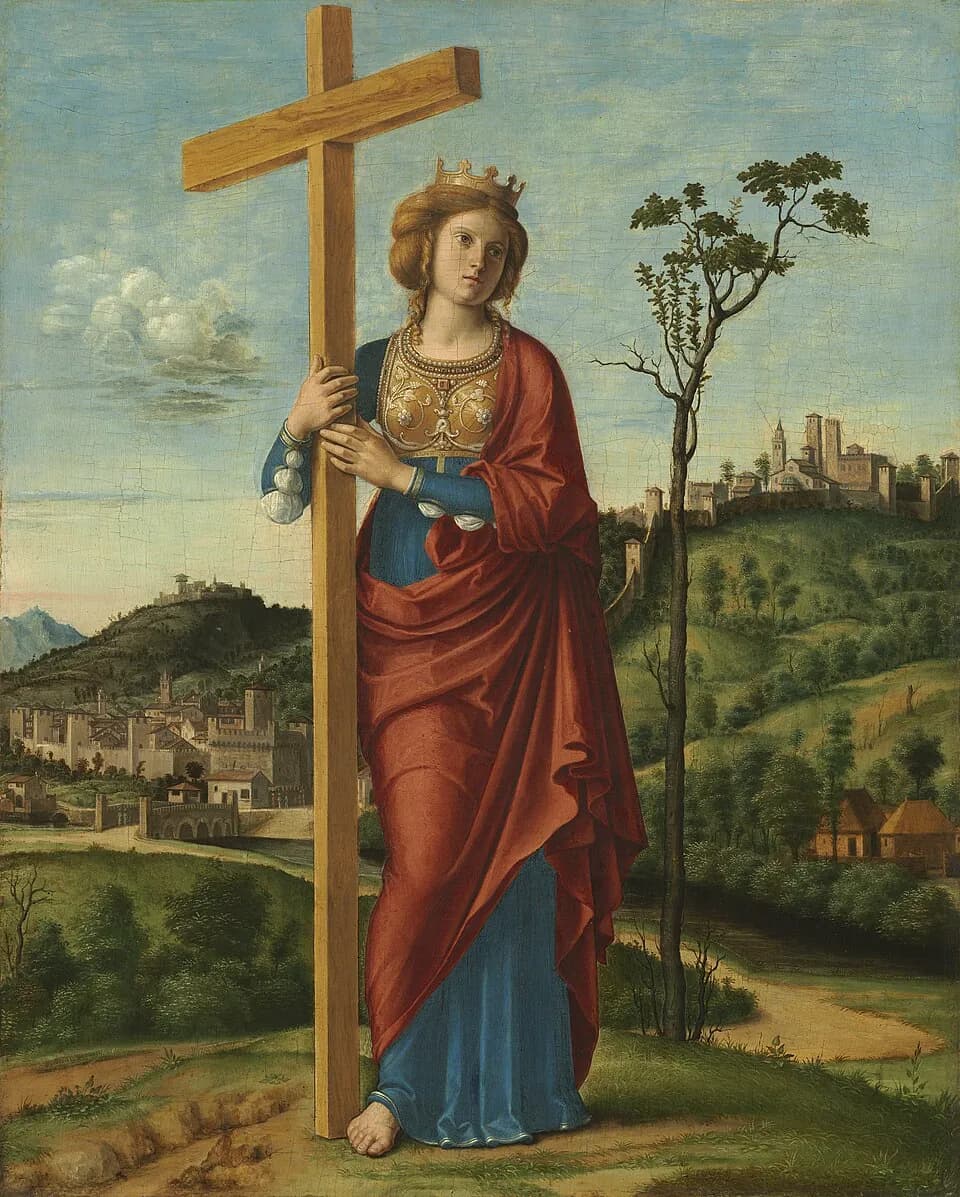
- Patron saint of
- Archaeologists, converts, difficult marriages and divorced people 89; Catholic Culture adds empresses, cloth dyers, nail smiths and needle makers, and protection against fire, storms and thunder 9
- Born
- Around the middle of the third century, possibly or probably at Drepanum, later Helenopolis, on the Gulf of Nicomedia 14
- Son
- Constantine the Great, born at Naissus in 274 according to the 1910 Catholic Encyclopedia 1
Saint Helena was the mother of Constantine the Great, a woman of humble birth who was made empress by her son and became a Christian late in life. 14 In her old age she traveled to Palestine and built churches at Bethlehem and on the Mount of Olives, and tradition credits her with finding the cross on which Christ died. 12 That tradition is old and widely held, but the earliest historian of her journey does not mention it, and the Catholic Encyclopedia sets out plainly which early writers tell the story and which do not. 2
An innkeeper who married a future emperor
Helena was born around the middle of the third century, and the place usually named is Drepanum on the Gulf of Nicomedia, in Asia Minor. 14 Johann Peter Kirsch, writing in the 1910 Catholic Encyclopedia, says "possibly"; Vatican News says "probably." 14 Her family was poor. Saint Ambrose, in his funeral oration for the emperor Theodosius, called her a stabularia, an innkeeper, and Vatican News describes her as having worked as a stable maid. 14
An English tradition of the Middle Ages made her the daughter of a British prince, and the city of Colchester long claimed her as its own. The excerpt from Butler's Lives of the Saints that Catholic Culture prints for her feast states that "it is certain that she was a British princess." 9 Kirsch disagrees in the strongest terms, calling the story "entirely without historical foundation" and suggesting it grew from a misread line in a panegyric on Constantine. 1
She became the lawful wife of Constantius Chlorus, a Roman officer, and bore him one son, Constantine. 14 Kirsch puts the birth at Naissus in Upper Moesia in 274; Vatican News places it in the Balkans "sometime after the year 270." 14
In 292, according to Kirsch, Constantius was made co-ruler in the West and, for political reasons, put Helena aside to marry Theodora, the stepdaughter of the emperor Maximian. 1 Vatican News calls the new wife Maximian's daughter and says that Helena, separated from her son, "remained in the shadows" as he rose. 4 Pope Leo XIV, speaking of her in 2025, put it simply: Constantius "did not hesitate to repudiate her, separating her from her son Constantine for years." 6
Augusta, and a late conversion
When Constantius died and Constantine succeeded him, the new emperor called his mother to court, gave her the title of Augusta, and had coins struck with her image. 14 The sources do not agree on when she became a Christian. Kirsch, following Eusebius, says it was under her son's influence after his victory over Maxentius, which came in 312. 1 Vatican News puts it "shortly after her son's accession." 4
Eusebius, who knew the imperial family, wrote that she became "such a devout servant of God, that one might believe her to have been from her very childhood a disciple of the Redeemer of mankind." 1 Kirsch adds that tradition links her with church building at Rome and at Trier, and sees no reason to reject it. 1 Vatican News describes her almsgiving, and her efforts to free prisoners and people condemned to the mines or to exile. 4
Her own family brought grief. In 326 Constantine ordered the execution of his son Crispus, Helena's grandson, and shortly afterward the death of his second wife, Fausta. 14 Pope Leo said that once Constantine became emperor he "caused her no shortage of pain and disappointment, but Helena always remained true to herself." 6
The pilgrimage to Palestine
After Constantine became sole ruler of the empire in 324, Helena, by then an old woman, traveled to Palestine. 1 Vatican News dates the start of the pilgrimage to 326. 4 Eusebius, quoted by Kirsch, says she gave generously to individuals and to whole communities, with the poor as her particular concern. 1
Eusebius also records two churches she had built: one at Bethlehem by the grotto of the Nativity, the other on the Mount of the Ascension near Jerusalem. 14 Franciscan Media says that she had the second-century temple of Aphrodite razed, since tradition held it had been built over Christ's tomb, and that her son built the Basilica of the Holy Sepulchre on the spot. 7
Did Helena find the True Cross?
Here the record has to be read carefully. Orazio Marucchi, in the 1908 Catholic Encyclopedia, notes that Eusebius describes the excavation and building at the Holy Sepulchre in his Life of Constantine "but says nothing about her finding the Cross," though he tells everything else Helena did in Jerusalem. 2 The earliest reference to the relic comes from Saint Cyril of Jerusalem in his catecheses of 348, about twenty years after the excavation. 2
Marucchi then names the witnesses on the other side. Cyril, in a letter to the emperor Constantius, is "explicit and formal" that the Cross was found at Jerusalem in Constantine's reign. 2 Saint Ambrose, in his oration on the death of Theodosius, and Rufinus, in his Church History, both testify to the finding, and Kirsch says that the story of Helena's part in it was "first recorded by Rufinus." 12 From the beginning of the fifth century, Marucchi says, every Church writer accepted it, though with many variations in the telling. 2
His own conclusion is cautious in both directions. The silence of Eusebius is hard to explain, and many critics have treated the story as legend because of it, but "it would be unsound to annihilate with a negative argument a universal tradition dating from the fifth century." 2 He is clear, though, about the wonders added later, including the tale of a Jew named Cyriacus who revealed to Helena where the Cross lay buried: the popular beliefs drawn from them "are universally held to be apocryphal." 2 Fernand Cabrol's article on the True Cross credits the excavations, around 327, to Macarius, bishop of Jerusalem, and does not name Helena. 3
The modern accounts tell the story as hers. Vatican News says she oversaw the work, hoping to find the relics of the Passion, and that the Cross was identified when a dead man laid on it came back to life. 4 Franciscan Media says three crosses were found and reports, as legend, that the true one was known when its touch healed a dying woman. 7 Pope Leo said that "Helena's great 'invention' was the rediscovery of the Holy Cross," reminding his listeners that the Latin word means "to find." 6
Marucchi says the nails went to Constantine, one fixed to his helmet and one to his horse's bridle, and that another was later worked into the Iron Crown of Lombardy at Monza. 2 Vatican News says Helena gave Constantine all three and that the other relics of the Passion are kept today at the Roman basilica of Santa Croce in Gerusalemme. 4 Kirsch thinks it quite possible that Constantine built that church at her suggestion, on the site of the palace where she probably lived when in Rome. 1
Her death and burial
Kirsch says she died at about eighty, around 330, with Constantine beside her, and that her body was laid in the imperial vault of the Church of the Apostles at Constantinople; he adds that her remains were presumed to have been moved to the abbey of Hautvillers, near Reims, in 849. 1 Vatican News gives 329 and says the place of her death is unknown, and that Constantine had her buried in a mausoleum on the Via Labicana in Rome. Her porphyry sarcophagus, it says, is now in the Vatican Museums. 4 This page does not try to reconcile the two.
She was chosen, with Andrew, Veronica and Longinus, for one of the pilasters that hold up the great dome of Saint Peter's. 4
What is Saint Helena the patron saint of?
The Catholic Culture liturgical calendar lists her as patron of archaeologists, converts, difficult marriages, the divorced, cloth dyers, empresses, nail smiths and needle makers, and invokes her against fire, storms and thunder. 9 FOCUS names archaeologists, converts, difficult marriages and divorced people. 8
Saint Helena's feast day
Praying with Saint Helena
She was not born to the court. 6 She came from a humble family, married above her station, and was set aside by her husband when an alliance with the emperor's family became more useful. 14 She was separated from her son for years, and when he did bring her back, it was as the mother of a ruler whose household would later be torn apart by executions. 46
She became a Christian when she was no longer young, and the sources disagree about exactly when. 14 What the oldest of them records is what she did afterward: she gave to the poor and to whole communities, freed prisoners, and built churches at the places where Christ was born and where he ascended. 14
Pope Leo XIV used her life to speak about hope, calling her "a woman who seeks" and suggesting that she understood the Cross "perhaps, because she had long carried her own cross." 6 He said she "always practised charity, never forgetting the humble people from whom she herself came." 6
The story of the finding stays open in the historical record, and the Church's own scholars have said so for more than a century. 2 What is not in doubt is that she made the journey in old age, went to the places of the Passion, and spent what she had there. 1
Saint Helena, pray for us.
Sources
- 1.Johann Peter Kirsch, "St. Helena," The Catholic Encyclopedia, Vol. 7 (New York: Robert Appleton Company, 1910).
- 2.Orazio Marucchi, "Archæology of the Cross and Crucifix," The Catholic Encyclopedia, Vol. 4 (New York: Robert Appleton Company, 1908).
- 3.Fernand Cabrol, "The True Cross," The Catholic Encyclopedia, Vol. 4 (New York: Robert Appleton Company, 1908).
- 4."St. Helena, Empress," Saint of the Day, Vatican News.
- 5."18 August," Saint of the Day, Vatican News.
- 6.Pope Leo XIV, Jubilee Audience, "To hope is to dig. The Empress Helena," September 6, 2025.
- 7."Exaltation of the Holy Cross," Saint of the Day, Franciscan Media.
- 8."Meet the Saints: St. Helena," FOCUS (Fellowship of Catholic University Students).
- 9."St. Helena of the Cross," Liturgical Year, August 18, Catholic Culture.
Saints to turn to next
Others in this collection who are turned to for some of the same things.
- Saint Margaret of Cortona1247 - February 22, 1297ConversionMarriage and family
- Saint CajetanOctober 1480 - August 7, 1547Poverty and simplicityConversion
- Saint Charles de FoucauldSeptember 15, 1858 - December 1, 1916ConversionPoverty and simplicity
- Saint Elizabeth Ann SetonAugust 28, 1774 - January 4, 1821Marriage and familyConversion