Saint Clotilde
c. 474 - June 3, 545
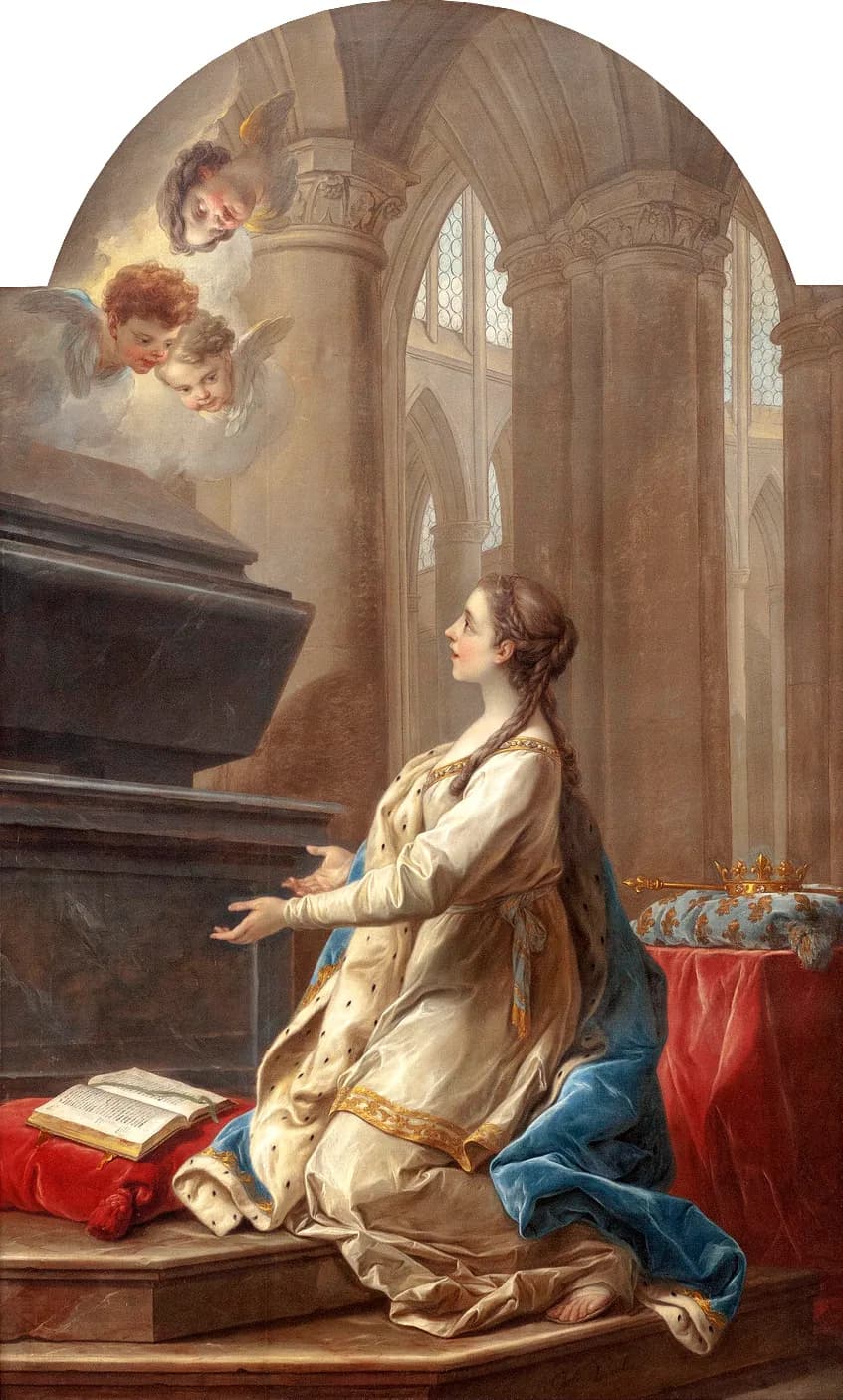
- Born
- Probably at Lyons, about 474, according to Kurth 1; Catholic Culture gives 475, and elsewhere about 470 5
- Children
- Ingomir, who died in infancy; Clodomir, Childebert and Clotaire, all kings; and a daughter, Clotilda 1
Saint Clotilde was the Burgundian princess who married Clovis, king of the Franks, and spent years trying to persuade him to become a Christian before he was baptized at Reims in 496. 12 The Catholic Encyclopedia calls her "the instrument in the conversion of a great people." 1 She outlived him by thirty-four years, and they were hard ones: one son killed in battle, two grandsons murdered by their own uncles, and her surviving sons at war with each other. 1 She spent most of them at Tours, near the tomb of Saint Martin, and died there in 545. 13
A Burgundian princess
Clotilde was the daughter of Chilperic, who reigned over part of the Burgundian kingdom from Lyons, and his wife Caretena; Godefroid Kurth, writing in the 1908 Catholic Encyclopedia, thinks she was probably born there about 474. 1 Her father was a Catholic, and her uncle Gundobad an Arian. 1 Her mother gave her a religious training, and her sister became a nun. 13
Gregory of Tours, writing his History of the Franks in the following century, tells a darker story: Gundobad killed Chilperic "with the sword, and sank his wife in water with a stone tied to her neck." 3 Butler repeats it. 4 Kurth does not believe it. Gundobad lamented Chilperic's death, he points out, and Caretena lived until 506, dying, her epitaph says, "full of days." 1 The marriage became a theme of Frankish epic poetry, which also sent Clovis's friend Aurelian to her disguised as a beggar with a gold ring, and the chroniclers, Gregory among them, took in the altered versions. 1 Kurth calls the details "purely legendary." 1 Clovis asked for her hand soon after her father died, and they were married in 492 or 493. 12 Butler places the wedding at Soissons in 493. 4
The God of Clotilde
She was a Catholic married to a pagan, and she argued with him. Gregory gives her a long speech against gods who "are graven out of stone or wood or some metal." 3 Clovis let her have their first son baptized. 13 The child, Ingomir, died still in his white baptismal robes, and the king blamed her: dedicated to his gods, he said, the boy would have lived. 3 Gregory has her answer that she was not "stricken with grief for his sake," because the child had been taken into God's kingdom. 3
She had their second son, Clodomir, baptized as well, and when he fell ill the king expected him to die like his brother. 3 He recovered, and Gregory credits "the prayers of his mother." 3 Kurth draws a large conclusion from it: with the king's heirs baptized, "the future of Catholicism was already assured in the Frankish Kingdom." 1
Clovis himself held out until a battle against the Alemanni, the one Kurth notes has "without apparent reason" been called the battle of Tolbiac. 2 With his army close to breaking, Gregory writes, he cried out to "Jesus Christ, whom Clotilda asserts to be the son of the living God," and promised to be baptized if he won. 3 He won, and told the queen how it had happened. 3 Gregory says it was Clotilde who then asked Remigius, bishop of Reims, to meet the king in secret and instruct him. 3 Clovis was baptized at Reims by Remigius at Christmas 496, with three thousand of his warriors. 2
For the fifteenth centenary of that baptism in 1996, John Paul II told the French president at Tours, "During my journey, I will recall in Reims the figures of St. Remigius, St Clotilde and Clovis." 7 His Reims homily, published in French, names her first among those whose witness Clovis had long reflected on. 8
Queen and widow
She bore Clovis five children: Ingomir, the three kings Clodomir, Childebert and Clotaire, and a daughter named Clotilda after her. 1 Little is known of her during the rest of the reign. 1 Clovis died at Paris in 511 and was buried in the church of the Apostles, later called Sainte-Geneviève. 12 Gregory says the king built it "together with his queen Clotilda," and Kurth's article on her agrees, adding that she was left to finish it; his article on Clovis calls it a foundation "undoubtedly due to Clovis," and Butler says it was built at her request. 1234
Her son Clodomir went to war against the Burgundian king Sigismund, captured him and had him killed with his wife and children; Clodomir was himself killed in battle at Vézeronce in 524. 13 Gregory says Clotilde had urged her sons into that war to "avenge with a wise zeal the death of my father and mother." 3 Kurth calls this the legend "cruelly defaming the memory of Clotilda," since in his reading she had no parents' deaths to avenge and had probably helped bring about the alliance with Gundobad. 1 Both accounts agree that she took Clodomir's three small sons, Theodoald, Gunther and Clodoald, into her care. 13
The scissors and the sword
Childebert, seeing that his mother loved the boys and fearing she would make them kings, sent for his brother Clothar, and the two asked her to send the children to them to be raised to the throne. 3 "And she rejoiced, not knowing their treachery." 3 Once the boys were seized, the brothers sent a man named Arcadius to her with a pair of scissors and a naked sword, and asked whether the boys should live with their hair shorn, like common people, or die. 3
Gregory reports her answer as words spoken by a woman "not knowing in her grief what she was saying": "It is better for me to see them dead rather than shorn, if they are not raised to the kingship." 3 Arcadius did not wait for her to think better of it. 3 In Gregory's telling, Clothar stabbed the older boy; the younger threw himself at Childebert's knees, Childebert begged for his life in tears, and then, threatened, gave him up. 3 They were ten and seven. 3 She followed their bodies to the church of Saint Peter and buried them side by side. 3 The third boy, Clodoald, was rescued and later became a priest; Kurth adds that Saint-Cloud, near Paris, bears his name. 13
The other accounts are shorter and do not agree on who struck the blows. Kurth writes that Childebert and Clotaire slew the two eldest; Butler, that the murder was "committed in 526, by their uncles Childebert and Clotaire"; and Catholic Culture, quoting the Bunsons' encyclopedia of saints, that Clotaire killed two of his nephews. 145
At the tomb of Saint Martin
Kurth writes that her grief made Paris unbearable and that she withdrew to Tours, near the tomb of Saint Martin, to whom she was devoted. 1 Gregory places the move earlier, straight after Clovis's death, and says she "rarely" visited Paris afterward. 3 He describes her as "always diligent in alms," able to keep watch all night, and generous to churches and monasteries, "so that she was believed to serve God diligently, not as a queen but as his own handmaid." 3
Her daughter, married to the Visigothic king Amalaric, was so badly treated that she appealed to her brother Childebert, who defeated and killed Amalaric; she died on the journey home. 12 Later Childebert turned on Clotaire, who was trapped with his army in the forest of Brotonne in Normandy. 1 Kurth, following Gregory, says Clotilde spent the whole night in tears at Saint Martin's tomb asking that there be no fratricide in the family of Clovis, and that a sudden storm scattered both armies before they could fight. 13
Butler says that in her last illness she called Childebert and Clotaire to her and urged them to honor God, protect the poor and live at peace with each other. 4 She died at Tours on June 3, 545, and was buried in Paris in the church of the Apostles, beside her husband and children, according to Kurth. 1 Butler says it was at the feet of Saint Genevieve. 4
What is Saint Clotilde the patron saint of?
None of the sources used here names a patronage for Saint Clotilde, so this profile claims none. 1456 The encyclopedia describes her in terms of history rather than patronage: with the baptism of Clovis, Kurth writes, she "accomplished the mission assigned her by Providence." 1 Patronages found on other sites are not repeated here, because this library does not supply what its sources will not.
Saint Clotilde's feast day
Her feast is June 3, the day of her death. 14 Butler notes that the Roman Martyrology commemorates her on that day, and Catholic Culture lists her among its commemorations. 45 Vatican News includes "St. Clotilda, Queen of the Franks" among the saints of June 3, after the Uganda martyrs, whose memorial falls that day. 6
Praying with Saint Clotilde
The conversion of Clovis is usually told as a battlefield moment, and Gregory tells it that way. 3 Behind it, in his own account, are years of argument at home, a first son buried in his baptismal robes and a husband who blamed her for it, and a second baptism she insisted on anyway. 3 When Clovis finally prayed, he called on Christ as the one "whom Clotilda asserts" to be the Son of God. 3
Her widowhood does not resolve into a lesson. Gregory reports that, when her grandsons' lives were put to her as a choice, she said something she could not take back, and that the men who heard it made use of it. 3 He also reports that she buried the two boys herself. 3
What the sources describe afterward is a woman living near a saint's tomb at Tours, giving away what she had and keeping watch through the night, more, as Kurth puts it, "as a religious than as a queen." 13 When her sons went to war against each other, the account Kurth takes from Gregory has her praying until morning that the family be spared another killing. 1 For John Paul II in 1996 she stood at the beginning of Christian France, beside Remigius. 78
Saint Clotilde, pray for us.
Sources
- 1.Godefroid Kurth, "St. Clotilda," The Catholic Encyclopedia, Vol. 4 (New York: Robert Appleton Company, 1908).
- 2.Godefroid Kurth, "Clovis," The Catholic Encyclopedia, Vol. 4 (New York: Robert Appleton Company, 1908).
- 3.Gregory of Tours, History of the Franks, Books II-IV, trans. Earnest Brehaut (New York: Columbia University Press, 1916), Internet Medieval Sourcebook, Fordham University.
- 4.Alban Butler, "St. Clotildis or Clotilda, Queen of France," The Lives of the Fathers, Martyrs and Other Principal Saints, Vol. 6 (D. & J. Sadlier, 1864), EWTN Library.
- 5."St. Clotilde," Liturgical Year calendar for June 3, 2025, Catholic Culture, with an excerpt from Our Sunday Visitor's Encyclopedia of Saints by Matthew, Margaret and Stephen Bunson.
- 6."03 June," Saint of the Day, Vatican News.
- 7.John Paul II, Address at the meeting with Mr. Jacques Chirac, President of the Republic, Tours, September 19, 1996.
- 8.John Paul II, Homily at the Mass for the fifteenth centenary of the baptism of Clovis, Reims, September 22, 1996 (French text).
Saints to turn to next
Others in this collection who are turned to for some of the same things.
- Saint Elizabeth Ann SetonAugust 28, 1774 - January 4, 1821ParentingMarriage and familyConversion
- Saint EustaceMartyred at Rome, in 118 by tradition; other accounts give 140 or 188ConversionMarriage and familySuffering and illness
- Saint Gianna Beretta MollaOctober 4, 1922 - April 28, 1962Marriage and familyParentingSuffering and illness
- Saint Joachima de Vedruna1783 - 1854Marriage and familySuffering and illnessParenting