Saint Zeno of Verona
d. c. 380
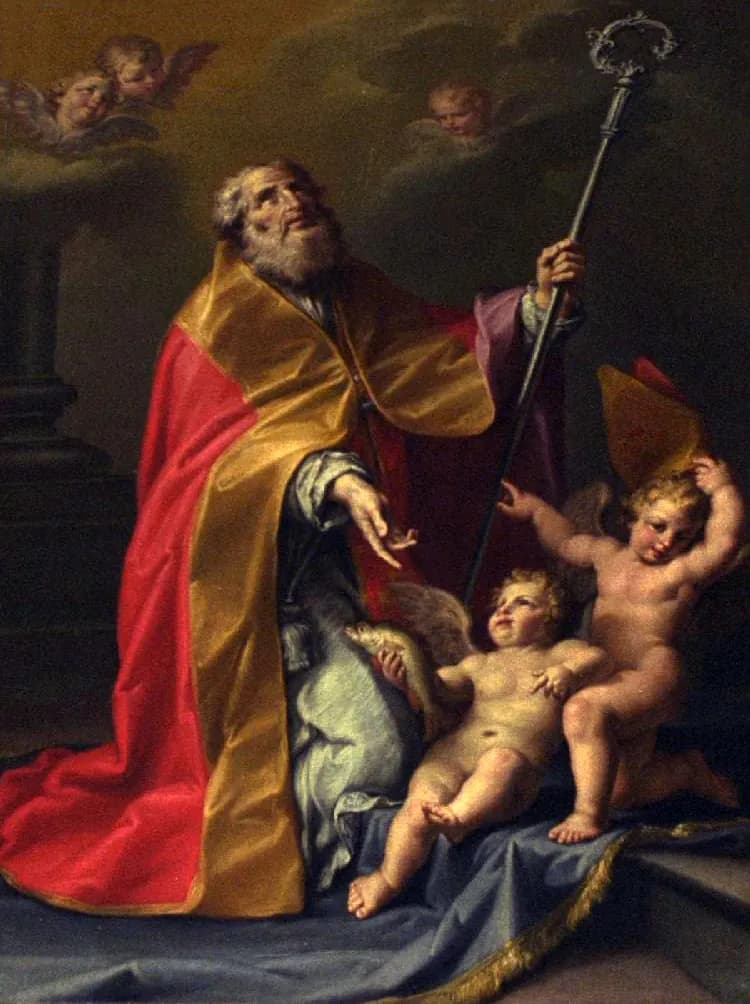
Saint Zeno of Verona was an African who became the eighth bishop of Verona in 362 and spent the rest of his life preaching there against paganism and the Arian heresy. 13 About ninety of his sermons survive, though nobody knew he had written anything until they were printed in 1508. 1 Verona keeps his body in the basilica that bears his name and calls him its principal patron. 37 The Roman Martyrology enters him on April 12. 4
An African in Verona
Almost everything known about Zeno comes from his own sermons. The Diocese of Verona says so plainly: the surest facts of his life are drawn from the discourses that have come down to us. 3 It is from their style, and from their memories of famous Africans, that scholars concluded he came from Roman Africa. 3 Alban Butler notes that others had guessed from his name that he was a Greek. 2
The Diocese of Pistoia, whose cathedral is dedicated to him, passes on what his hagiography adds: that he may have been born at Caesarea in Mauretania, that he left Africa in the company of Saint Athanasius, the exiled patriarch of Alexandria, and that he settled at Verona at the invitation of its bishop, Lucillus. 5
One date is firm. Verona calls December 8, 362, the day of his consecration as bishop, the most certain date of his life. 3 Julian the Apostate was emperor, and paganism was enjoying a brief revival. 23 The lists of the early bishops of Verona make Zeno the eighth. 18
Pagans, Arians and a new church
Francis Mershman, in the 1913 Catholic Encyclopedia, sums up what the sermons show: "an able speaker, and an untiring champion of Christianity against the heathens and of orthodoxy against the Arians." 1 Butler fills in the detail. Every year Zeno baptized a great number of converts from idolatry. The Arians had been strengthened in northern Italy by the favor of the emperor Constantius, and Zeno preached against them steadily. 2 The encyclopedia's article on Verona observes that his sermons show "how deeply paganism was still rooted in Verona in his time, particularly in the country districts." 8
It cost him something. The Diocese of Verona says he suffered much for the faith, opposed and beaten by Arians and by pagans alike. 3
His flock grew so large that he had to build a great church, and the rich citizens of Verona paid for it willingly. 2 He trained clergy for the altar, ordained at Easter, and at Easter also solemnly reconciled penitents. 2 Saint Ambrose, writing to Zeno's successor Syagrius, mentions women at Verona whom Zeno had consecrated as virgins. Some lived in their own homes and others in a monastery, which Butler thinks Zeno founded before Ambrose had established any at Milan. 2
He also scolded. The love-feasts held at the tombs of the martyrs had turned into occasions for drinking, and he preached warmly against them. He rebuked mourners whose loud grief interrupted the prayers the Church offered for their dead. 2
The alms of Verona
The sermon Butler dwells on longest is about money. Under Zeno, he says, the people of Verona became so generous that their houses stood open to poor strangers and none of their own neighbors had to ask for help. 2 Zeno congratulated them from the pulpit: "For what can be richer than a man to whom God is pleased to acknowledge himself debtor?" 2
In 378 the Goths destroyed a Roman army at Adrianople and carried off great numbers of captives from the neighboring provinces. Butler believes it was then that the charity of Verona reached far beyond the city, ransoming many from slavery and saving others from death or hard labor. 2 Of the bishop he adds one short sentence: "St. Zeno himself lived in great poverty." 2
Martyr or confessor?
For centuries the Roman Martyrology entered Zeno as a bishop of Verona martyred under the emperor Gallienus, who reigned a hundred years before him. 1 A ninth-century Veronese poem says the same. The encyclopedia's verdict is that "the legend had corrupted chronology," since the old documents know only one bishop of that name and he was a contemporary of Ambrose. 8 Mershman concludes: "Probably, however, he was a confessor." 1
The evidence is Ambrose himself, who speaks of Zeno as a bishop of holy memory and of his happy death. 12 Pope Saint Gregory the Great did call him a martyr, and Butler and the Diocese of Verona explain the word the same way: he had suffered enough at the hands of pagans and heretics to earn it, though he died in peace. 23 The Martyrology as it is printed today calls him simply a bishop, by whose labors and preaching the city was brought to the baptism of Christ. 4
He died on April 12. Both encyclopedia articles and Butler give the year as 380. 128 The Diocese of Verona says scholars place it anywhere between 372 and 380, and the Diocese of Pistoia says about 373. 35
Sermons lost for a thousand years
Neither Saint Jerome nor Gennadius lists Zeno among Christian writers. 1 He was not known as an author at all until 1508, when two Dominicans, Albertus Castellanus and Jacobus de Leuco, published at Venice 105 sermons that had been found in the bishop's library at Verona fifty years before. 1 The Ballerini brothers edited them again in 1739. Twelve have since been assigned to other authors. Of the ninety-three that remain, sixteen are full-length and the rest are sketches or perhaps fragments. 13
They "contain valuable material on Catholic doctrine, practice, and liturgy," the encyclopedia says, and range over creation, the Blessed Virgin, Scripture, the Church and the sacraments. 1 The Diocese of Verona quotes one addressed to people about to be baptized, telling them that the warmth of the eternal font is already calling and that Mother Church already knows them as her children. 9 Verona counts him among the Fathers of the Church. 3
The flood at the church door
The first church to bear his name was built over his tomb on the bank of the Adige, outside the walls. 2 Gregory the Great tells what happened there two centuries later, on the word of an eyewitness. The Adige flooded Verona, the people crowded into Zeno's church, and the water rose as high as the windows without coming through the open doors. It "stood like a firm wall," in Butler's retelling, for twenty-four hours while the people prayed inside. 26 Butler and one Pistoia page date the flood to 589; the other says 588. 256
His relics were later moved into a larger church. The Diocese of Verona dates the translation to 807 and keeps its anniversary on May 21. 3 The present basilica dates from the eleventh century. Its bronze doors are worked with scenes from his life, and its altarpiece is by Mantegna. 8 Inside sits a statue in red Verona marble from about 1300 that the Veronese call San Zen che ride, laughing Saint Zeno, for the expression on its face. 9
What is Saint Zeno of Verona the patron saint of?
Saint Zeno of Verona is the principal patron of the city and diocese of Verona. 37 The diocese counts forty churches dedicated to him. 3
He is also invoked as the protector of freshwater fishermen. The Diocese of Pistoia explains that artists show him as a bishop with a fish, often hanging from a hook on his crozier, and that his legend describes a humble man who caught his own supper in the Adige. 5 Because of the miracle Gregory records, towns beside rivers and lakes took him as their patron against floods. Pistoia, often flooded itself, put his name on its cathedral, where it appears from 923. 56 The same page adds a homelier custom: parents ask his help for small children who are slow to talk or to walk. 5
Saint Zeno of Verona's feast day
Saint Zeno of Verona's feast day is April 12. The Roman Martyrology enters him on that date, Butler gives it as the day he died, and Pistoia keeps it as a solemnity in its cathedral. 246 In Verona the feast was kept on April 12 until 2004. Since then the diocese has celebrated its patron on May 21, the anniversary of the translation of his relics. 3
The encyclopedia and Butler say Verona once commemorated his consecration on December 6; the diocese now dates it to December 8. 123
Praying with Saint Zeno of Verona
What survives of Zeno is his preaching, and the preaching is practical. He had a city only half converted, a heresy with imperial backing, and a congregation that drank too much at the martyrs' tombs. 28 He dealt with all of it from the pulpit, year after year, and at Easter he baptized whoever had come that far. 2
John Paul II, speaking to catechists in Zeno's basilica, picked out one complaint of his that has not dated. Zeno described half-hearted believers as people who cannot be called faithful, because there is unbelief in them, nor unbelievers, because there is a shadow of faith in them: they serve God with their words and the world with their deeds. 7 The pope drew a conclusion for those who teach the faith: do not lose heart and do not put up barriers, but meet such people with the compassion of the Good Shepherd. 7
Butler translated the close of his sermon on patience, a prayer addressed to the virtue itself. It ends with a wish to praise patience "by my life and manners more than by my words." 2 Butler pairs it with the remark that the bishop who taught Verona to give lived poor himself. 2
Verona did not remember him as stern. A Life written by a notary named Coronatus in Lombard or Carolingian times, which the diocese still quotes, says he was so gentle in speech and bearing that people praised God on meeting him, and the statue in his basilica shows a bishop who is nearly laughing. 9 The diocese calls him a shepherd and a fisher of men. 9
Saint Zeno of Verona, pray for us.
Sources
- 1.Francis Mershman, "St. Zeno," The Catholic Encyclopedia, Vol. 15 (New York: Robert Appleton Company, 1912).
- 2.Alban Butler, "St. Zeno, Bishop of Verona, Confessor," The Lives of the Fathers, Martyrs and Other Principal Saints, Vol. 4 (New York: D. & J. Sadlier, 1864), as published by EWTN.
- 3."Zeno (362-380 ca.)," Archivio Storico della Curia Diocesana di Verona, Diocese of Verona (in Italian).
- 4.Roman Martyrology, entry for April 12, "San Zeno, vescovo," as printed in "Santo del giorno," Conferenza Episcopale Italiana (in Italian).
- 5."San Zeno," Diocesi di Pistoia (in Italian).
- 6."San Zeno: dall'Africa a Verona a Pistoia," Diocesi di Pistoia (in Italian).
- 7.John Paul II, Homily at Mass in the Basilica of San Zeno, Verona, April 17, 1988 (in Italian).
- 8.Umberto Benigni, "Verona," The Catholic Encyclopedia, Vol. 15 (New York: Robert Appleton Company, 1912).
- 9."San Zen che ride, scultore veronese, inizio sec. XIV, Basilica di San Zeno, Verona," Diocese of Verona, materials for the visit of Pope Francis, 2024 (in Italian).
Saints to turn to next
Others in this collection who are turned to for some of the same things.
- Saint Alexander Sauli1533 or 1534 - October 11, 1592Poverty and simplicityStudy and teaching
- Saint Anthony the Abbotc. 251 - c. 356Poverty and simplicityProtection
- Saint Antoninus of FlorenceMarch 1, 1389 - May 2, 1459Poverty and simplicityStudy and teaching
- Saint Brigid of Kildare451 or 452 - February 1, 525Study and teachingPoverty and simplicity