Saint Anthony the Abbot
c. 251 - c. 356
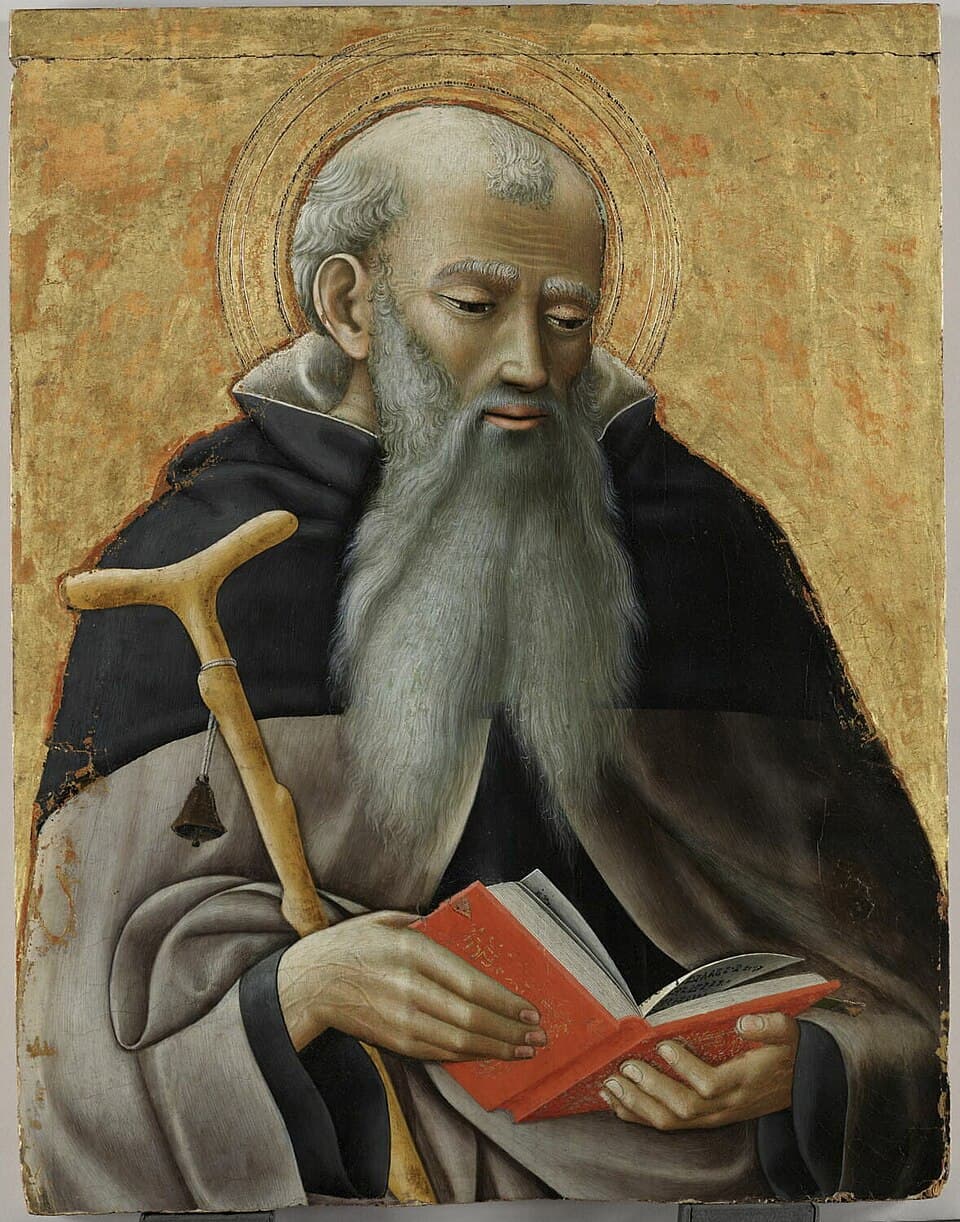
- Patron saint of
- Butchers, gravediggers and skin diseases, per Franciscan Media 5; Vatican News calls him "protector of animals" 4
Saint Anthony the Abbot was the son of well-to-do Christian parents in Egypt who heard one sentence of the Gospel read aloud in church, gave away three hundred acres of good land, and spent the rest of a very long life in the desert. 2 The 1913 Catholic Encyclopedia calls him the founder of Christian monasticism and judges that few names have had an influence on the human race "more deep and lasting." 1 He is not Saint Anthony of Padua, the medieval Franciscan friar invoked for lost things. This is the desert hermit also called Anthony of Egypt, whose feast falls on January 17. 45
One sentence in church
He was born at Coma, near Heracleopolis Magna, about the middle of the third century. 1 Vatican News gives about 250 and Franciscan Media 251. 45 His parents died when he was about eighteen or twenty, leaving him responsible for the house and for one younger sister. 2 Athanasius, who wrote his life, says that as a boy he "could not endure to learn letters," and Butler adds that he never learned Greek and spoke only Coptic. 12
Less than six months after his parents' deaths, walking to church, he was turning over in his mind how the Apostles had left everything to follow Christ. He went in as the Gospel was being read, and heard: "If you would be perfect, go and sell that you have and give to the poor." 2 He took it as said to him personally. He gave the family land, three hundred acres, to the villagers, sold the rest of the property, and gave the money to the poor, keeping back a little for his sister. 2 Shortly afterward, hearing "be not anxious for the morrow" in church, he gave that away too, and placed his sister with a community of consecrated virgins. 2
Franciscan Media points out the obvious comparison with Francis of Assisi, and the obvious difference: most of Anthony's life was spent alone. 5
Learning from the old men
There was no desert monasticism yet to join. Butler explains that Christians had long practiced asceticism inside their own families, and that by about 270, when Anthony withdrew, Egyptian ascetics lived in huts on the edges of towns and villages. 1 He worked with his hands, spending part of what he earned on bread and giving part to the needy, and he prayed constantly; he listened so closely to Scripture that his memory, Athanasius says, "served him for books." 2
He also went looking for teachers. Whenever he heard of a holy man nearby he went to find him, "like the prudent bee," and studied what each did best: the prayer of one, the freedom from anger of another, the fasting of a third. 2 Then he moved into one of the tombs outside his village, where the Life records violent conflicts with demons in the shape of wild beasts that beat him and sometimes left him nearly dead. 1
Twenty years in a fort
After fifteen years of this, at about thirty-five, he crossed the Nile to a mountain called Pispir, shut himself into an abandoned fort, and lived there for twenty years without seeing anyone, his food thrown to him over the wall. 1 Would-be disciples settled in caves and huts around the mountain and begged him to come out and guide them. 1 Eventually, around 305 by Butler's reckoning, they broke the door down. 12 Franciscan Media puts it at fifty-four, which on its own dates is the same year. 5
The people waiting outside were surprised by what they saw. Athanasius says he was "neither fat, like a man without exercise, nor lean from fasting," and that his soul was "neither contracted as if by grief, nor relaxed by pleasure." 2 For five or six years he instructed and organized the monks who had gathered, and then withdrew again, this time into the inner desert near the Red Sea, to the mountain where, Butler wrote in 1907, the monastery bearing his name, Der Mar Antonios, still stood. 1 He lived there for his last forty-five years, though he received visitors freely and often crossed back to Pispir. 1
Two journeys to Alexandria
He left the desert for the city twice. 1 The first time was during the persecution of 311, and he went hoping to die a martyr. 15 He did not give himself up; instead he ministered to the confessors in the mines and the prisons. When the judge ordered every monk out of the city, Anthony washed his garment and stood the next day on a raised place where the governor would pass. 2 The governor saw him and passed by, and Athanasius says he seemed "as one grieved that he had not borne his witness." 2
The second visit came near the end of his life, to preach against the Arians. Butler dates it to about 350. 1 Franciscan Media has him fighting the Arian heresy at eighty-eight. 5 Benedict XVI, in his audience on Athanasius, calls Anthony "the most important champion of St Athanasius' faith." 3
A founder, with qualifications
Butler is careful about the title. Anthony was probably not the first Christian hermit, and he was not a legislator and organizer of monks the way his younger contemporary Pachomius was. 1 Yet from the middle of the fourth century, in Egypt and elsewhere, even Pachomius's own monks regarded Anthony as "the founder and father of Christian monachism." 1 The life that grew up around him was semi-eremitical, with monks living in separate cells and gathering only occasionally for worship; in the West, Butler names the Carthusians as its nearest descendants. 1
Butler counts the sermons and twenty epistles under his name as spurious, leaves seven letters undecided, and accepts one Greek letter to Theodore. 1 The most reliable record of his teaching is the long discourse in the Life, in which, Butler says, the warfare with demons occupies the chief place. 1 Butler also passes on a remark from Cassian: Anthony held that of all the virtues, discretion was the most essential. 1 He quotes John Henry Newman as well, who found Anthony's temper "without cowardice, without gloom, without formality, without self-complacency." 1
His death, and the book that followed
Knowing his end was near, he made a last visit to the monks at the outer mountain and told them he was "near a hundred and five years old." 2 His parting advice was to "live as though dying daily." 2 He asked the two disciples who had cared for him in his old age to bury him in secret, so that no one could make a shrine of his body, and to give one sheepskin to Bishop Athanasius and the other to Bishop Serapion. 2 They did, and the grave stayed hidden. 12 Jerome places the death in 356-357, and Butler is candid that the whole chronology of the life rests on that date and the Life's figures being right. 1
Athanasius wrote the Life of Anthony shortly afterward, while he was himself in exile among the monks of the Egyptian desert. 3 Benedict XVI calls it "the bestseller of early Christian literature." 3 It was translated almost at once into Latin and then into several Eastern languages, and it did much to spread monasticism in both East and West; Augustine placed a story of two officials converted by reading it into his Confessions, just before the account of his own conversion. 3
What is Saint Anthony the Abbot the patron saint of?
Franciscan Media lists Saint Anthony the Abbot as patron of butchers, gravediggers and skin diseases. 5 Vatican News calls him the "protector of animals," and notes that on his feast day stalls are blessed, along with any domestic animals brought for blessing. 4
The pig that so often stands beside him in paintings gets two explanations. Vatican News connects it with the Antonines, a hospitaller order who raised pigs because the fat was used to anoint the sick suffering from ergotism, a disease then called "the fire of Sant'Antonio." 4 Franciscan Media reads the pig as a symbol of the devil he fought, and the T-shaped cross as the means of his power over evil spirits. 5 Vatican News identifies that staff as the tau, the last letter of the Hebrew alphabet. 4
Saint Anthony the Abbot's feast day
Praying with Saint Anthony the Abbot
Anthony is the clearest case in the tradition of someone who heard a Gospel sentence and simply did what it said. 2 Most people who pray with him are not going to give away their land. What his life shows is what happens when a single line is allowed its full weight, and how much of the rest of his story followed from one morning in a village church.
He did not do it alone, or not at first. He went from one holy neighbor to another, taking from each the thing that person did best. 2 His own word for the quality that held it together, as Cassian reports it, was discretion, and Newman's portrait is of a man without gloom. 1 The Life says the same in its own way: he was recognizable in a crowd of monks because "his soul was at peace" and "his mind was joyous." 2
Some of his story does not resolve neatly. He went to Alexandria wanting to die for Christ and came home alive, apparently grieved by it. 2 He spent two decades behind a wall and was then pulled out by people who needed him. 1 Neither is offered here as a lesson. They are what happened, and he seems to have accepted both.
He wanted no shrine and arranged for his grave to be lost. 2 Athanasius saw the irony and wrote at the end of the Life that, even if such people "wish to remain in obscurity, yet the Lord shows them as lamps to lighten all." 2 The animals brought to be blessed on January 17 are a part of that. 4
Saint Anthony the Abbot, pray for us.
Sources
- 1.Edward Cuthbert Butler, "St. Anthony," The Catholic Encyclopedia, Vol. 1 (New York: Robert Appleton Company, 1907).
- 2.Athanasius of Alexandria, Life of Antony, trans. H. Ellershaw, Nicene and Post-Nicene Fathers, Second Series, Vol. 4 (Buffalo, NY: Christian Literature Publishing Co., 1892), via New Advent.
- 3.Benedict XVI, General Audience of 20 June 2007 (Libreria Editrice Vaticana).
- 4."St. Antony, Abbot," Saint of the Day, Vatican News.
- 5."Saint Anthony of Egypt," Saint of the Day, Franciscan Media.
Saints to turn to next
Others in this collection who are turned to for some of the same things.
- Saint Gilesc. 650 - early 8th centuryPoverty and simplicityProtectionPrayer
- Saint Francis of Assisic. 1181 - October 3, 1226Poverty and simplicityPrayer
- Saint Teresa of CalcuttaAugust 26, 1910 - September 5, 1997Poverty and simplicityPrayer
- Saint Anthony of Paduac. 1195 - June 13, 1231Poverty and simplicityPrayer