Saint Giles
c. 650 - early 8th century
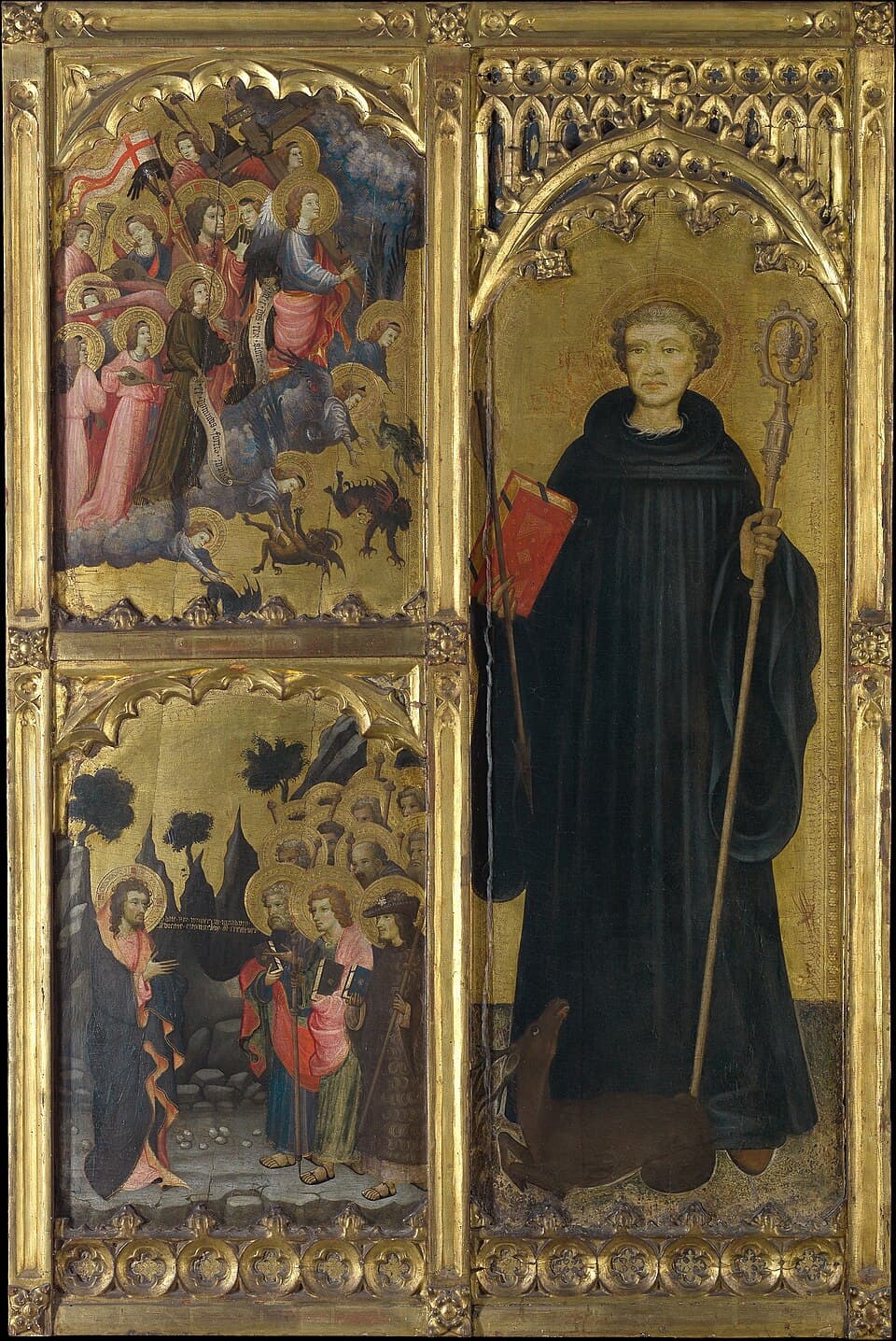
- Patron saint of
- Beggars, the poor, the disabled, and those caught in disasters, per Franciscan Media 2
- Feast day
- September 1. Murphy: "His feast is kept on 1 September" 1
- Died
- In his own monastery in the valley near Nimes, early in the eighth century 1
- His symbol
- A hind. Murphy: in medieval art he is "always depicted" with it 1
- One of the Fourteen
- The only Holy Helper who was not a martyr, per Franciscan Media 2
Saint Giles left home because people admired him too much. 1 He crossed from his native country to Gaul, was found out twice, and finally hid in a forest near Nimes where his only companion for years was a deer. 1 A king's hunting party tracked the deer to his cave, and that is how the most popular saint of the Middle Ages was discovered. 1
Running away from a reputation
The sources do not agree on where he started. Murphy says he was "said to have been born of illustrious Athenian parentage about the middle of the seventh century" - note the hedge, which is his, not ours. 1 Franciscan Media, granting that "much about Saint Giles is shrouded in mystery", says "Likely, he was born in the first half of the seventh century in southeastern France." 2 Athens or Provence. This page reports both and settles neither.
What both agree on is the shape of his life, and it begins with an unusual motive. Murphy: "Early in life he devoted himself exclusively to spiritual things, but, finding his noble birth and high repute for sanctity in his native land an obstacle to his perfection, he passed over to Gaul." 1 He emigrated because he was too well thought of at home.
It did not work the first time. He settled in a wilderness near the mouth of the Rhone, then by the river Gard, "but here again the fame of his sanctity drew multitudes to him." 1 So he went further: "he withdrew to a dense forest near Nimes, where in the greatest solitude he spent many years, his sole companion being a hind." 1
The hunters
The solitude ended the way such things do. "This last retreat was finally discovered by the king's hunters, who had pursued the hind to its place of refuge." 1 They were chasing his deer and found a man.
Murphy identifies the king and then, in the same sentence, refuses to. The bracket is worth quoting whole, because it is a small lesson in how to read a saint's life: the king "[who according to the legend was Wamba (or Flavius?), King of the Visigoths, but who must have been a Frank, since the Franks had expelled the Visigoths from the neighbourhood of Nimes almost a century and a half earlier]". 1 The legend names a man who could not have been there.
Whoever he was, he "conceived a high esteem for the solitary, and would have heaped every honour upon him; but the humility of the saint was proof against all temptations." 1 Giles had crossed a sea to escape exactly this. He did not take the honors.
He did make one concession: "He consented, however, to receive thenceforth some disciples, and built a monastery in his valley, which he placed under the rule of St. Benedict." 1 The man who had fled two reputations founded a house and accepted the responsibility of it, and died there "in the early part of the eighth century, with the highest repute for sanctity and miracles." 1
How large he became
The scale of his cult is hard to credit for a hermit nobody can place. Murphy measures it three ways: by "the numberless churches and monasteries dedicated to him in France, Germany, Poland, Hungary, and the British Isles"; by "the numerous manuscripts in prose and verse commemorating his virtues and miracles"; and "especially by the vast concourse of pilgrims who from all Europe flocked to his shrine." 1
The monastery sat on the road. Franciscan Media explains the mechanism: it "became a popular stopping-off point for pilgrims making their way to Compostela in Spain, and the Holy Land." 2 Everybody walking to Santiago went past his door.
The traces are still on the map. A town, St-Gilles, grew up around the abbey, and Murphy counts "nineteen other cities" bearing his name. 1 Relics were claimed at Toulouse, Antwerp, Bruges, Tournai, Cologne, Bamberg, Prague, Rome and Bologna. 1 In England, Franciscan Media notes, "many ancient churches and hospitals were dedicated to Saint Giles", and a quarter of Brussels carries his name. 2
And in Germany he was numbered among the Fourteen Holy Helpers, the group invoked "especially for recovery from disease, and for strength at the hour of death", alongside Christopher, Barbara and Blaise. 2 Franciscan Media adds the detail that sets him apart from all of them: "Interestingly, Giles was the only non-martyr among them." 2 Thirteen violent deaths and one old abbot.
The shrine, emptied and refilled
It did not last. In 1562, Murphy records, the relics "were secretly transferred to Toulouse to save them from the hideous excesses of the Huguenots who were then ravaging France, and the pilgrimage in consequence declined." 1 Franciscan Media says simply that "the pilgrimage center that once drew so many fell into disrepair some centuries after Giles' death." 2
Three hundred years later it came back. "With the restoration of a great part of the relics to the church of St. Giles in 1862, and the discovery of his former tomb there in 1865, the pilgrimages have recommenced." 1 Murphy is writing forty-odd years after that recovery, and the tense he uses - have recommenced - is that of a man describing something going on in his own time.
What is Saint Giles the patron saint of?
Saint Giles is the patron saint of beggars, of the poor, of people with disabilities, and of those caught in disasters. 2 Franciscan Media says he "was soon invoked as the patron of the poor and the disabled." 2
The patronage of the disabled is the best known and neither source explains it. A later tradition connects it to the hunt in the forest, but Murphy does not tell that story and this page will not supply it for him. 1 What can be said is that his shrine stood on the pilgrim roads, that hospitals across England were dedicated to him, and that the people who came to those hospitals were the poor, the lame and the ill. 12 A patronage can grow out of who actually turned up.
The hind stayed with him in art. Murphy: in medieval art "he is a frequent subject, being always depicted with his symbol, the hind." 1 A thousand years of altarpieces show an abbot with a deer at his knee, because of an animal that shared a cave with him.
Saint Giles's feast day
The feast of Saint Giles is September 1. Murphy states it outright, and Franciscan Media presents him on the same day. 12
Murphy adds a caution worth carrying. Two other men are commemorated on 1 September: "another St. Giles, an Italian hermit of the tenth century", and "a Blessed Giles, d. about 1203, a Cistercian abbot of Castaneda in the Diocese of Astorga, Spain." 1 Three Giles, one date. A reader tracing him in older calendars should be sure which one the entry means.
Praying with Saint Giles
His whole life is a single pattern repeated: he is admired, he leaves, he is found. Home, then the Rhone, then the Gard, then the deep forest - and each time the reputation caught up with him. 1 There is something almost comic about it, and something exact. A person who is genuinely trying to avoid being impressive is unusually difficult to stop being impressed by.
What he does at the end is the part that matters. When the king offered him honors he refused them, and then he accepted disciples and built a monastery. 1 Those are not the same thing, and the distinction is worth having. He would not take the prestige and he did take the work.
The hind is not decoration. For years his only company was an animal, and the hunt that ended his solitude was a hunt for it. 1 Anybody who has been alone for a long stretch and found that one living creature kept them tethered will recognize what the medieval artists were doing when they painted the deer leaning against his knee.
And then consider what he became: the most visited shrine on the road to Compostela, nineteen towns, hospitals across England, one of the Fourteen Holy Helpers - and the only one of those fourteen who was not killed for the faith. 12 A man who wanted nothing but to be left alone became, for five hundred years, one of the most sought-after saints in Europe. He would have hated it. The poor and the sick who came to his hospitals did not, and he is still their patron.
Saint Giles, pray for us.
Sources
Saints to turn to next
Others in this collection who are turned to for some of the same things.
- Saint Teresa of CalcuttaAugust 26, 1910 - September 5, 1997Poverty and simplicityPrayer
- Saint Anthony of Paduac. 1195 - June 13, 1231Poverty and simplicityPrayer
- Saint Benedict Joseph Labre1748 - April 16, 1783Poverty and simplicityPrayer
- Saint Louis de MontfortJanuary 31, 1673 - April 28, 1716PrayerPoverty and simplicity