Saint Brigid of Kildare
451 or 452 - February 1, 525
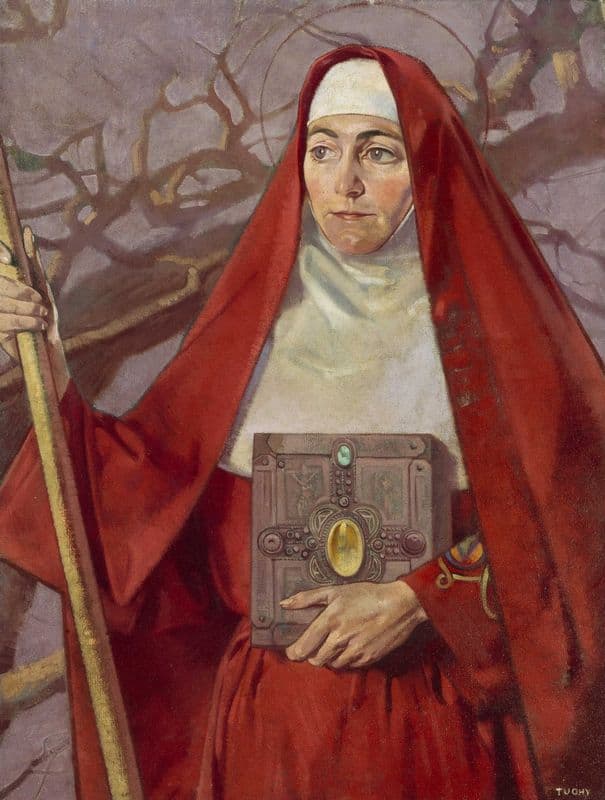
- Born
- 451 or 452, at Faughart, near Dundalk, County Louth 1
- Relics
- Taken to Downpatrick about 878; a hand kept at Lumiar, near Lisbon, since 1587 1
Saint Brigid founded Kildare, a monastery for women and for men that grew from an oratory under an oak tree into a cathedral city, and she is honored as a patroness of Ireland. 125 The 1913 Catholic Encyclopedia admits that her biographers are "exceedingly difficult to reconcile" and that legend has to be allowed for, but it holds that "the personality of the founder of Kildare stands out clearly." 1 Her feast is February 1. 14
Faughart, and a slave mother
The encyclopedia gives her birth as 451 or 452 at Faughart, near Dundalk in County Louth, "of princely ancestors." 1 It concedes that her early Lives are hard to square with one another, but notes that the Third, Fourth and Fifth Lives agree in giving her a slave mother at the court of her father, Dubhthach, a chieftain of Leinster. 1 Edward D'Alton, writing the encyclopedia's entry on her early biographer Cogitosus, is blunter: she was illegitimate, her mother was a slave, and Cogitosus, who names both parents, "is careful to conceal" it. 3 Of Faughart the encyclopedia says, "It seems certain" that it was her birthplace, and the old well of St. Brigid beside the ruined church there "still attracts pilgrims." 1
Vatican News, in an article for her feast in 2020, says she lived around the time of Saint Patrick and that "it was he who inspired her to convert to Christianity." 5 The encyclopedia does not describe a conversion. What it records is a friendship, attested by the eighth-century Book of Armagh: "Between St. Patrick and St. Brigid, the columns of the Irish, there was so great a friendship of charity that they had but one heart and one mind." 1
The church of the oak
She refused "many good offers of marriage" and became a nun, receiving the veil from Saint Macaille. 1 With seven other women she settled for a time at the foot of Croghan Hill, then moved to Druim Criadh on the plain of the Liffey, where "under a large oak tree" she built the convent of Cill-Dara, "the church of the oak," which is now Kildare. 1 John Healy, in the encyclopedia's article on the school that grew up there, describes the tree as "the stately oak-tree so much loved by St. Brigid." 2
Macaille gave her the veil, but the encyclopedia thinks it "tolerably certain" that she was professed by Saint Mel of Ardagh, who "also conferred on her abbatial powers," and it dates her journey with the two of them into Teffia, in Meath, to about 468. 1
Kildare became a double monastery, one house for women and one for men. 12 A community like that needed a bishop to consecrate its churches and ordain its clergy, so she chose an anchorite, Conleth, "to govern the church along with herself." 12 Both encyclopedia writers take pains over what that meant. She did not give him jurisdiction; Healy calls that "the absurd statement sometimes made," and says she selected him and he received his authority "in the ordinary way." 12 For centuries afterward Kildare was ruled by a double line of abbot-bishops and abbesses, and the annalists kept the succession of its abbesses in a column beside that of its abbots. 12
Kildare was not her only foundation. The encyclopedia finds "ample evidence" in the old collections of Irish lives for a stay in Connacht, especially in County Roscommon, and for "the many churches founded by her" in the Diocese of Elphin. 1 At Armagh, Patrick's own see, there was a small abbey church known as Regles Brigid, which held relics of her until they were destroyed in 1179. 1
A school, a book and a fire
She also founded a school of art at Kildare, taking in metalwork and illumination, with Conleth at its head. 12 Its scriptorium produced a book of the Gospels that Giraldus Cambrensis saw in the twelfth century and could not praise enough. He wrote of its interlaced ornament and "the harmony of the colours," and concluded that "all this is the work of angelic, and not human skill." 1 The book has been lost since the Reformation. 1
Cogitosus left a description of the church at Kildare as it stood in his day, which the encyclopedia calls "perhaps the most interesting feature" of his work. 1 Healy summarizes it: the church was spacious, divided strictly between men and women, and hung with paintings and embroidered hangings around richly ornamented windows and doors. 2 None of it survives except the Round Tower, which Healy gives as the tallest in Ireland at 136 feet. 2
Healy records one more thing kept at Kildare: a holy fire called "the inextinguishable," which "had probably been kept alight since the days of Brigid." 2 Henry de Londres, archbishop of Dublin, had it put out, and "perhaps thought the practice savoured of superstition." 2 Healy's own guess is that it began with her nuns keeping lamps burning before their founder's shrine. 2 The Bishop of Kildare lit it again, and it burned until the suppression of the monasteries under Elizabeth. 2
Her death and her relics
She died at Kildare on February 1, 525. 13 Saint Ninnidh, who brought her viaticum, was known ever after as "Ninnidh of the Clean Hand," because he had his right hand encased in metal so that nothing would defile it afterward. 1 She was buried to the right of the high altar of Kildare Cathedral, under a costly tomb that became a place of pilgrimage. 1
Around 878, during the Scandinavian raids, her relics were carried to Downpatrick and laid in the tomb of Saint Patrick and Saint Columba. 1 The relics of all three were found in 1185, and on June 9 of the following year they were moved to a new resting place in Downpatrick Cathedral, in the presence of Cardinal Vivian and fifteen bishops. 1 A hand said to be hers has been kept at Lumiar, near Lisbon, since 1587, and another relic at St. Martin's in Cologne. 1
How much of it is history
Her Lives were written long after her death. The encyclopedia thinks the oldest is probably a verse life in Irish by Saint Broccan Cloen. 1 Cogitosus, a monk of Kildare, wrote the Latin "Second Life"; Grattan-Flood places him in the eighth century, while D'Alton says it is "uncertain even in what century he lived" and thinks the beginning of the ninth the more likely. 13 D'Alton calls the work "a panegyric rather than a biography." It omits the date and place of her birth and the date of her death, and "narrates at length the many miracles she wrought." 3 Vatican News puts the same process more gently: her "generosity, courage, and compassion for the poor became legendary as Irish missionaries spread her story on their travels." 5
The encyclopedia's judgment is that "we must allow a large margin for the vivid Celtic imagination and the glosses of medieval writers," while still holding that the leading events of her life can be traced "with tolerable accuracy." 1 This page follows that line. The foundation, the school, the friendship with Patrick, the shrine and the feast rest on evidence the encyclopedia accepts. The many miracle stories told about her are not retold here.
Even her name has a small history. The encyclopedia heads its article "St. Brigid of Ireland," with the note "Incorrectly known as BRIDGET," and then spells it Bridget twice in the body of the same article. 1 It also records that Brigid became one of the most common Christian names for Irish women. 1
What is Saint Brigid the patron saint of?
Saint Brigid is a patroness of Ireland. The 1913 Catholic Encyclopedia calls her "the Patroness of Ireland," and Vatican News calls her the country's "second patron saint, after St Patrick." 15 The encyclopedia also names her "a patroness of students." 1 Pope Francis, speaking at Dublin Castle in 2018, listed her among the Irish saints whose names "are still revered throughout Europe and beyond." 6
Popular lists often add dairy workers, farmers or newborn babies. None of the sources consulted for this page says so, and it is not repeated here.
Saint Brigid's feast day
Her feast is February 1, the day of her death. 145 The feast is an old one: Cogitosus described crowds coming to her shrine at Kildare "from all the provinces of Erin," especially on her feast day. 12 Vatican News lists her on February 1 as "St. Brigid, Abbess in Ireland." 4 Before the Reformation she was commemorated in a number of Continental breviaries, and her name appears in a litany in the Stowe Missal. 1
Praying with Saint Brigid
Nearly everything certain about Brigid is something she built. A convent under an oak, a second house for men beside it, a school of metalwork and illumination, a church whose abbesses were listed next to its bishops for centuries. 12 The sources know her mostly through what she left at Kildare, and what she left was a community able to carry on without her.
She also knew where her part ended. A double monastery needed a bishop, and she went and found one and asked him to govern alongside her; his authority came to him from the Church, as both encyclopedia writers are careful to say. 12 Founding a work and then seeking out the people it needs is ordinary enough, and Kildare is what it looked like in the fifth century.
Her mother was a slave, and her first Latin biographer left that out. 3 The Church kept her feast anyway, a writer in the Leabhar Breac called her "the Mary of the Gael," and Ireland is full of places named for her: Kilbride, Brideswell, Tubberbride, Templebride. 1 A family history that others would rather not mention did not keep her from any of it.
The fire at Kildare was put out by one archbishop and lit again by a bishop, and it burned until the monasteries were closed. 2 Healy thought it began as nothing grander than lamps kept burning at her shrine by the women who came after her. 2 When the encyclopedia was written, in 1907, her old well at Faughart still drew pilgrims. 1
Saint Brigid of Kildare, pray for us.
Sources
- 1.William Grattan-Flood, "St. Brigid of Ireland," The Catholic Encyclopedia, Vol. 2 (New York: Robert Appleton Company, 1907).
- 2.John Healy, "School of Kildare," The Catholic Encyclopedia, Vol. 8 (New York: Robert Appleton Company, 1910).
- 3.Edward D'Alton, "Cogitosus," The Catholic Encyclopedia, Vol. 4 (New York: Robert Appleton Company, 1908).
- 4."St. Brigid, Abbess in Ireland," Saint of the Day, Vatican News.
- 5.Lydia O'Kane, "Chernobyl charity founder, Adi Roche on 'Trailblazer' St. Brigid," Vatican News, January 31, 2020.
- 6.Pope Francis, Address to Authorities, Civil Society and the Diplomatic Corps, Dublin Castle, August 25, 2018.
Saints to turn to next
Others in this collection who are turned to for some of the same things.
- Saint John Baptist de la SalleApril 30, 1651 - April 7, 1719Study and teachingWork and vocationPoverty and simplicity
- Saint John NeumannMarch 28, 1811 - January 5, 1860Study and teachingWork and vocationPoverty and simplicity
- Saint Thomas of Villanova1488 - September 8, 1555Poverty and simplicityWork and vocationStudy and teaching
- Saint Isidore of Sevillec. 560 - April 4, 636Study and teachingWork and vocation