Saint John Baptist de la Salle
April 30, 1651 - April 7, 1719
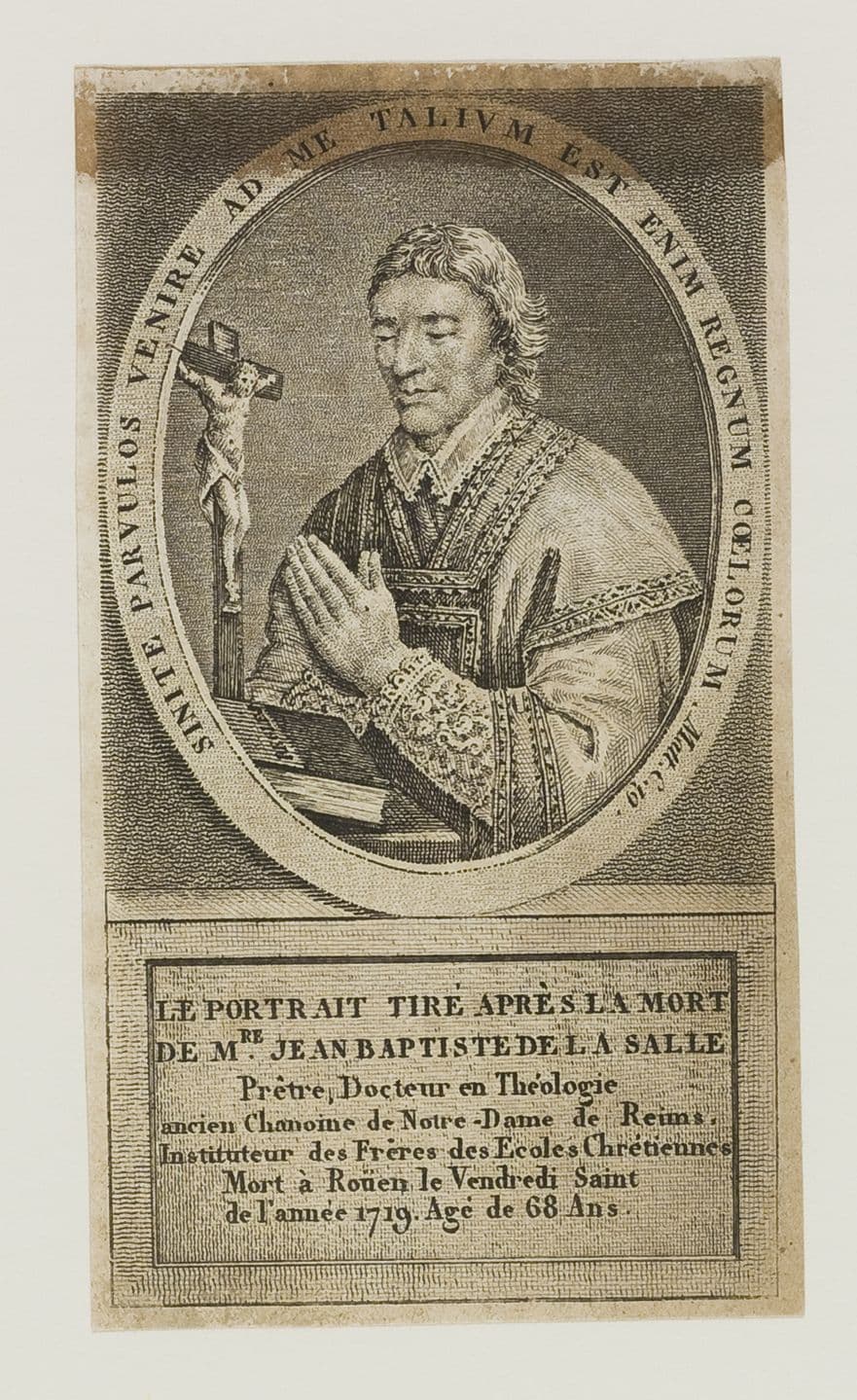
- Patron saint of
- Schoolteachers, named by Pope Pius XII in 1950 2
- Born
- Reims, April 30, 1651, eldest child of Louis de la Salle and Nicolle de Moet de Brouillet 1
- Died
- Saint-Yon, Rouen, on Good Friday, April 7, 1719 1
- Age at death
- Sixty-seven. Both the death portrait and Franciscan Media say sixty-eight; his own dates make him three weeks short of it 12
- Made a canon of Reims
- January 7, 1667, at fifteen. He resigned it in July 1683 1
- Canonized
- By Leo XIII on May 24, 1900 1
Saint John Baptist de la Salle was a canon of Reims cathedral with a doctorate in theology, a noble name and a private fortune, and he gave away all three to live with the men who taught in free schools for poor boys. 12 He did not want the work and said so afterward in writing: if God had shown him in advance what it would cost, "my courage would have failed me, and I would never have undertaken it." 1 He founded the Brothers of the Christian Schools, wrote the teaching manual they used for two centuries, and opened what Franciscan Media calls the first training college for teachers. 12 Pope Pius XII made him the patron of schoolteachers in 1950. 2
Everything going right
Franciscan Media lists what he started with and the list is deliberate: "scholarly bent, good looks, noble family background, money, refined upbringing." 2 Graham traces the family back to a ninth-century commander of the forces of Alfonso the Chaste and a move into Champagne around 1350. 1 He was the eldest of the children of Louis de la Salle and Nicolle de Moet de Brouillet, and his parents were careful about his education. 1
The career assembled itself early. He took the tonsure at ten, in March 1662. 1 He was installed as a canon of the metropolitan see of Reims on January 7, 1667, at fifteen - a post his cousin Pierre Dozet, chancellor of the university of Reims, resigned in his favor. 1 He took his master of arts in July 1669 and went to Saint-Sulpice in Paris in October 1670, attending theology lectures at the Sorbonne. 1
His father wanted him to read law and keep up the family tradition, and he refused. 1 Then both parents died within nine months of each other - his mother in July 1671, his father in April 1672 - and at twenty-one he left the seminary to run the household and educate his brothers and sisters. 1 Graham says his biographer Canon Blain records that he went through many mental struggles at this point. 1
He was ordained priest on Holy Saturday, April 9, 1678, and took his doctorate in theology in June 1680. 1 Franciscan Media's summary of where that left him is accurate and worth keeping: "He seemed assured then of a life of dignified ease and a high position in the Church." 2
Work he did not want
In March 1679 a Madame Maillefer asked him to help Adrien Nyel open a free school at Reims. 1 Franciscan Media calls it "a chance meeting" and does not soften what followed: "Though the work was extremely distasteful to him at first, he became more involved in working with the deprived youths." 2
Graham's account of the same years is a sequence of approaches and withdrawals. He helped establish the school of St-Maurice and "quietly withdrew from the work, as if it were not his mission." Another free school opened in St-Jacques parish and drew him back, "but he soon retired again." He let Nyel take the credit. 1
What caught him was not a vision but a practical problem. The teachers were getting discouraged because nobody was guiding them once school was out, so he took on housing them - first to direct them and teach them how to use their time, then making up the shortfall in their cost of living, then admitting them to his own table, then sheltering them under his own roof. 1 Monsignor Guibert, quoted by Graham, saw it as the obvious motive: "They were like abandoned sheep without a shepherd. He assumed the responsibility of uniting them." 1
He wrote afterward that he had walked into it blind. "The idea never occurred to me. If I had ever thought that what I did out of pure charity for the poor school teachers would make it incumbent upon me to live with them, I would have given it up at once." 1 And near the end of his life, the harder version: "If God had revealed to me the good that could be accomplished by this institute, and had likewise made known to me the trials and sufferings which would accompany it, my courage would have failed me, and I would never have undertaken it." 1
He resigned the canonry in July 1683 and distributed his fortune to the poor in the winter of 1684. 1 Franciscan Media's phrasing is the blunt one: he "reduced himself to the level of the poor to whom he devoted his entire life." 2
What he actually built
The Institute of the Brothers of the Christian Schools - also called the Christian Brothers, or the De La Salle Brothers - grew quickly and taught the sons of poor families using methods he designed. 2 Graham calls him the "father of modern pedagogy" in the article's opening line, which is a large claim, and then supports it with a book. 1
"Conduite des Ecoles", published in 1717, is a treatise on teaching method setting out fundamental principles systematically. Graham, writing in 1910, thought it had aged remarkably: "It is remarkable that the methods herein given have not been considerably changed since the time of its author, and that the principles laid down are as applicable today as when they were written." 1 He also wrote a manual of manners and Christian civility in 1695. 1
Franciscan Media records two things Graham's catalog of books does not stress. The Institute "prepared teachers in the first training college for teachers" - training the teachers rather than just the children was the structural idea - and it "also set up homes and schools for young delinquents of wealthy families." 2 The motive under all of it, Franciscan Media says, was simply "the desire to become a good Christian." 2
Opposition from three directions
Franciscan Media does not let the success stand unqualified. There was "heart-rending disappointment and defections among his disciples"; there was "bitter opposition from the secular schoolmasters who resented his new and fruitful methods"; and there was "persistent opposition from the Jansenists of his time, whose moral rigidity and pessimism about the human condition John resisted vehemently all his life." 2
Graham describes the Jansenist ascendancy in France as the background condition rather than a personal quarrel: it "fostered internal dissensions and promoted Gallicanism, to the great detriment of the Faith and of loyalty to the Holy See", while in the social order "a spirit of exaggerated independence was abroad, condemning authority or thrusting it aside." 1 A man proposing a disciplined, systematic free school for the poor was crosswise to all of it.
The schoolmasters are the part most easily missed. Free schools taught for nothing what paying schoolmasters charged for, and the methods worked. The opposition was commercial, and Franciscan Media names it as such. 2
Good Friday
He had asthma and rheumatism in his last years. 2 In Holy Week of 1719 it became clear he was dying. 1
On Holy Thursday, at the request of Brother Barthelemy, he blessed the Brothers gathered at his bedside and gave them his last counsel. 1 Graham records his final words: "In all things I adore the will of God in my regard." 1 He died on the morning of Good Friday, April 7, 1719, at Saint-Yon in Rouen. 1
Somebody drew him that day or shortly after, and the engraving taken from that drawing says so across the bottom: the portrait was taken after the death of Jean Baptiste de la Salle, priest, doctor of theology, former canon of Notre-Dame de Reims, founder of the Brothers of the Christian Schools, died at Rouen on the Good Friday of the year 1719. 1 It gives his age as sixty-eight, as Franciscan Media does. 2 By Graham's own dates he was sixty-seven and would have turned sixty-eight three weeks later. 1
He was canonized by Leo XIII on May 24, 1900. 1
What is Saint John Baptist de la Salle the patron saint of?
Saint John Baptist de la Salle is the patron saint of schoolteachers. Pope Pius XII named him so in 1950, "for his efforts in upgrading school instruction." 2
The 1910 encyclopedia article cannot mention this, because it was written forty years before the declaration. 1 What it does instead is argue the case without knowing the verdict, calling him the father of modern pedagogy and "the lawgiver of primary and elementary teaching, as well as the creator of a new system of intellectual training." 1
The patronage is exact rather than general. He is not the patron of education or of learning; he is the patron of the people who stand in front of a class, which is the group he actually went to live with.
Saint John Baptist de la Salle's feast day
The feast of Saint John Baptist de la Salle is April 7, the day he died. 2
The 1910 encyclopedia gives a different day: "He was canonized by Leo XIII on 24 May 1900. His feast is celebrated on 15 May." 1 That was correct when it was printed, and it is the older of the two dates rather than a mistake. Neither source explains why the feast was moved, and this page does not supply a reason of its own.
Where the two sources disagree here, the modern one is followed, because a liturgical calendar is a current instrument rather than a historical claim. Both dates are given above so that a reader who meets May 15 in an older book knows what they are looking at. 12
Praying with Saint John Baptist de la Salle
He is the saint for work you did not choose and do not like. This is stated by him, not inferred about him. The work was "extremely distasteful to him at first". 2 He wrote that the idea of living with poor schoolteachers never occurred to him and that he would have dropped the whole thing at once had he seen it coming. 1 He approached it, withdrew, approached it again, and withdrew again, over a period of years, before it closed on him. 1
Nothing about that resembles a call he recognized and answered. What he did was keep turning up to a problem he had not asked for until there was no honest way to leave it, and then he gave away a canonry, a fortune and a family name to stay.
His instinct throughout was to fix the thing one level further back than the visible need. The boys needed schools, so he helped open schools; the schools needed teachers who were not demoralized, so he housed the teachers; the teachers needed to be taught, so he wrote the method down and then founded a college to train them in it. 12 The book he produced was still in use, Graham thought, two centuries later. 1
And the last sentence anybody recorded from him is not about schools at all. "In all things I adore the will of God in my regard." 1 It is the same sentence as the memoir about never having wanted the work, said from the other end.
Saint John Baptist de la Salle, pray for us.
Sources
Saints to turn to next
Others in this collection who are turned to for some of the same things.
- Saint Thomas of Villanova1488 - September 8, 1555Poverty and simplicityWork and vocationStudy and teaching
- Saint Charles BorromeoOctober 2, 1538 - November 3, 1584Work and vocationStudy and teaching
- Saint Ephremc. 306 - June 9, 373Study and teachingWork and vocation
- Saint Gregory the Greatc. 540 - March 12, 604Work and vocationStudy and teaching