Saint Thomas of Villanova
1488 - September 8, 1555
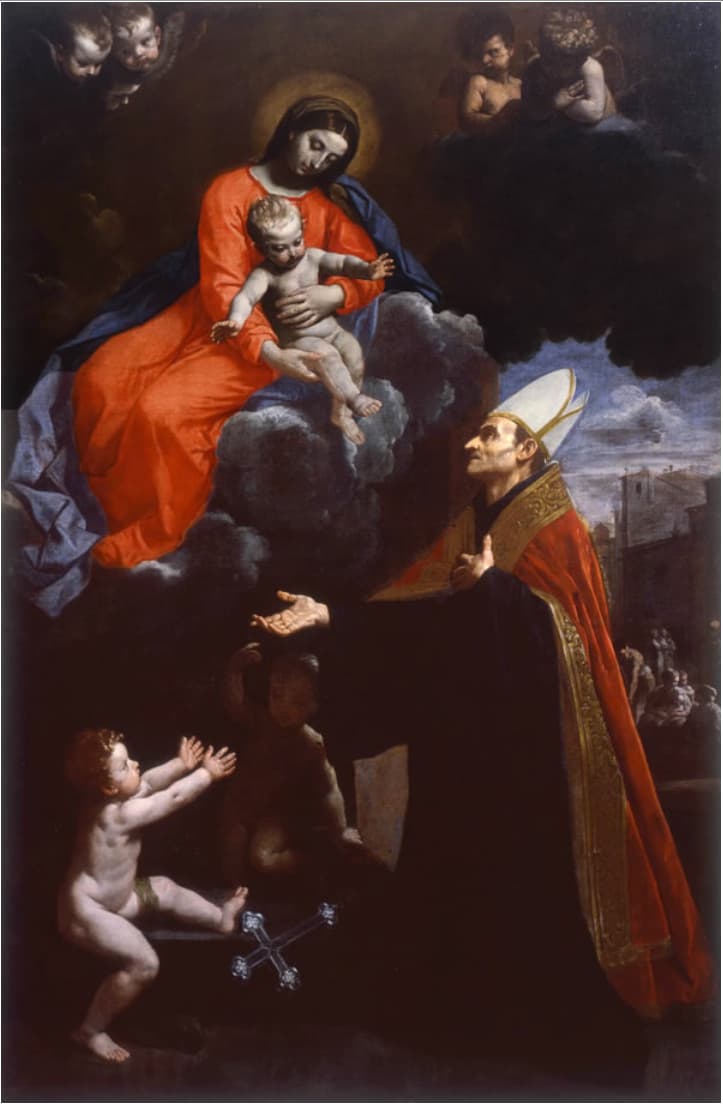
- Feast day
- September 22. He died on 8 September 1555 1
- What he inherited
- A diocese that "for well-nigh a hundred years had witnessed no bishop in residence" 1
- Called
- Almsgiver, Father of the Poor, and Model of Bishops, at his beatification in 1618 1
Saint Thomas of Villanova was a professor at Alcala who became an Augustinian friar, refused one archbishopric, and was pressed into another that had not had a resident bishop in a century. 12 When his cathedral chapter gave him money to furnish the palace, he gave it to a hospital. 2 Several hundred poor people came to his door every morning, and when he was told they were taking advantage of him he said his duty was to the ones who came. 2
A household that gave things away
He was born at Fuentellana in Castile in 1488, and took his surname from Villanueva de los Infantes, the town where he grew up. 12
Dohan describes the family habit rather than the family piety, and the specifics are worth having. "Every Friday his father was wont to give in alms all the meal he earned at the mill, besides his usual daily dole of bread. On great feast-days he added wood, wine, and money; while to poor farmers he loaned money and seed." 1 A miller giving away a day's entire earnings every week, and lending seed to men who could not afford it.
When the father died, "Lucia continued the usual alms, and supplied indigent maidens in the neighbourhood with clothing and money." 1 Nothing Thomas later did as archbishop was new to him. He had grown up in a house that worked this way.
At sixteen he went to the University of Alcala, took his master of arts and his licentiate in theology, and held the chair of arts, logic and philosophy from 1514. 1 Among the students who heard him were scholars who became famous in their own right. 1 Franciscan Media adds a detail that makes him easier to like: he taught well "despite a continuing absentmindedness and poor memory." 2
He turned down a chair at Salamanca and joined the Augustinians there in 1516 instead, professed a year later, ordained the year after that, and said his first Mass at Christmas 1518. 1
Court preacher, and the letters he burned
He was given scholastic theology to teach "because of his attachment for books, chiefly the Lombard and St. Thomas, and his exemplary life", and began preaching across Spain. 1
At Valladolid, where the imperial court sat, Charles V made him court preacher and one of his councillors of state. 1 And then a detail that shows exactly how he held the position: "Rarely, however, did the saint pay visits of ceremony to the then master of Europe, though his written correspondence with Charles, who held his opinions in high esteem, was voluminous." 1 He wrote constantly and did not turn up at court to be seen.
Near the end of his life "he had all the emperor's letters destroyed; his own letters to the emperor, however, are now stored at Simancas." 1 A lifetime of correspondence from the most powerful man in Europe, burned by the man who received it. What survives is only his own side, because the emperor kept his.
He was twice provincial of his order, and Dohan records what came of the second term: "whence the first mission band of his brethren was sent across the Atlantic in 1533 to establish houses of their order in Mexico." 1 Franciscan Media: he sent "the first Augustinians to the New World." 2
Valencia
He had already declined the archbishopric of Granada when the emperor offered it. 1 When Valencia fell vacant in 1544 he was nominated again, and Franciscan Media says he "was pressured to accept." 2 Dohan puts it exactly: he took it "only through obedience to his superiors." 1
What he was taking on is the crucial fact, and Dohan states it plainly: Valencia was "a post that for well-nigh a hundred years had witnessed no bishop in residence." 1 A hundred years of absentee archbishops. He entered the see on 1 January 1545.
His first act was a visitation of the whole diocese, and one instruction in it tells you what he expected to find: "he inhibited his visitators from accepting any gifts whatever." 1 Nobody inspecting a parish on his behalf was to take anything from it.
Then the money. The cathedral chapter voted him a sum to furnish the archbishop's house, and he sent it to a hospital. Franciscan Media preserves what he told them: "our Lord will be better served by your money being spent on the poor in the hospital. What does a poor friar like myself want with furniture?" 2
He wore the same habit he had been given as a novice, and mended it himself. "The canons and domestics were ashamed of him, but they could not convince him to change." 2 His own staff were embarrassed by how their archbishop dressed.
The door
"Several hundred poor came to Thomas's door each morning and received a meal, wine, and money." 2 Every morning, for eleven years.
He took in orphans, and did something cleverer than waiting for them: "paid his servants for every deserted child they brought to him." 2 He put a bounty on abandoned children, so that his household had a reason to look.
He was criticized for being soft, and his answer is the best thing recorded of him. "If there are people who refuse to work, that is for the governor and the police to deal with. My duty is to assist and relieve those who come to my door." 2
That is a complete answer to a complaint that has not changed in five centuries. He does not deny that some of them were working him. He declines to make it his job to find out.
He was also criticized for not disciplining sinners harshly enough, and answered by pointing at two of the greatest bishops in history: "Let him inquire whether Saint Augustine and Saint John Chrysostom used anathemas and excommunication to stop the drunkenness and blasphemy which were so common among the people under their care." 2
And he preached the same thing to the rich - encouraging them "to imitate his example and be richer in mercy and charity than they were in earthly possessions." 2
The end
Dying, "Thomas commanded that all the money he possessed be distributed to the poor. His material goods were to be given to the rector of his college." 2 He emptied the accounts before he went.
Mass was being said in his room. "After Communion he breathed his last, reciting the words: 'Into your hands, O Lord, I commend my spirit.'" 2 It was 8 September 1555. 1
Paul V beatified him in 1618, and Dohan records the three titles he was given then: "Almsgiver", "Father of the Poor", and "Model of Bishops." 1
What is Saint Thomas of Villanova the patron saint of?
Neither Dohan nor Franciscan Media assigns Saint Thomas of Villanova a formal patronage. 12 What he carries are the three names given him at his beatification - Almsgiver, Father of the Poor, Model of Bishops - which amount to the same thing. 1
He is invoked by people who give money away and are told they are being naive, and his answer is on record for them. 2 He belongs to those running soup kitchens and shelters, to anyone who has been asked to means-test a queue, and to bishops who would rather not live in the house.
He also has a claim on abandoned children, because of the arrangement he made with his own servants. 2
Saint Thomas of Villanova's feast day
The feast of Saint Thomas of Villanova is September 22.
He died on 8 September 1555, the feast of the Nativity of the Virgin - a day already fully occupied - so his own commemoration was placed later in the month. 1 A reader will find September 18 in some older calendars.
This library first recorded him on September 10, which is the slot Franciscan Media's Saint of the Day column runs him in; the column's own text gives September 22. 2 The correction is one of twenty-five of that kind found in this library's research pipeline, and the reason it no longer reads a publishing slot as a feast.
Praying with Saint Thomas of Villanova
The answer about the undeserving poor is the thing to carry away, and it is worth quoting to oneself: if some of them refuse to work, that is a matter for the governor and the police; my duty is to assist those who come to my door. 2 He has separated two questions that almost everybody runs together - whether a person deserves help, and whether I should give it - and assigned the first to somebody else. It is not naivety. It is a decision about what his job was.
The furniture money is the same decision in a different key. A chapter voted him funds to live as an archbishop should, and he concluded that the money would do more in a hospital. 2 His household found this humiliating. He wore the mended novice's habit anyway, for eleven years, in the second city of Spain.
What he inherited is easy to skip and should not be. Valencia had had no resident bishop for a century. 1 He did not arrive to reform a functioning diocese; he arrived to start one. That is why the first thing he did was go and look at it in person, and forbid his inspectors to accept so much as a gift. 1
And the letters. He burned everything Charles V had written him. 1 A man with a reputation, an emperor's confidence and a lifetime of correspondence made sure none of it survived to be used - by himself, or by anybody else, for anything. What is left at Simancas is only what he wrote, kept by somebody else. He arranged, as far as he could, to leave nothing behind but the work.
Saint Thomas of Villanova, pray for us.
Sources
Saints to turn to next
Others in this collection who are turned to for some of the same things.
- Saint John Baptist de la SalleApril 30, 1651 - April 7, 1719Study and teachingWork and vocationPoverty and simplicity
- Saint Mary MacKillopJanuary 15, 1842 - August 8, 1909Poverty and simplicityWork and vocation
- Saint CajetanOctober 1480 - August 7, 1547Work and vocationPoverty and simplicity
- Saint John BoscoAugust 16, 1815 - January 31, 1888Study and teachingWork and vocation