Saint John Bosco
August 16, 1815 - January 31, 1888
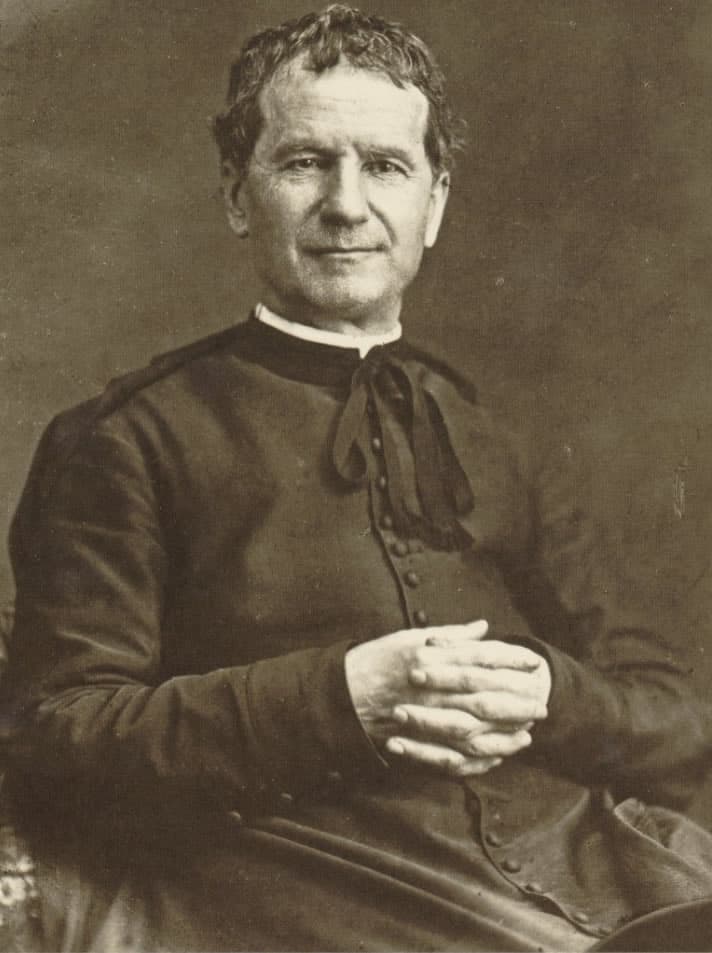
- Patron saint of
- Young apprentices and Catholic publishers, from his work in trades and printing 2
- Feast day
- January 31, the day he died in 1888 1
- Born
- In a cabin at Becchi, near Castelnuovo in Piedmont, August 16, 1815 1
- Founded
- The Salesians, in 1859, with seventeen men, and later the Salesian Sisters 2
- Was nearly
- Committed to an asylum. His persistence "led many to the conclusion that he was insane" 1
- Rule
- "As far as possible avoid punishing... try to gain love before inspiring fear" 1
Saint John Bosco went with another priest to visit the prisons of Turin and saw children in them "abandoned to the most evil influences, and with little before them but the gallows." 1 He spent the rest of his life on that, running an operation that was evicted from one building after another and that many of his neighbors believed was the work of a madman - somebody tried to have him committed. 1 He would not punish the boys. "Try to gain love before inspiring fear." 1 By the end there were workshops, night schools, a printing press and an order of priests. 12
A shepherd who wanted to read
He was born in a cabin to poor parents, and his father died when he was a little over two, leaving his mother Margaret with three boys. 1 "John's early years were spent as a shepherd and he received his first instruction at the hands of the parish priest." 1
Saxton puts the difficulty plainly and without drama: "He possessed a ready wit, a retentive memory, and as years passed his appetite for study grew stronger. Owing to the poverty of the home, however, he was often obliged to turn from his books to the field, but the desire of what he had to give up never left him." 1 He got to the seminary at Chieri in 1835 and was ordained six years later. 1
The prisons, and a boy thrown out of a church
In Turin one of his duties was to go with Don Cafasso on visits to the city prisons, and what he saw there decided everything after it. The condition of the children held in them, "abandoned to the most evil influences, and with little before them but the gallows, made such an indelible impression upon his mind that he resolved to devote his life to the rescue of these unfortunate outcasts." 1
The work began with one boy and an act of rudeness by somebody else. On December 8, 1841, while Don Bosco was vesting for Mass, "the sacristan drove from the Church a ragged urchin because he refused to serve Mass. Don Bosco heard his cries and recalled him." 1 The boy was Bartolomeo Garelli, and Saxton dates the whole Salesian enterprise to the friendship that followed. 1 Franciscan Media tells the same beginning slightly differently - "His service to young people started when he met a poor orphan in Turin, and instructed him in preparation for receiving Holy Communion." 2
The numbers then move very fast. Twenty boys by February 1842. Thirty by March. "In March, 1846, four hundred." 1 They came, Saxton says, "all drawn by a kindness they had never known." 1
Evicted, and thought insane
There was nowhere to put them. On good Sundays he walked them into the country outside Turin, ate lunch with them and played games, and because he had noticed "the charm which music held for the untamed spirits of his disciples" he got hold of some old brass instruments and formed a band. 1
The list of addresses is the clearest measure of how unwelcome the work was. From two rooms beside the Rifugio, the Oratory moved to St. Martin's, then to St. Peter's Churchyard, then to three rooms in Via Cottolengo, then to an open field, and finally to a rough shed. 1 On that last site it grew to seven hundred members. 1
Saxton is blunt about the hostility. "He was subjected to petty annoyances and obstacles which, at times, seemed to spell the ruin of his undertaking. His perseverance in the face of all difficulties led many to the conclusion that he was insane, and an attempt was even made to confine him in an asylum. Complaints were lodged against him, declaring his community to be a nuisance, owing to the character of the boys he befriended." 1
That last clause is worth reading twice. The objection was not to his methods. It was to the boys.
Mama Margaret
His mother came to live with him at the Oratory and stayed for the last ten years of her life. 1 "When she joined her son at the Oratory the outlook was not bright. But sacrificing what small means she had, even to parting with her home, its furnishings, and her jewelry, she brought all the solicitude and love of a mother to these children of the streets." 1
A widow who had raised three sons in poverty sold everything she had left to feed other people's children, and is remembered in the article by the name the boys gave her. 1
Not with blows
Saxton traces the method to a dream Don Bosco reported from boyhood, in which he was shown what his work would be and told: "Not with blows, but with charity and gentleness must you draw these friends to the path of virtue." 1 The article does not insist on the dream - "whether this be accounted as nothing more than a dream, that was in reality the spirit with which he animated his Oratory" - and this page follows it in leaving the question open. 1
What the method meant in practice was that punishment was removed as a tool. "Don Bosco's method of study knew nothing of punishment. Observance of rules was obtained by instilling a true sense of duty, by removing assiduously all occasions for disobedience, and by allowing no effort towards virtue, how trivial soever it might be, to pass unappreciated." 1 He held "that the teacher should be father, adviser, and friend, and he was the first to adopt the preventive method." 1
Franciscan Media describes the same system and notes how modern it still sounds: "It was a preventive system, rejecting corporal punishment and placing students in surroundings removed from the likelihood of committing sin... He combined catechetical training and fatherly guidance, seeking to unite the spiritual life with one's work, study and play." 2
His own summary, written in 1887, is the strongest claim in the article: "I do not remember to have used formal punishment; and with God's grace I have always obtained, and from apparently hopeless children, not alone what duty exacted, but what my wish simply expressed." 1
He was not sentimental about education itself. "Instruction", he said, "is but an accessory, like a game; knowledge never makes a man because it does not directly touch the heart. It gives more power in the exercise of good or evil; but alone it is an indifferent weapon, wanting guidance." 1 And he thought indulgent parents did real damage - producing a child who understands quickly and charms everybody, which is to say "an affectionate, perfected, intelligent animal." The object, he wrote, "should be to form the will and to temper the character." 1
Workshops, a press, and an order
The city authorities eventually came round, and he raised money for technical schools and workshops. 1 Franciscan Media lists what the boys were actually taught: patrons' money paid for "two workshops for the boys, shoemaking and tailoring", and "by 1856, the institution had grown to 150 boys and had added a printing press for publication of religious and catechetical pamphlets." 2
In 1868 he built a church for the Valdocco quarter of Turin, on a cross-shaped plan covering fifteen hundred square yards, for more than a million francs he did not have and had to raise. 1 It was consecrated on June 9, 1868, under the title of Our Lady, Help of Christians. 1
The order came out of a staffing problem. Franciscan Media: "by 1850 he had trained his own helpers because of difficulties in retaining young priests." 2 In 1854 he and his followers banded together informally, taking Francis de Sales as their patron, and in 1859, with Pius IX's encouragement, he gathered seventeen men and founded the Salesians. 2 Saxton dates the formal society to 1868, when fifty priests and teachers adopted a common rule, approved provisionally by Pius IX in 1869 and finally in 1874. 1 He later organized the Salesian Sisters to do the same work for girls. 2
What is Saint John Bosco the patron saint of?
Saint John Bosco is the patron saint of young apprentices and of Catholic publishers. Franciscan Media gives the reason rather than just the title: "John's interest in vocational education and publishing justify him as patron of young apprentices and Catholic publishers." 2
Both come straight out of the workshops. He taught shoemaking and tailoring because those were trades a boy could live on, and he bought a printing press because he wanted the pamphlets made in-house. 2 The patronages are of the actual work, not of an idea about it.
Saxton's article, written in 1907 while Bosco was still only Venerable, states no patronage. 1
Saint John Bosco's feast day
The feast of Saint John Bosco is January 31, the day he died in 1888. 1
Saxton's article was written before the canonization and says so in its opening line - he was "declared Venerable by Pius X, 21 July, 1907." 1 A note added to the text since records what happened next: Pius XI beatified him in 1929 and canonized him in 1934. 1
Praying with Don Bosco
He is the saint for anyone working with people other people have written off, and for anyone being told that the work itself is the problem. The complaints lodged against the Oratory were not about noise or money. They were "declaring his community to be a nuisance, owing to the character of the boys he befriended." 1 His neighbors wanted the boys gone, and when he would not send them away they decided he was mad.
The refusal to punish is the part worth taking seriously rather than admiring. It was not softness; he thought indulgence produced "an affectionate, perfected, intelligent animal", and said the point of the whole thing was to form the will. 1 What he removed was fear as a shortcut. Everything else - the rules, the expectation, the duty - stayed. That is harder than punishing, not easier, and it took him a lifetime and an order of priests to make it scale.
The detail to keep from the beginning is that the work started because he contradicted a sacristan. A ragged boy was thrown out of a church for refusing to serve Mass, and a priest who was already vested for the altar heard him crying and went and got him back. 1 Everything after that - four hundred boys in five years, the shed, the workshops, the press, the Salesians - is downstream of one moment of not letting somebody be turned away.
And his mother sold her furniture. 1 It is the least famous thing in the article and it is the reason the first Salesian home had anything in it.
Saint John Bosco, pray for us.
Sources
Saints to turn to next
Others in this collection who are turned to for some of the same things.