Saint John Neumann
March 28, 1811 - January 5, 1860
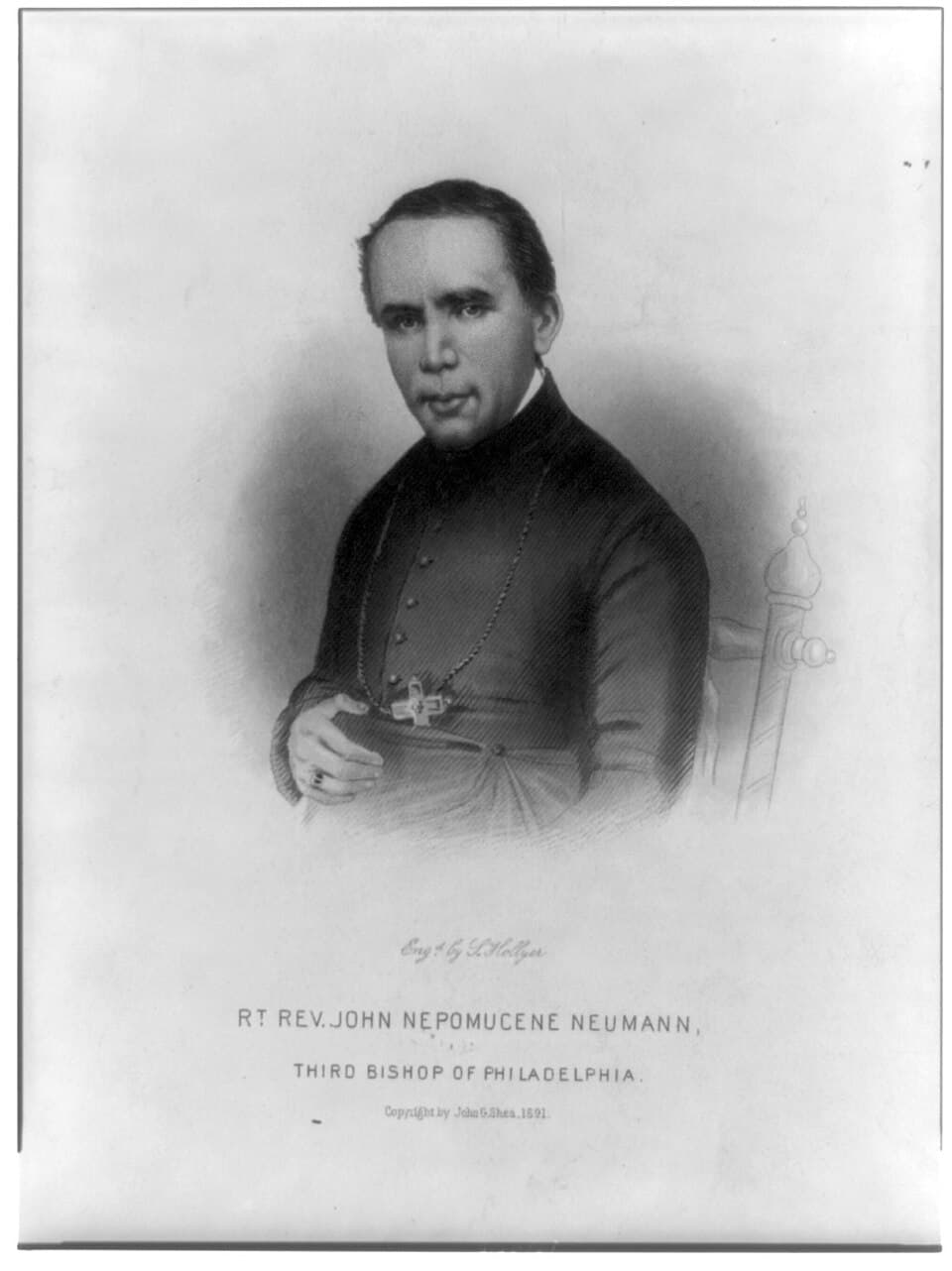
- Patron saint of
- Educators and teachers 5
- Ordained
- June 25, 1836, in New York, by Bishop Dubois 1
- Religious order
- The Redemptorists, first professed in America on January 16, 1842 1
- Died
- Philadelphia, January 5, 1860, after collapsing in the street 4
- Motto
- Passio Christi conforta me 3
Saint John Neumann came to New York from Bohemia in 1836 as an unordained seminarian with no diocese, was a priest within the month, and sixteen years later was Bishop of Philadelphia. 14 He served a parish that ran from Lake Ontario to Pennsylvania, owned one pair of boots, learned Irish to hear the confessions of Irish immigrants, and built the Catholic schools of his diocese faster than anyone could agree on how to count them. 14 He is a patron of teachers, and his feast is January 5. 45
A seminarian with a gift for languages
He was born on March 28, 1811, at Prachatitz in Bohemia, then part of the Austrian Empire and now in the Czech Republic. 14 Wissel, writing for the Catholic Encyclopedia, notes dryly that his biographers had "erroneously set down" the day as Good Friday. 1 He was named for Saint John Nepomucene, the martyred priest who was patron of his homeland. 4
He entered the seminary at Budweis in 1831 and finished his course at the University of Prague in August 1835. 1 The encyclopedia credits him with eight modern languages besides Latin, Greek and Hebrew, and a serious amateur's knowledge of botany. 1 While still a seminarian he read letters sent home to the Leopold Missionary Society by Father Baraga, a missionary in America who later became Bishop of Marquette, and decided he would go to the American missions himself. 1 Vatican News adds that he began teaching himself English. 4
One dollar and one set of clothes
His ordination at home kept being put off, because Budweis had more priests than it needed. 4 In 1836 he left anyway, with little money and no promise from any American diocese. Vatican News says he said goodbye to his sister and could not bring himself to tell his mother when he was going. 4 He landed in New York on June 2, 1836, by Vatican News's account with one dollar and one set of clothes. 14
Bishop Dubois of New York accepted him and ordained him on June 25. 1 Vatican News says he received the subdiaconate, the diaconate and the priesthood all in the same week. 4 The diocese then took in all of New York State and part of New Jersey, and had thirty-six priests for 200,000 Catholics. 4 He was sent to the western end of the state, where he spent four years "amid incredible hardships," in a parish Vatican News describes as reaching from Lake Ontario to Pennsylvania. 14 He traveled on horseback, by wagon and on foot, and said Mass in kitchens where there was no church. 4 "Only a poor priest," he wrote, "one who can endure hardship, can labor here." 4
A Redemptorist
Wissel says he entered the Redemptorist Congregation in 1840 and was the first of its members professed in America, on January 16, 1842. 1 Vatican News dates his joining to 1842 and calls him the order's "first American vocation," and Franciscan Media says he joined at 29 and was the first Redemptorist to profess vows in the United States. 45
For three years he was superior of the Redemptorists at Pittsburgh, where he built the church of St. Philomena and worked chiefly among German-speaking Catholics. 1 Franciscan Media places his missionary work in Maryland, Virginia and Ohio, "where he became popular with the Germans." 5 In 1846 he was made vice-provincial of the Redemptorists in America, and Franciscan Media credits him with putting the order "in the forefront of the parochial movement" during that short term. 15 He became an American citizen in 1848. 4
Bishop of Philadelphia
In 1852, at the suggestion of Archbishop Kenrick of Baltimore, Pius IX gave him "a command under obedience" to accept the see of Philadelphia. 1 Kenrick consecrated him at St. Alphonsus in Baltimore on March 28, 1852, his forty-first birthday. 12 Vatican News calls Philadelphia the largest diocese in the country at the time, and describes a city where immigrants from Germany and Ireland were resented by part of the population and anti-Catholic riots broke out often. 4 Loughlin's history of the archdiocese refers the reader to the burning of Catholic churches in the riots of 1844. 2
He visited the larger congregations every year and the smaller ones every two, staying several days in country places to preach, hear confessions, confirm and anoint the sick. 1 Wissel records that he once walked twenty-five miles and back to confirm one boy. 1 Vatican News says he kept a single pair of boots the whole time he was in America and learned enough languages to hear confessions in German, Italian, Spanish and Dutch, and in Irish Gaelic too. 4 Hearing him, one Irish woman is supposed to have said, "Isn't it grand that we have an Irish bishop?" 4
Ten churches went up in his first year, and Wissel counts fifty in five years along with the exterior of the cathedral. 12 In 1853 he became the first American bishop to bring the Forty Hours devotion into his diocese. 1 Paul VI singled the same devotion out in 1977, saying that through it "he helped his parishes become communities of faith and service." 3 He went to Rome in October 1854 for the definition of the Immaculate Conception and came back the following March. 12
Not every fight went his way. Loughlin records that he failed "to bring the contumacious trustees of Holy Trinity to their senses," and got around them by building the church of St. Alphonsus. 2 In 1857 James Frederick Wood was made his coadjutor, chiefly to take the temporal business of the diocese off his hands, and Neumann told his clergy that completing the cathedral was now Wood's work. 2
The schools, and how many there were
Everyone agrees that schools were the center of his episcopate. Loughlin says "the constant topic of his exhortations was the necessity of parish schools." 2 Paul VI, in the English part of his canonization homily, spoke of him "promoting, with relentless energy, the Catholic school system in the United States." 3 He entrusted the boys to the Christian Brothers and the girls to several communities of sisters, brought the Sisters of the Holy Cross from France to run an industrial school, and at Pius IX's advice founded the Philadelphia branch of the Sisters of St. Francis. 1 He also protected the community in Baltimore that Wissel calls the "Colored Oblate Sisters," whom "by his tact and charity he saved from dissolution." 1
The numbers do not agree. Wissel says there were two parochial schools in Philadelphia at his consecration and "nearly one hundred" at his death. 1 Loughlin, in the same encyclopedia, reports 36 parish schools with 8,710 pupils in the diocese when he died. 2 Vatican News puts it at one school when he arrived and 200 by the end, "the first diocesan school system in the country." 4 Franciscan Media measures pupils instead and says their number rose "almost twentyfold within a short time." 5 All four readings are given here because the sources give all four.
A death in the street
On January 5, 1860, he collapsed from a sudden stroke while walking down a Philadelphia street and died. 4 He was 48. 14 The diocese he left, which still included Delaware, had an estimated 200,000 Catholics, 157 churches and 147 priests. 2 He was buried in a vault before the altar in the lower chapel of St. Peter's, the Redemptorist church in Philadelphia. 15
He was declared Venerable on December 15, 1896, and Wissel ends his article with the cause still under consideration in Rome. 1 He was beatified on October 13, 1963, the first American bishop to be beatified, and was canonized by Paul VI on June 19, 1977. 35
What is Saint John Neumann the patron saint of?
Franciscan Media lists Saint John Neumann as a patron saint of educators and teachers. 5 No other source consulted names a patronage. Paul VI called him "the honor of all immigrants" in his canonization homily, which is a title of praise rather than a patronage, and this page does not turn it into one. 3
Saint John Neumann's feast day
Praying with Saint John Neumann
His motto, Paul VI said, was "Passio Christi conforta me," and in the Passion of the Lord "he found strength and the inspiration of his ministry." 3 The record does not show a man who found his work easy. It shows a priest who wrote that only someone who could endure hardship could labor where he was, and then stayed. 4
A good deal of his holiness was spent on things that look like administration: visitation schedules, synods, catechisms, finding teachers for schools that did not exist yet. 12 Franciscan Media treats his "exceptional organizing ability" as the gift he was given for the Gospel. 5 Paul VI, praising him as a model, said: "love meant giving; love meant effort; love meant sacrifice." 3
The record shows him overruled as well. Trustees defied him, a coadjutor was sent to take over the temporal business of his diocese, and he died at 48 in the street. 24 A twenty-five-mile walk to confirm one boy belongs in the same life as all of that. 1 Neither cancels the other.
Paul VI also called him "close to the sick," "at home with the poor" and "a friend to sinners." 3 He learned other people's languages so that they could make their confessions in their own. 14 For anyone who teaches, or who serves people a long way from home, that is the part of him most worth keeping in view.
Saint John Neumann, pray for us.
Sources
- 1.Joseph Wissel, "John Nepomucene Neumann, Venerable," The Catholic Encyclopedia (New York: Robert Appleton Company, 1907-1912), reprinted unabridged by Catholic Answers.
- 2.James Loughlin, "Archdiocese of Philadelphia," The Catholic Encyclopedia, Vol. 11 (New York: Robert Appleton Company, 1911).
- 3.Paul VI, Homily for the Canonization of John Nepomucene Neumann, June 19, 1977.
- 4."St. John N. Neumann, Bishop of Philadelphia, United States," Saint of the Day, Vatican News.
- 5."Saint John Neumann," Saint of the Day, Franciscan Media.
Saints to turn to next
Others in this collection who are turned to for some of the same things.
- Saint John Baptist de la SalleApril 30, 1651 - April 7, 1719Study and teachingWork and vocationPoverty and simplicity
- Saint Thomas of Villanova1488 - September 8, 1555Poverty and simplicityWork and vocationStudy and teaching
- Saint Charles BorromeoOctober 2, 1538 - November 3, 1584Work and vocationStudy and teaching
- Saint Ephremc. 306 - June 9, 373Study and teachingWork and vocation