Saint Alexander Sauli
1533 or 1534 - October 11, 1592
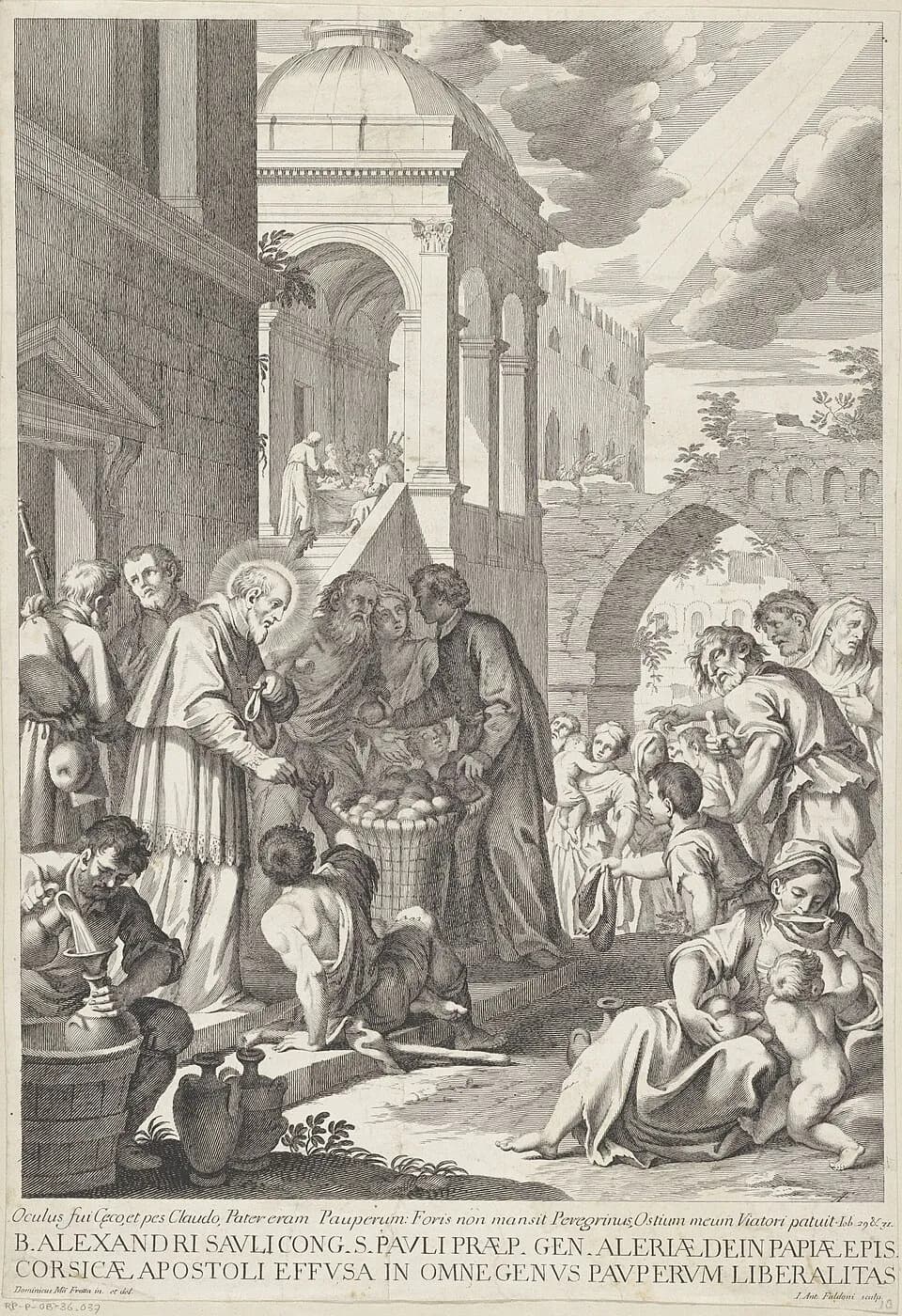
- Order
- Clerics Regular of Saint Paul (Barnabites), entered 1551 2
- Offices
- Superior general of the Barnabites; bishop of Aleria in Corsica; bishop of Pavia from 1591 12
- Canonized
- December 11, 1904, by Pope Pius X 2
- Patron of
- Barnabite seminarians, according to the Barnabites 2
Saint Alexander Sauli was a Milanese nobleman who joined the Barnabites as a teenager, taught at the University of Pavia, led his order in his thirties, and then spent about twenty years as bishop of Aleria in Corsica, an island diocese that, by the Barnabite account, had not seen a bishop in seventy years. 12 He is called the Apostle of Corsica. 13 He died on October 11, 1592, a year after being moved to Pavia, and October 11 is his feast. 245
A page with a cross
He was born in Milan, in 1533 according to the 1907 Catholic Encyclopedia and in 1534 according to the Barnabites, into a family the Barnabites describe as noble and Genoese. 12 Their menologion names his parents as Tommasina Spinola and Dominic Sauli, Marquis of Pozzuolo, and says that at seventeen, in 1551, he became a page at the court of the Emperor Charles V. 2
That same year he asked to join the Barnabites at their house of Saint Barnabas in Milan. The fathers hesitated. He was very young, they hardly knew him, and the menologion says they wondered whether a noble heir might be "plotting to become a Bishop." 2 So on May 17, 1551, the vigil of Pentecost, they asked him to carry a large cross through the streets of Milan in his page's dress and to preach in public on the love of God and the renunciation of the world. He did it, came back, and sent his sword home to his father with a servant. 2
He received the habit on August 15, 1551, made his vows on September 29, 1554, and was ordained on March 21, 1556, at twenty-two, with a dispensation for his age. 2
Pavia and the order
The Barnabites sent him to Pavia, a university city he already knew. He said Mass and heard confessions like his confreres, and he also gathered the children for recreation and catechism. 2 When university students who came to the church asked for help with their studies, he set up what the menologion calls an "academy," which opened on February 2, 1560, with weekly conferences on Saint Paul and daily repetition of the university's courses in theology, philosophy and law. 2 He took his own degree on May 28, 1563, joined the college of professors of theology, and three years later was its dean. 2 The encyclopedia says simply that he taught philosophy and theology at the University of Pavia. 1
He became superior general of the Barnabites at thirty-three. 23 The encyclopedia dates that to 1565. 1 In Milan the archbishop, Saint Charles Borromeo, leaned on him: the menologion says Charles had him draft the final document of the diocesan synod, "almost as if he was his personal secretary," and Vatican News calls Alexander his confessor. 24
Once, though, he told Charles no. The archbishop wanted to merge the Barnabites with the Humiliati, an order that refused every kind of reform. The union would have brought the poor Barnabites 94 rich houses and 150 new members. Alexander would not have it, the menologion says, because men who did not believe in reform and would nearly outnumber his own would have ruined the spirit of the house. 2
Bishop in Corsica
Pope Pius V named him bishop of Aleria in Corsica. The encyclopedia dates the appointment to 1571 and Vatican News to 1567; the Barnabites say it came three years after his election as general and that he landed on the island at the end of April 1570. 124 Before leaving he made a retreat with Charles Borromeo, who then supplied his vestments for the consecration in the cathedral of Milan. 2 The menologion quotes a letter to his father from that time: "The effort I have endured here as Superior General seems to me like roses in comparison with what I am starting to experience as a Bishop." 2
The pope had told him to bring at least a dozen Barnabites. The order could spare four, three priests and a brother; the encyclopedia counts three companions. 12 What they found is described bluntly on both sides. The encyclopedia says the faith was "all but extinguished" and that clergy and people were in "a state of deplorable ignorance." 1 The Barnabites say the bishop's residence had been destroyed in war and that there were no seminaries or schools on the island, and then add: "Still faith was alive." 2
He lived in what the menologion calls "precarious and humble dwellings," began visiting the whole diocese at once, and by the end of August held a synod with 150 priests. 2 It became a yearly meeting of three days. His secretary, Albert Grozio, is quoted describing it: the bishop invited the priests to stay with him at his own expense, ate with them, spoke with each one, and taught them by working through cases of conscience, and when they left for the hard journey home he sent them off with provisions, horses and wine. 2
He wrote booklets of instruction for his clergy, among them a simplified edition of the Roman catechism that the Barnabites say Saint Francis de Sales praised; their historical survey gives its title as the "Doctrine of Roman Catechism" and its printing as Pavia, 1581. 23 He founded a seminary at Bastia. 2 The encyclopedia credits him with rebuilding churches and founding colleges and seminaries "despite the depredations of corsairs, and the death of his comrades." 1 He suffered from malaria and fevers that several times nearly killed him, he had to deal with feuds, famine and drought, and one man tried to kill him. 2
When the Republic of Genoa wanted him as coadjutor to its archbishop, the Corsicans petitioned the pope and the republic to leave him where he was, and he stayed another seven years. 2 The Barnabite survey says he chose "to be a Corse by own choice." 3
One year in Pavia
In 1591 Pope Gregory XIV transferred him to Pavia. 12 He took possession of the diocese on October 19, 1591. According to the menologion, seeing the pomp prepared for his entry, he said to those beside him, "Vanity of earthly honors; in less than a year these festival pomps will change into mourning and tears." 2
Pavia was in a famine, with wheat priced out of reach. On his first Sunday he told the people he meant to be the father of the poor, and had a purse of a hundred gold scudi given out as a start; others added to it through the day. 2
He set out on a visitation of the diocese and fell ill with fever and gout at Calosso d'Asti. Not wanting to burden the parish priest, he accepted a room in the castle of Count Ercole Roero, a friend, and died there ten days later, on Sunday, October 11, 1592. 2 The Roman Martyrology also places his death at Calosso d'Asti; the encyclopedia says he died at Pavia. 15 The Barnabites record that his body was brought to Pavia on October 14 and that the solemn funeral was held the next day. 2
Pope Benedict XIV beatified him, on April 23, 1742, by the encyclopedia's date and April 23, 1741, by the Barnabites'. 12 Pope Pius X canonized him on December 11, 1904. 2
What is Saint Alexander Sauli the patron saint of?
Saint Alexander Sauli's feast day
Praying with Saint Alexander Sauli
The men who admitted him worried he wanted a bishop's miter. He got one, and it was Aleria: a ruined residence, fever, and priests who had never had a school. 2 His letter to his father does not pretend otherwise. Running the order had been "like roses" next to this. 2
What he did there was mostly teaching. A synod every year, three days at his own table, cases of conscience talked through one at a time, a catechism cut down so that it could be used. 2 The Barnabites' prayer for his memorial thanks God for "a model of faithful religious observance and of tireless pastoral dedication." 2
He also knew when to refuse a friend and a saint. The merger Charles Borromeo wanted would have brought 94 houses, and he turned it down to keep a small community honest. 2
Near the end, the menologion has him say that the visitation was not what killed him, and that he would do it all again: "For a pastor it is a duty to give his life for his flock. I thank God for allowing me to die serving His Church, in the midst of my apostolate." 2
Saint Alexander Sauli, pray for us.
Sources
- 1.F. M. Rudge, "Bl. Alexander Sauli," The Catholic Encyclopedia, vol. 1 (New York: Robert Appleton Company, 1907).
- 2."Menologion - October: October 11, Saint Alexander Sauli," Barnabite Fathers USA.
- 3."Historical Highlights of Barnabite Fathers," Barnabite Fathers USA.
- 4."Sant'Alessandro Sauli, vescovo di Pavia," Santo del giorno, 11 ottobre, Vatican News (in Italian).
- 5.Roman Martyrology, October 11, as printed in "Santo del giorno," Conferenza Episcopale Italiana (in Italian).
Saints to turn to next
Others in this collection who are turned to for some of the same things.
- Saint Antoninus of FlorenceMarch 1, 1389 - May 2, 1459Poverty and simplicityStudy and teachingWork and vocation
- Saint Brigid of Kildare451 or 452 - February 1, 525Work and vocationStudy and teachingPoverty and simplicity
- Saint Giuseppe MoscatiJuly 25, 1880 - April 12, 1927Work and vocationStudy and teachingPoverty and simplicity
- Saint Gregory Barbarigo1625 - 1697Study and teachingWork and vocationPoverty and simplicity