Saint Gregory Barbarigo
1625 - 1697
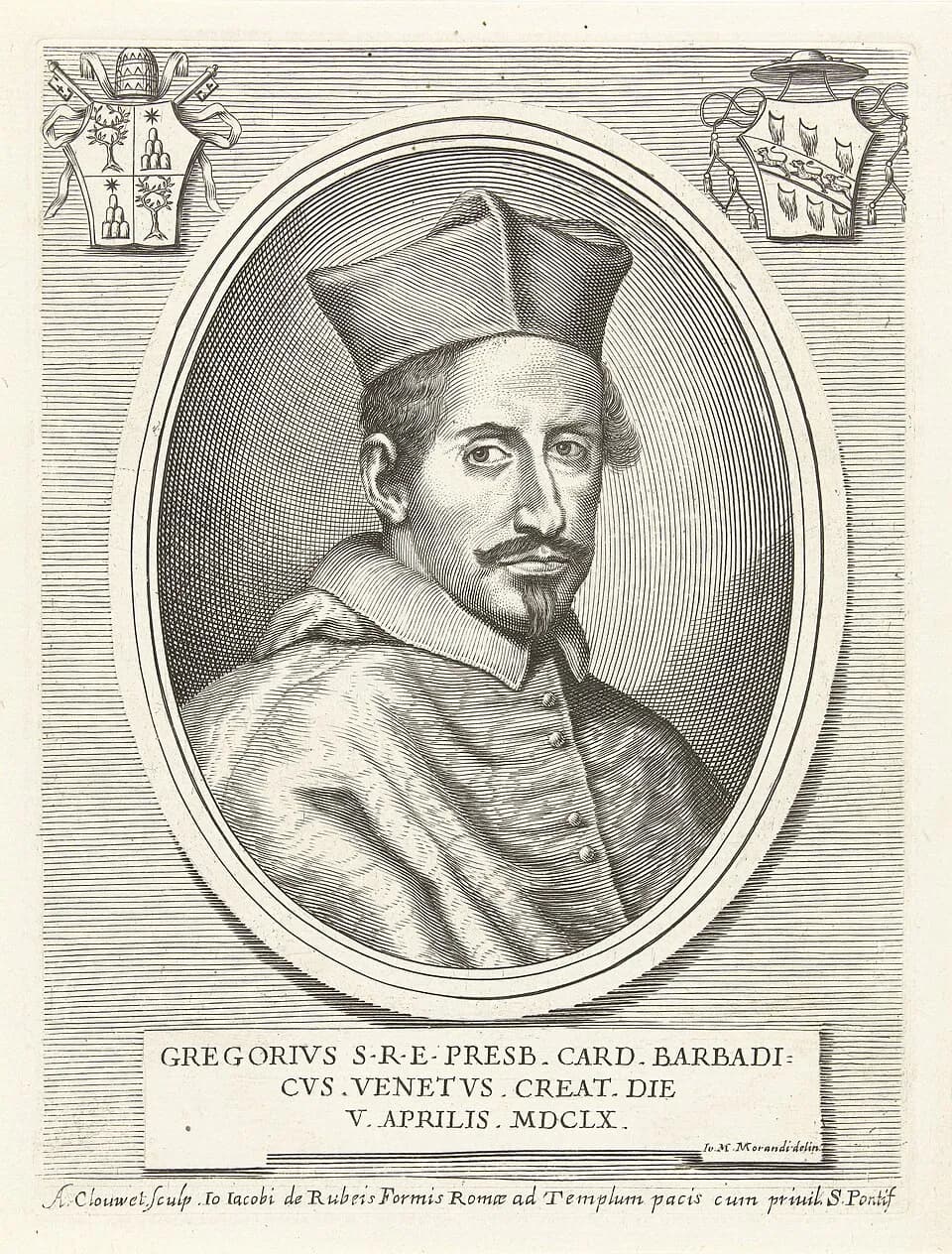
Saint Gregory Barbarigo was a Venetian patrician and cardinal who governed the dioceses of Bergamo and then Padua in the second half of the seventeenth century, and who built the seminary of Padua into what Vatican News calls one of the best in Europe. 1 John XXIII, who had learned to revere him as a seminarian in Bergamo, canonized him in 1960 and held him up to the world's bishops beside Saint Charles Borromeo. 2 His feast is June 18. 15
A Venetian at the peace congress
He was born in Venice in 1625, on September 16 by CatholicCulture's account, the fourth son of a family that was well regarded in the city. 14 His father was a senator of the Republic. His mother died of the plague when he was two. 1
In 1643 his father sent him with the Venetian ambassador Alvise Contarini to Münster, where the peace that would end the Thirty Years' War was being negotiated. 1 John XXIII, in the address he gave on the day of the canonization, recalled Contarini's report to the Venetian Senate: Gregory and another young nobleman, Pietro Duodo, had lived with him for five years, and he could describe the pair as more like angels than men. Gregory was between nineteen and twenty-three at the time. 2
At Münster he met Fabio Chigi, the future Pope Alexander VII, and Vatican News calls the meeting decisive for his life. 1 He finished his studies at Padua and was ordained a priest at thirty, in 1655. 14
The plague in Rome
Alexander VII brought him to Rome, and when plague broke out there the pope put him in charge of coordinating relief for the sick. 1 John XXIII dates the outbreak to 1656 and places his work in Trastevere. What made the young prelate known and loved among ordinary Romans, the pope said, was the direct contact: he went from house to house, to the families, the sick and the poor. 2
Bergamo and Padua
In 1657 Alexander VII made him bishop of Bergamo. 14 He was thirty-two. 2 In 1664 he was given Padua, which he governed for thirty-three years. 12 The sources differ on when he became a cardinal. Vatican News says 1658. 1 CatholicCulture says 1660, and John XXIII says it was the year Saint Vincent de Paul died, three centuries to the year before the canonization. 24
His model in both dioceses was Charles Borromeo. 12 Vatican News says he began by selling everything he owned for the poor, and that he traveled the length of his dioceses visiting parishes, sat with the dying, spread Catholic printed works among the people, and lodged in the houses of the poor. By day he taught the catechism to children; at night he prayed. 1 John XXIII notes that some sharp tongues of the time said he was only posing as a second Saint Charles, and answers that he had Charles's spirit and matched his example in his pastoral letters, his synods, and his schools of Christian doctrine. 2
The catechism he used was Saint Robert Bellarmine's, but the organization of the schools, for adults and for children, was his own. John XXIII describes him in Padua getting the benches and chairs ready for the children himself and ringing the bell to call them, and before that, in Rome, walking along the Tiber in the hottest hours to teach the little ones at San Tommaso in Parione. 2 The Roman Martyrology adds that he taught the children their catechism in their own dialect, and sums him up as generous to everyone and severe with himself. 5
He was not always in his diocese. Vatican News says he spent a period in Rome between Bergamo and Padua and took part in several conclaves. 1 Pope Innocent XI made him an adviser, and by John XXIII's account the pope's esteem kept him in Rome for four full years after he had been named to Padua. 12 CatholicCulture counts five conclaves and says he was a candidate in three. 4
The seminary of Padua
The training of priests was the center of his work. 1 John XXIII called the seminary of Padua his most lasting monument and his masterpiece, and pointed to the rules of education he left for it. He stocked its library with valuable books that trusted agents sought out for him across Europe, set up a well-equipped printing house with rare typefaces, opened colleges for boys, and promoted the study of languages and mathematics. 2
The printing house had a purpose beyond the seminary. Gregory bought costly Eastern typefaces for it because, as a Venetian who knew the sea routes, he wanted cultural ties between Europe and the East and had his eye on the religious reunion of peoples separated from Rome. 2 Vatican News says he worked for reunion with the Eastern Churches under Innocent XI. 1 CatholicCulture says the press printed pamphlets for Christians living under Muslim rule and that he labored for reunion with the Greek Church. 4
Three years after the canonization, Paul VI returned to the same point in his letter for the fourth centenary of seminaries. "In Italy it was above all the merit of St. Gregory Barbarigo, at the end of the 17th century to have labored indefatigably for the reorganization of the seminaries of Bergamo and Padua according to the norms laid down by the Council of Trent," he wrote, and he praised the saint for combining "fidelity to traditional methods with wise innovations," among them "the study of Oriental languages." 3
Death and canonization
He died at Padua in 1697. 1 His remains are in the cathedral there. 4 His nephew Giovanni Francesco Barbarigo, who became bishop of Padua in his turn in 1723, promoted the cause of his beatification, and he was beatified in 1761. 16
John XXIII, a native of the Bergamo region, had been among those who signed appeals for his canonization years before becoming pope. 1 He canonized him on May 26, 1960, the feast of the Ascension, at the Lateran, the cathedral of Rome, and then spoke about him to the pilgrims in Saint Peter's. He said that his respect and devotion for the new saint had first been handed on to him in the seminary of Bergamo. 2
What is Saint Gregory Barbarigo the patron saint of?
Saint Gregory Barbarigo's feast day
Praying with Saint Gregory Barbarigo
John XXIII summed him up in four works of charity: care for the poor, teaching the faith, forming priests, and serving learning. 2 The order is worth noticing. The cardinal who bought rare typefaces and had books sought out across Europe is first remembered going door to door in Trastevere during a plague. 2
He did small jobs himself. A bishop who sets out the benches and rings the bell for a children's catechism class has decided the class matters. 2 The Martyrology remembers that he taught those children in their own dialect. 5
His interest in the Christian East was practical. He paid for type, had the languages taught, and printed books, with reunion in view. 23
John XXIII repeated a question Gregory once put to his clergy about their vocation, about never tiring and never saying that one has done enough: are we like that? 2 It is a hard question from a man who, by the Martyrology's account, was generous to everyone except himself. 5
Saint Gregory Barbarigo, pray for us.
Sources
- 1."San Gregorio Barbarigo, vescovo di Padova e cardinale," Santo del giorno, 18 giugno, Vatican News (in Italian).
- 2.Pope John XXIII, Address to the pilgrims gathered in Rome for the canonization of Gregorio Barbarigo, May 26, 1960 (in Italian).
- 3.Pope Paul VI, Apostolic Letter Summi Dei Verbum, November 4, 1963.
- 4."Ordinary Time: June 18th," Liturgical Year, CatholicCulture.org (life excerpted from the St. Gregory Barbarigo Parish website).
- 5.Roman Martyrology, June 18, as printed in "Santo del giorno," Conferenza Episcopale Italiana (in Italian).
- 6.Nicholas Weber, "Giovanni Francesco Barbarigo," The Catholic Encyclopedia, vol. 2 (New York: Robert Appleton Company, 1907).
Saints to turn to next
Others in this collection who are turned to for some of the same things.
- Saint Alexander Sauli1533 or 1534 - October 11, 1592Work and vocationPoverty and simplicityStudy and teaching
- Saint Antoninus of FlorenceMarch 1, 1389 - May 2, 1459Poverty and simplicityStudy and teachingWork and vocation
- Saint Brigid of Kildare451 or 452 - February 1, 525Work and vocationStudy and teachingPoverty and simplicity
- Saint Giuseppe MoscatiJuly 25, 1880 - April 12, 1927Work and vocationStudy and teachingPoverty and simplicity