Saint Antoninus of Florence
March 1, 1389 - May 2, 1459
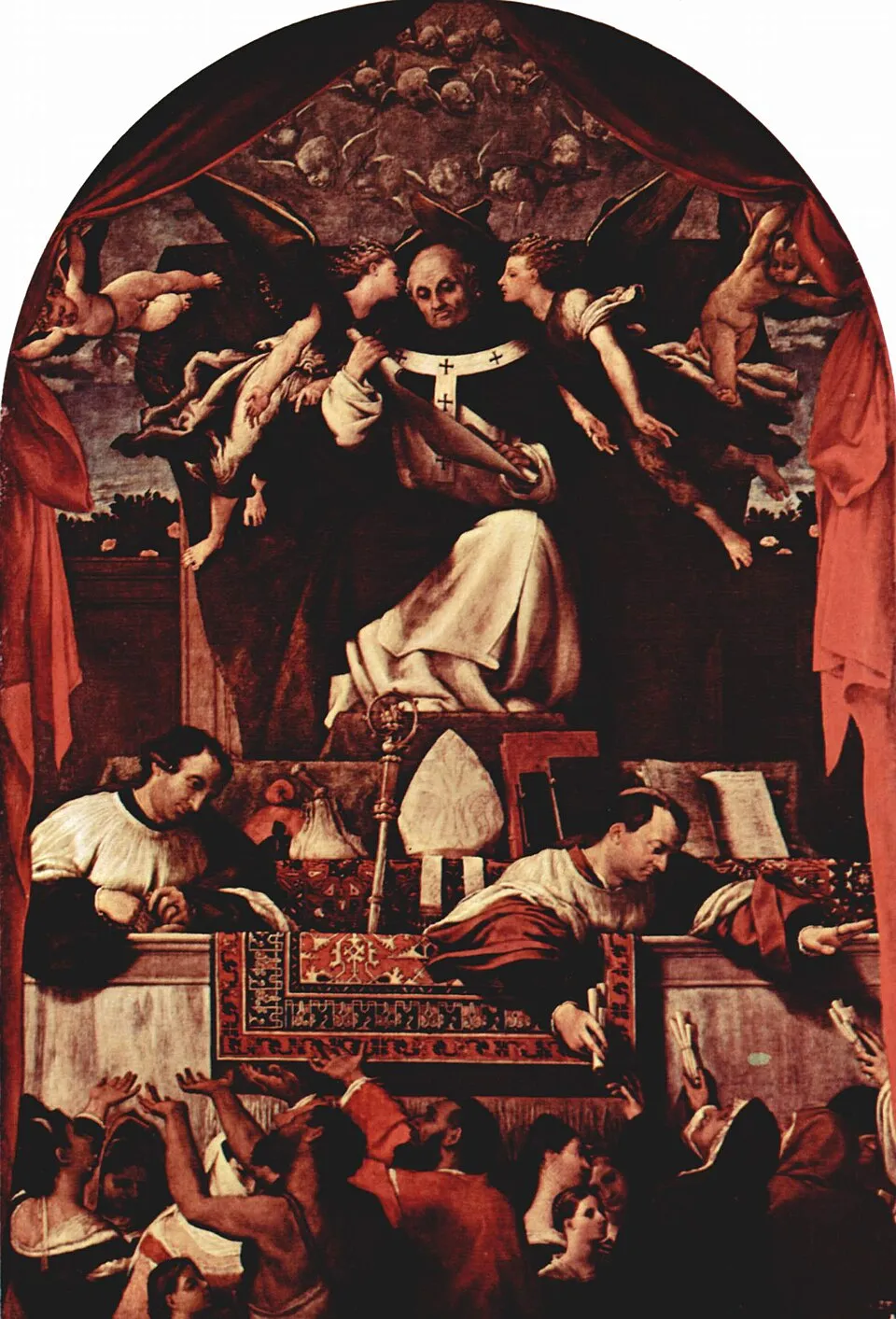
- Archbishop of Florence
- Consecrated March 13, 1446; held the see until his death 1
- Chief work
- Summa Theologica Moralis, a summary of moral theology in four parts 1
Saint Antoninus was a Dominican friar who founded the priory of San Marco in Florence and in 1446, against his own wishes, became the city's archbishop. 1 He ran the diocese for thirteen years in a friar's habit, with a household of six and no gold or silver on his table, and when he died Pope Pius II wrote that nothing was found in his house but a mule and some cheap furniture. 2 The Dominicans keep his feast on May 10. 23
Little Anthony
He was born in Florence on March 1, 1389, the son of Niccolò Pierozzi, a notary of the Florentine Republic, and his wife Thomasina. 1 He was baptized Antonius, Anthony, and that is the name in his own handwriting and in the bull of his canonization. 1 The name he is known by is a diminutive. The Catholic Encyclopedia says it was given him "by his affectionate fellow-citizens." 1 Fr. Samuel Burke, an English Dominican, says his contemporaries called him Antonino, little Anthony, "because of his diminutive stature," and adds that he "may have been physically small, but he was a spiritual giant." 2
At fifteen, in 1404, he asked to join the Dominicans. The man he asked was Blessed John Dominic, the leader of a reform that was bringing Dominican houses back to a stricter observance, who was then at Santa Maria Novella in Florence. 12 He was accepted a year later, the first friar to receive the habit for the priory John Dominic was about to build at Fiesole. 15
He made his novitiate at Cortona under Blessed Lawrence of Ripafratta. 1 One of the novices with him was the friar who became the painter Fra Angelico. 13 After his year he went back to Fiesole, and in 1409 he and his brothers, who held to Pope Gregory XII when Florence did not, had to take shelter in the priory at Foligno. 1
Prior, reformer and founder of San Marco
Burke says he was ordained a priest in 1413 and soon had a name for austerity and for his teaching. 2 The offices followed one after another. The encyclopedia lists him as vicar at Foligno in 1414, then subprior and prior at Cortona, and later prior in Rome at the Minerva, in Naples, Gaeta and Siena, and several times at Fiesole. 1 Burke dates his first priorship, at Cortona, to 1418, and his return to Florence to 1439. 2 From 1433 to 1446 he was vicar of the Tuscan Congregation, the group of houses John Dominic had formed around a more rigorous discipline. 1 The Dominican nuns' account adds that he became "a distinguished master of canon law." 5
In 1436 he established the priory of San Marco in Florence, with a community drawn from Fiesole. 1 Burke says the buildings had belonged to Sylvestrine monks and that Antoninus had the architect Michelozzo convert them, while Fra Angelico was set to work on the interior. 2 The church next door was built with what the encyclopedia calls "the munificent aid of Cosimo de' Medici," and Pope Eugene IV attended its consecration on the Epiphany of 1441. 1 The house also held a library that Burke says "is reckoned to be the first public library in Europe." 2
When the Council of Florence met in 1439 he took part as a theologian, and he lodged at San Marco the Dominican theologians the pope had called to it. 1
Archbishop against his will
According to the encyclopedia, he made every effort to escape promotion and "was forced by Eugene IV, who had personal knowledge of his saintly character and administrative ability, to accept the Archbishopric of Florence." 1 Burke repeats a story, with the words "it is said," that the pope first meant to appoint Fra Angelico and that the painter proposed Antoninus. 2 He was consecrated at Fiesole on March 13, 1446. 1
Burke describes how he took possession. A new archbishop was expected to ride in on horseback, finely dressed and with a retinue. Antoninus came on a donkey in his Dominican habit, and he went on wearing the habit for the rest of his life. 2 He kept a household of six and no guard, shunned luxury in food and clothing, and "had no vessels of gold or silver." 2
The encyclopedia sums up his work as visiting parishes and religious communities, remedying abuses, strengthening discipline, preaching, improving the condition of the poor, and writing books for clergy and laity. 1 Burke says he made a visitation of the diocese every year. 2 The Province of St. Joseph adds that he set up confraternities of Christian doctrine in Florence to teach the young. 3
Plague, the poor and the Good Men of Saint Martin
Fr. Lawrence Lew writes that Antoninus, "to mitigate the wide-spread misery caused by the taxes of the Medici," founded a society of laymen, the Good Men of Saint Martin, "who systematically sought out the poor and gave assistance to them." 4 The nuns' account says the society was placed under the patronage of Saint Martin of Tours. 5
Then came a run of disasters, which Lew lists: plague in 1448 and 1449, an earthquake in 1453, a cyclone in 1456, and after that a famine. 4 Burke says that during the plague the archbishop took a donkey laden with food and medicine through the poorest parts of the city and into the prisons. 2 Lew has him frequently seen in those years with his mule loaded with emergency supplies, bringing relief and the sacraments. 4 His friars followed his example, Burke says, and several of them died of it. 2
The Angel of Counsels
People came to him for advice, and so did governments. The Province of St. Joseph says he was known as the "Angel of Counsels," that princes and prelates consulted him, and that he was called on to make peace between warring parties. 3 Florence used him as an ambassador: illness kept him from an embassy to the emperor in 1451, but he led the city's embassies to the pope in 1455 and 1458. 1
Three popes relied on him. Eugene IV sent for him when he was dying. Nicholas V consulted him often, and Pius II charged him, with several cardinals, to reform the Roman court. 1 The Province of St. Joseph says Nicholas V thought him as worthy of canonization as Bernardine of Siena while he was still alive, and forbade appeals against his judgments. 3
He also wrote. His main work is the Summa Theologica Moralis, in four parts, which the encyclopedia says "marked a new and very considerable development in moral theology." Fifteen editions were printed within fifty years of the first. 1 Manuals for confessors and penitents were drawn from it, and he wrote treatises on the Christian life for women of the Medici family and a history of the world. 1 Of the history the encyclopedia remarks that he accepted too much from older chroniclers about the distant past, but that on the events of his own time his judgment has been of great value to later historians. 1 Burke notes that he preached against usury. 2
Death and canonization
He died on May 2, 1459. 12 The nuns' account gives his last words as "to serve God is to reign." 5 Pius II gave instructions for the funeral and presided at it himself eight days later. 1
The same pope left a description of him, which Burke quotes at length. "He used only glass and clay dishes," Pius wrote; he gave the revenues of the Church to the poor, "but to his relatives and friends (unless they were very needy) he gave nothing." 2 And at the end: "At his house was found nothing except the mule on which he used to ride and some cheap furniture: the poor had had everything else." 2 Adrian VI canonized him on May 31, 1523. 12
What is Saint Antoninus of Florence the patron saint of?
None of the sources consulted for this page names Saint Antoninus of Florence as the patron saint of anything, and the page does not supply a patronage. 123 The Dominicans remember him for counsel, for generosity to the poor and for teaching, which is how the Province of St. Joseph sums him up, but that is a description and not a patronage. 3
Saint Antoninus of Florence's feast day
Praying with Saint Antoninus of Florence
For more than forty years Antoninus was handed one office after another: prior of house after house, vicar of a congregation, archbishop, ambassador, adviser to popes. 1 The one the encyclopedia says he tried to escape was the archbishopric. 1 What Burke shows staying the same once he had it is a set of habits: the friar's habit he wore, the small household, the yearly round of visits. 2
His learning went to practical uses. The great book is a summary of moral theology, and the Province of St. Joseph calls it "an immensely helpful aid to pastors and confessors." 13 The man who wrote it also organized laymen to go looking for the poor. 4
Pius II, who knew him, wrote that he "strove earnestly to settle quarrels" and "did his best to clear the city of feuds." 2 The same passage says he was a popular preacher "though he inveighed against sin with the utmost energy." 2
The last thing Pius records is the inventory of the house: a mule, some cheap furniture, and nothing else, because "the poor had had everything else." 2 Pius adds that the whole state believed he had passed to a life of bliss, "nor can we think their belief unfounded." 2
Saint Antoninus of Florence, pray for us.
Sources
- 1.Arthur McMahon, "St. Antoninus," The Catholic Encyclopedia, vol. 1 (New York: Robert Appleton Company, 1907).
- 2.Samuel Burke, O.P., "Great Dominicans: St. Antoninus," Godzdogz, English Province of the Order of Preachers, May 18, 2016.
- 3."Dominican Saints 101: St. Antoninus," Dominican Friars Province of St. Joseph, May 9, 2012.
- 4.Lawrence Lew, O.P., "The Feast of Saint Antoninus of Florence," Dominican Friars (Province of St. Joseph).
- 5."St. Antoninus of Florence," Dominican Saints, Dominican Nuns of the Monastery of Our Lady of Grace, North Guilford, Connecticut.
- 6.Liturgical Year calendar for May 10, Catholic Culture (note on the 1962 Missal).
Saints to turn to next
Others in this collection who are turned to for some of the same things.
- Saint Alexander Sauli1533 or 1534 - October 11, 1592Work and vocationPoverty and simplicityStudy and teaching
- Saint Brigid of Kildare451 or 452 - February 1, 525Work and vocationStudy and teachingPoverty and simplicity
- Saint Giuseppe MoscatiJuly 25, 1880 - April 12, 1927Work and vocationStudy and teachingPoverty and simplicity
- Saint Gregory Barbarigo1625 - 1697Study and teachingWork and vocationPoverty and simplicity