Saints Zechariah and Elizabeth
First century B.C. - first century A.D.
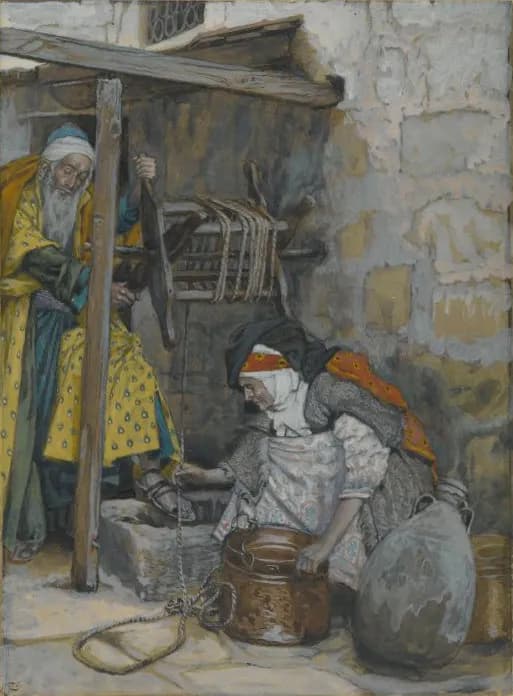
- Feast day
- September 23 in the current Roman Martyrology 456; November 5 for Elizabeth in the Latin Church of 1909, according to the Catholic Encyclopedia 1
- Zechariah
- A priest of the division of Abijah, the eighth of twenty-four; called Zachary in older books 29
- Their words in the Church's prayer
- Elizabeth's greeting in the Hail Mary; Zechariah's canticle, the Benedictus, at Lauds 34
- Patronage
- Catholic Culture lists Elizabeth as patron of expectant mothers and of the diocese of Fulda 4
Saints Zechariah and Elizabeth were the parents of John the Baptist: an old priest of the Jerusalem temple and his wife, a relative of the Virgin Mary, who were no longer expecting a child. 279 Everything known about them comes from the first chapter of Luke, which gives each of them words the Church still prays. 34 The Roman Martyrology commemorates them together on September 23. 56
A priest and a daughter of Aaron
Luke introduces them in a single sentence set in the days of Herod, King of Judea. Zechariah was a priest "of the priestly division of Abijah; his wife was from the daughters of Aaron, and her name was Elizabeth." 9 The Catholic Encyclopedia explains that this was the eighth of the twenty-four courses into which the priests were divided, and the note in the bishops' Bible adds that each division served in the temple for a week at a time, twice a year. 29 Older Catholic books, the encyclopedia among them, call him Zachary. 12
The Gospel describes their character before it describes their trouble. "Both were righteous in the eyes of God, observing all the commandments and ordinances of the Lord blamelessly." 9 They had no child, "because Elizabeth was barren and both were advanced in years." 9 The note on that verse observes that Luke is setting Elizabeth beside the mothers of the Old Testament who waited as she did: Sarah, Rebekah, Rachel, the mother of Samson, and Hannah. 9
Luke places their home in "the hill country," in "a town of Judah," and does not name it. 9 Charles Souvay, in the encyclopedia, reports a tradition older than the Crusades that points to the little town of Ain-Karim, five miles southwest of Jerusalem. 2
The angel at the altar of incense
When his division's turn came, Zechariah was chosen by lot to enter the sanctuary and burn incense while the people prayed outside. 9 There "the angel of the Lord appeared to him, standing at the right of the altar of incense." 9 Zechariah was afraid. The angel told him that his prayer had been heard, that Elizabeth would bear a son, and that the boy was to be named John. 9
He answered with a question: "How shall I know this? For I am an old man, and my wife is advanced in years." 9 The angel gave his name, Gabriel, and then the sign. Zechariah would be unable to speak until the day these things happened, "because you did not believe my words, which will be fulfilled at their proper time." 9 Souvay puts it that he "was slow in believing this startling prediction" and was struck dumb "in punishment of his incredulity." 2
Outside, the people wondered why he was so long. When he came out and could say nothing, they understood that he had seen a vision. "He was gesturing to them but remained mute." 9 He finished his days of service and went home. 9
Elizabeth and Mary
Elizabeth conceived and kept to herself for five months. Luke records what she said: "So has the Lord done for me at a time when he has seen fit to take away my disgrace before others." 9
In the sixth month Gabriel was sent to Nazareth, and part of his message to Mary was about Elizabeth, "your relative," who had conceived a son in her old age. 9 How the two women were related is not known. Souvay says so directly, and he mentions a genealogy attributed to Saint Hippolytus that makes their mothers sisters, which he thinks was probably drawn from an apocryphal writing and "cannot be ascertained." 1
Mary went in haste to the hill country and greeted Elizabeth in Zechariah's house. "When Elizabeth heard Mary's greeting, the infant leaped in her womb," and Elizabeth, filled with the Holy Spirit, cried out: "Most blessed are you among women, and blessed is the fruit of your womb." 9 She called her relative "the mother of my Lord," and she ended with a blessing on Mary's faith, which begins "Blessed are you who believed." 9 The note in the bishops' Bible reads that last line as a contrast with her own husband, who had not believed. 9 Mary stayed about three months. 9
His name is John
Elizabeth gave birth to a son, and her neighbors and relatives rejoiced with her. 9 On the eighth day they came to circumcise the child and meant to call him Zechariah after his father. His mother stopped them. "No. He will be called John." 9 They objected that no one in the family had that name, and made signs to the father to ask what he wanted. 9
Zechariah asked for a tablet and wrote, "John is his name." 9 Luke continues: "Immediately his mouth was opened, his tongue freed, and he spoke blessing God." 9 The story went all through the hill country of Judea, and people who heard it asked, "What, then, will this child be?" 9
What Zechariah said when he could speak again is the canticle called the Benedictus, from its first word in Latin. It begins, "Blessed be the Lord, the God of Israel, for he has visited and brought redemption to his people." 9 The encyclopedia's article on the canticle divides it in two: a thanksgiving for the fulfillment of Israel's hopes, and then an address by the old priest to his own newborn son. 3 "And you, child, will be called prophet of the Most High," he says, and he speaks of "the daybreak from on high" that will "guide our feet into the path of peace." 9
There Luke leaves them. The next verse is about the child, who grew and lived in the desert until he appeared to Israel. 9 The encyclopedia notes that after the birth and circumcision of John, the Gospels do not mention Elizabeth again, and Catholic Culture's excerpt says the same of Zechariah. 14
What later writers added
Later writers supplied an ending. One story, which Souvay reports only to reject, has Herod seeking the life of the infant John and putting Zechariah to death "between the temple and the altar" for having prophesied the Messiah. 2 Souvay calls this and its companion tale "worthless legends," and notes that Saint Jerome had already dismissed them as the dreams of the apocrypha. 2
A different kind of afterthought concerns the Magnificat, the canticle Luke places on Mary's lips during the visit. Souvay mentions that some modern critics would attribute it to Elizabeth. 1 The note in the bishops' Bible gives the evidence, which is thin: a few Old Latin manuscripts name Elizabeth as the speaker, "even though the overwhelming textual evidence makes Mary the speaker." 9
Even the meaning of her name is given two ways. Souvay glosses Elizabeth as "God is an oath"; the life excerpted by Catholic Culture says it means "worshiper of God." 14
What are Saints Zechariah and Elizabeth the patron saints of?
None of the fuller sources used for this page names a patronage for the two of them together. The Catholic Encyclopedia, the Martyrology and Pope Francis are all silent on the point. 157 Catholic Culture's calendar page lists a patronage for Elizabeth alone, "expectant mothers, diocese of Fulda, Germany," without saying where the list comes from, and lists none for Zechariah. 4 This page records that listing as Catholic Culture's and does not add to it.
Saints Zechariah and Elizabeth's feast day
The feast day of Saints Zechariah and Elizabeth is September 23. That is where the current Roman Martyrology places them, as the Italian bishops' conference prints it, in an entry that recalls Elizabeth welcoming Mary into her house and Zechariah praising God at the birth of his son. 5 Aleteia gives the entry in English: "Commemoration of Saints Zechariah and Elizabeth, parents of Saint John the Baptist, forerunner of the Lord." 6 Catholic Culture also notes them on September 23, the day the Church keeps the memorial of Saint Pius of Pietrelcina. 4
The date has a history. Philip Kosloski, writing for Aleteia, points out that September 23 falls about nine months before the Baptist's birthday on June 24, and that it was once kept as the feast of his conception, which many Eastern Christians still observe. 67
Older books give another day. In 1909 the Catholic Encyclopedia said of Elizabeth, "Her feast is celebrated on 8 September by the Greeks, and 5 November in the Latin Church." 1 One further listing should be reported as it stands: the English saints' calendar of Vatican News carries "Sts. Zachary and Elizabeth, parents of St. John the Baptist" under 23 August, with no accompanying text. 8 No other source consulted for this page gives that date.
Praying with Saints Zechariah and Elizabeth
Pope Francis, preaching on the birth of the Baptist in 2018, described what the years of waiting had done to these two. "These elderly parents had dreamed and even prepared for that day, but they were no longer expecting it: they felt excluded, humiliated, disappointed: they were childless." 7 Luke says that they were keeping all the commandments blamelessly, childless as they were. 9
Zechariah's doubt came to him in the sanctuary, while he was offering the incense. 9 Francis called the silence that followed "a sign," and drew from it that "we must learn to trust and be silent before the mystery of God." 7 The Gospel shows a man who went through the whole pregnancy unable to speak and whose first act, when he could, was to bless God. 79
Elizabeth recognizes who Mary's child is before he is born, and says so aloud. 9 Catholic Culture observes that the two of them gave the Church words it has never stopped using: her greeting became part of the Hail Mary, and his canticle is prayed each morning in the Divine Office. 4 The encyclopedia thinks the Benedictus has had its place at Lauds since Saint Benedict, and notes that it is also said at the graveside at funerals. 3
The name they both insisted on was a break with family custom, and each of them held to it separately, she by speaking and he in writing. 9 Francis remarked that the name John means "God has given grace," and that the whole event was surrounded by "wonder, surprise and gratitude." 7
Saints Zechariah and Elizabeth, pray for us.
Sources
- 1.Charles Souvay, "Elizabeth," The Catholic Encyclopedia, vol. 5 (New York: Robert Appleton Company, 1909).
- 2.Charles Souvay, "St. John the Baptist," The Catholic Encyclopedia, vol. 8 (New York: Robert Appleton Company, 1910).
- 3.Bernard Ward, "The Benedictus (Canticle of Zachary)," The Catholic Encyclopedia, vol. 2 (New York: Robert Appleton Company, 1907).
- 4."Memorial of St. Pius of Pietrelcina, Priest," Liturgical Year, September 23, 2026, Catholic Culture (sections "St. Elizabeth" and "St. Zachary," excerpted from Lives of Saints, John J. Crawley & Co.).
- 5.Roman Martyrology, entry for September 23, "Santi Zaccaria ed Elisabetta," Santo del giorno, Conferenza Episcopale Italiana (in Italian).
- 6.Philip Kosloski, "St. John the Baptist's conception has a liturgical feast," Aleteia, September 22, 2024.
- 7.Pope Francis, Angelus, Solemnity of the Nativity of Saint John the Baptist, June 24, 2018.
- 8."23 August," Saint of the Day, Vatican News.
- 9.Luke 1. Bible, United States Conference of Catholic Bishops.
Saints to turn to next
Others in this collection who are turned to for some of the same things.