Saint Matilda
c. 895 - March 14, 968
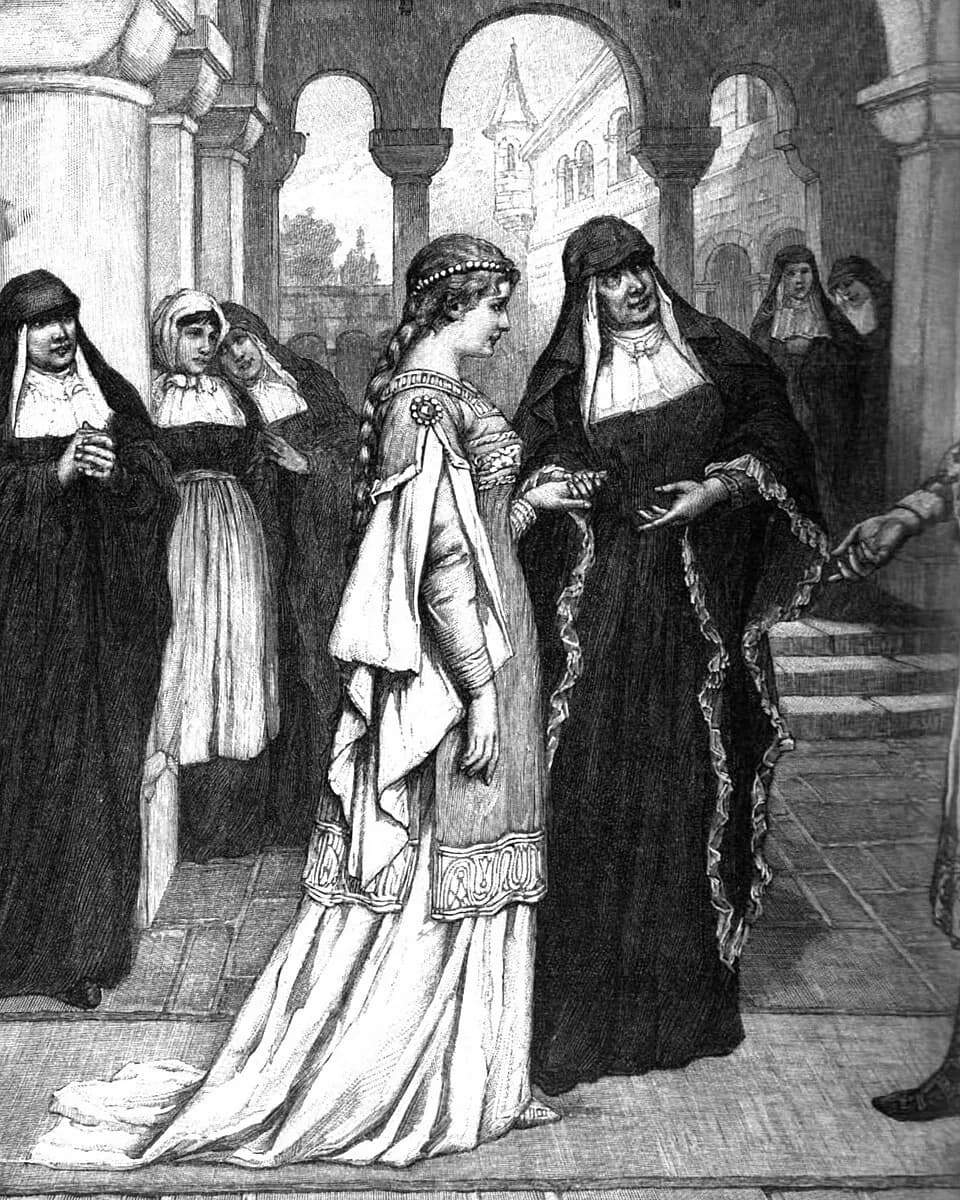
- Patronage
- CatholicIreland.net: "recognised as patroness of mothers with disappointing children" 3
Saint Matilda was Queen of Germany, the wife of King Henry the Fowler and the mother of the Emperor Otto I, of a duke of Bavaria and of a saint who became Archbishop of Cologne. 13 After her husband died in 936, two of her sons accused her of impoverishing the crown with her almsgiving, and to satisfy them she gave up her inheritance and left court. 13 She died at Quedlinburg in 968, was honored as a saint immediately, and is remembered on March 14. 15
A Saxon count's daughter
She was born about 895 at Engern in Westphalia. 13 Her father was Count Dietrich of Westphalia; her mother, Reinhild, came, as CatholicIreland.net puts it, from "the royal house of Denmark." 34 She was brought up at the convent of Erfurt, where, according to both CatholicIreland.net and Angelus, her grandmother was abbess. 134 CatholicIreland.net says she learned needlework there along with a taste for prayer and spiritual reading. 3
Henry was the son of the Duke of Saxony. 4 He had already been married once, to a young widow named Hathburg, and that marriage had been declared invalid. 1 He asked for Matilda, and they were married in 909 at Walhausen, which he gave her as her dowry. 1 Henry became Duke of Saxony in 912. 1 When King Conrad died, Henry was chosen to succeed him, in 918 according to the encyclopedia and in 919 according to CatholicIreland.net. 13 He is known as "the Fowler"; CatholicIreland.net says it was for his love of falconry. 3
Queen of Germany
The encyclopedia describes her as a queen who was "humble, pious, and generous, and was always ready to help the oppressed and unfortunate," and says she "wielded a wholesome influence over the king." 1 CatholicIreland.net adds that Henry encouraged her to use the resources of the kingdom for works of charity. 3
They had five children whom the sources name. 13 Otto succeeded his father and became emperor; Henry became Duke of Bavaria; Bruno became Archbishop of Cologne and is himself venerated as a saint; Gerberga married King Louis IV of France; and Hedwig was the mother of Hugh Capet. 13 The encyclopedia's article on Otto says that "some part of the spirit of ascetic piety which distinguished his mother, Mathilda, was found also in the son." 2
Henry died in 936, after a reign of seventeen years, and left her all his possessions at Quedlinburg, Poehlden, Nordhausen, Grona and Duderstadt. 1 CatholicIreland.net says that as soon as he died she called a priest to say Mass for his soul, took off the jewels she was wearing, and handed them to the priest as a pledge that she was finished with the things of the world. 3 She lived as a widow for thirty-two more years. 3
A mother against her sons
Henry had wanted Otto, his eldest son by Matilda, to follow him. 1 Matilda wanted her favorite, the younger Henry, and the encyclopedia says she argued that he was the first son born after his father became king, and persuaded a few nobles to vote for him. 1 Otto was elected anyway and crowned on August 8, 936. 1 The coronation was held at Aachen, and the encyclopedia's article on Otto says it showed that the Carolingian traditions of empire were still in force. 2 CatholicIreland.net says Otto held her preference against her. 3
Three years later the younger Henry rebelled against his brother and failed. 1 At Matilda's intercession he was made Duke of Bavaria, and Angelus says it was she who persuaded Otto to give him the title. 14 It did not settle him. The article on Otto says the reconciliation was insincere, that Henry soon conspired with the Archbishop of Mainz to have his brother assassinated, and that the brothers were not finally reconciled until 941. 2
Then the brothers turned on her together. The encyclopedia says they "joined in persecuting their mother, whom they accused of having impoverished the crown by her lavish almsgiving." 1 CatholicIreland.net, which lays most of the blame on Otto, agrees on the charge: both sons complained of her generosity to the Church and to the poor. 3 To satisfy them she gave up the property her husband had left her. 13 The encyclopedia says she retired to her villa at Engern in Westphalia; CatholicIreland.net says to a convent she had built; Angelus says to her family home. 134
She was brought back. The encyclopedia says it happened when misfortune overtook her sons, and that both Otto and Henry then begged her pardon. 1 Angelus says she was welcomed back to court by Otto's wife, Edith, that her sons asked her forgiveness, and that she went straight back to her almsgiving. 4
Churches and convents
The rest of her life went into building. The encyclopedia says she built many churches and founded or supported many monasteries, chief among them Quedlinburg, Nordhausen, Engern and Poehlden. 1 She spent long stretches at them and was especially fond of Nordhausen, where, Angelus says, she passed many of her last years. 14
She died on March 14, 968, at the convent of Saints Servatius and Dionysius at Quedlinburg, and was buried there beside Henry. 1 The encyclopedia says she "was venerated as a saint immediately after her death." 1 Two early lives of her survive, it notes: an older one written at Nordhausen and dedicated to her grandson, the Emperor Otto II, and a second written by order of the Emperor Henry II. 1
What is Saint Matilda the patron saint of?
Saint Matilda's feast day
Saint Matilda's feast is March 14, the day she died in 968. 1 The Catholic Encyclopedia says "Her feast is celebrated on 14 March," Vatican News lists "St. Matilde, Queen" on that date, and CatholicIreland.net keeps her there too. 135 She is not to be confused with Saint Mechtilde of Hackeborn, the Benedictine mystic of Helfta, whose feast the same encyclopedia puts in February. 6
Praying with Saint Matilda
Her story does not flatter her. The encyclopedia is plain that she had a favorite son and lobbied for him against her husband's wishes. 1 Within a few years both sons had turned on her. 1 The patronage CatholicIreland.net gives her, of mothers whose children disappoint them, comes out of a family in which the disappointment ran in both directions. 13
What her sons held against her was charity. 13 They called it ruinous, and to quiet them she handed over everything her husband had left her. 1 The sources do not say that she won the argument. She was recalled, and her sons asked her pardon, and she went on giving. 14
The son she had not wanted on the throne is the one the encyclopedia credits with her piety. Otto, it says, was violent in temper and conscious of his power, yet "prayed devoutly as a child," and carried some of his mother's ascetic spirit into the way he ruled. 2 Whatever passed between them in the years of the quarrel, something of her reached him.
Her widowhood began with a Mass and a handful of jewels. 3 It lasted thirty-two years and went into churches and convents. 13 She is buried at Quedlinburg beside the husband who had encouraged her to give in the first place. 13
Saint Matilda, pray for us.
Sources
- 1.Michael Ott, "St. Matilda," The Catholic Encyclopedia, vol. 10 (New York: Robert Appleton Company, 1911).
- 2.F. Kampers, "Otto I, the Great," The Catholic Encyclopedia, vol. 11 (New York: Robert Appleton Company, 1911).
- 3.Patrick Duffy, "Mar 14 – St Matilda (895-968)," Saints of the Day, CatholicIreland.net, 2012.
- 4."Saint of the day: Matilda," Angelus News, Archdiocese of Los Angeles.
- 5.Saint of the Day, 14 March: "St. Matilde, Queen," Vatican News.
- 6.Gertrude Casanova, "St. Mechtilde," The Catholic Encyclopedia, vol. 10 (New York: Robert Appleton Company, 1911).
Saints to turn to next
Others in this collection who are turned to for some of the same things.
- Saint Alexius of RomeFifth century, by traditionPoverty and simplicityMarriage and familyPrayer
- Saint CunegundeDied March 3, 1040Marriage and familyPoverty and simplicityPrayer
- Saint Germaine Cousin1579 - 1601Marriage and familyPoverty and simplicityPrayer
- Saint Hedwig of Silesiac. 1174 - October 1243Marriage and familyPoverty and simplicityPrayer