Saint Joachim
First century BC
- Patron saint of
- Grandparents, jointly with Saint Anne 4
- His name
- "Yahweh prepares," according to the 1910 Catholic Encyclopedia 1
Saint Joachim is the father of the Virgin Mary and the grandfather of Jesus, and the Gospels never name him. 14 His name and his story come from the Protoevangelium of James, a second-century text in which a rich, childless man is turned away from the Temple, fasts forty days in the wilderness, and is told by an angel that his wife will conceive. 23 The 1910 Catholic Encyclopedia warns that this origin "is likely to rouse well-founded suspicions," and the Church keeps his feast anyway, on July 26 with Anne. 145
What Scripture says, and what it does not
Matthew and Luke both give Jesus a genealogy, and both trace it through Joseph. Franciscan Media points out that Mary's family is left out entirely: "we also know nothing factual about them except that they existed," and even the names Joachim and Anne "come from a legendary source written more than a century after Jesus died." 4
Some commentators have tried to find him in Luke anyway. Luke 3:23 calls Joseph the son of Heli, and the theory runs that Heli is a short form of Eliachim, or Joachim, and that Joseph became Joachim's son in law by marrying Mary. 1 The 1910 encyclopedia calls that reading "very doubtful," and the identification of the two names doubtful as well. 1 It is equally unwilling to say, against the Bollandists, that Joachim was Heli's son and Joseph's brother. 1
The same article opens with a warning from Saint Peter Damian that it is "a blameable and needless curiosity" to ask about things the Evangelists chose not to relate, the parents of the Virgin among them. 1 Then it goes on to ask anyway.
Where his story comes from
Three apocryphal books carry the tradition: the Protoevangelium, or Gospel, of James; the Gospel of the Nativity of Mary; and the Gospel of Pseudo-Matthew. 12 The 1907 encyclopedia article on Anne dates the earliest form of the Protoevangelium to about A.D. 150 and treats the other two as built on it, directly or indirectly. 2 The East gave it great authority and read parts of it on Marian feasts; the Western Fathers rejected it, until Jacobus de Voragine folded its contents into the Golden Legend in the thirteenth century. 2
Charles Souvay, who wrote the Joachim article, does not throw the material out. Apocryphal books contain "unwarranted and legendary facts," he says, but also "some historical data borrowed from reliable traditions or documents," and "it would be unwise and uncritical indiscriminately to reject the whole." 1 What he will not do is vouch for any particular detail. He doubts, for example, the claim that Joachim owned "large possessions in herds and flocks," which he says rests on "sources of very doubtful value." 1
The story in the Protoevangelium
The text opens with Joachim as "a man rich exceedingly," who brought his offerings to the Temple double. 3 On a great feast a man named Rubim stopped him: it was not right for him to offer first, "because you have not made seed in Israel." 3 Joachim went to the registers of the twelve tribes to see whether he alone among the righteous was childless, found that he was, and remembered that God gave Abraham a son "in the last day." 3
He did not go home to his wife. He "retired to the desert, and there pitched his tent, and fasted forty days and forty nights," saying he would not come down for food or drink until God looked on him, and that "prayer shall be my food and drink." 3 The 1907 encyclopedia's summary of the same story sends him "into the mountains" instead. 2
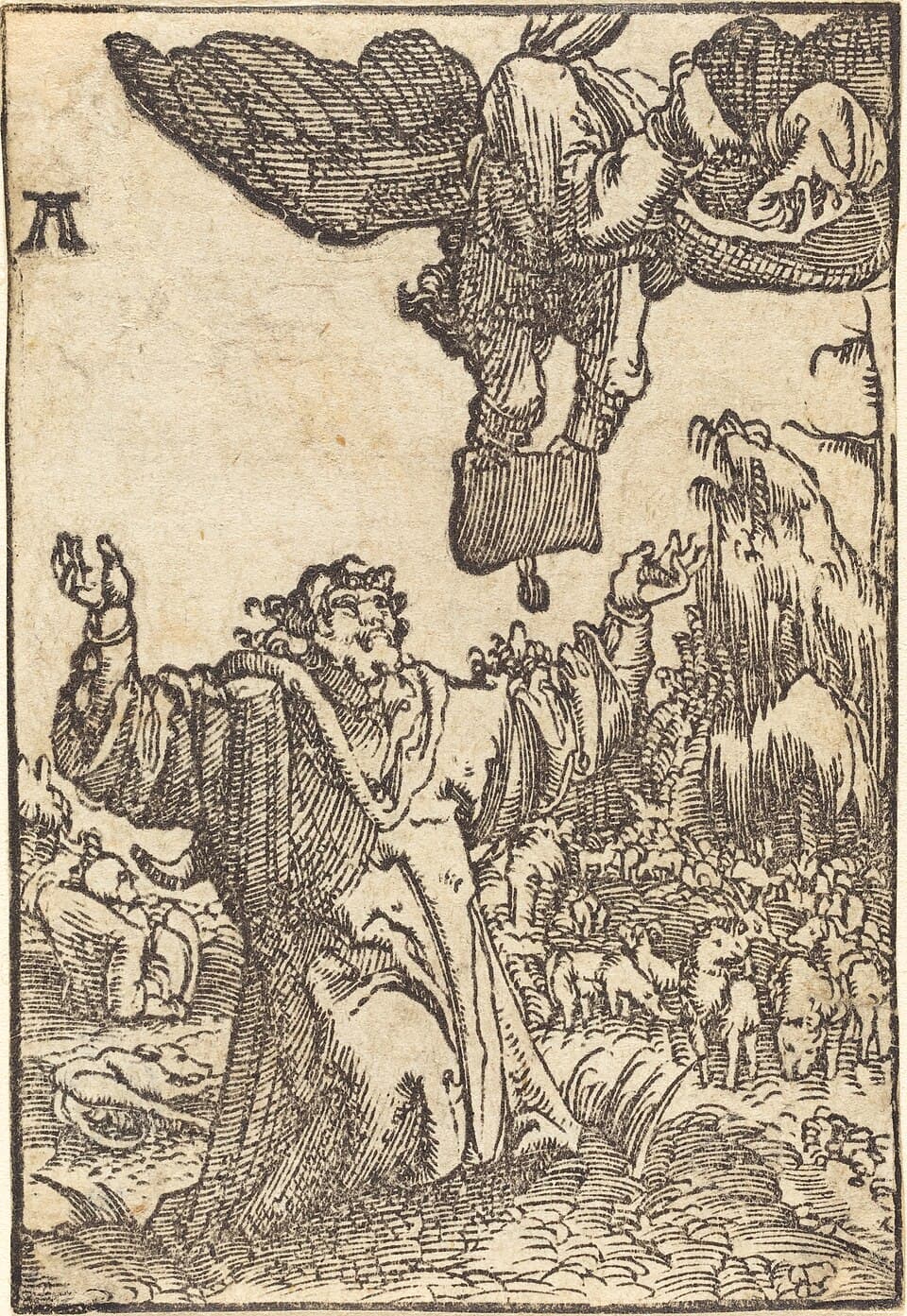
Meanwhile Anne prayed at home, and an angel told her she would conceive. 3 An angel went to Joachim as well, saying, "Joachim, Joachim, the Lord God has heard your prayer." 3 He came down with his flocks and sent ahead ten lambs for God, twelve calves for the priests and elders, and a hundred goats for the people. 3 Anne was waiting at the gate and "ran and hung upon his neck." 3 The next day he offered his gifts at the Temple, watching the plate on the priest's forehead for a sign, "and he saw no sin in himself." 3
The child was a girl, and Anne named her Mary. 3 At her first birthday Joachim gave a great feast for the priests, the scribes and the elders, and brought the child to them to be blessed. 3 When she was two he wanted to take her to the Temple to keep their vow; Anne asked to wait a year "in order that the child may not seek for father or mother," and Joachim agreed: "So let us wait." 3 At three she was brought up to the Temple with lamps burning ahead of her. 3
The 1907 encyclopedia notes that the whole account closely mirrors the conception of Samuel in First Samuel, whose mother was also named Hannah, and it treats that as grounds to doubt the names. 2 The translation itself marks Anne's vow to give her child to the Lord with a reference to 1 Samuel 1:11, Hannah's vow. 3
Jerusalem and the tomb
The Anne article's summary of the Protoevangelium places the couple in Nazareth. 2 The Joachim article reports a different tradition, that they lived first in Galilee and later settled in Jerusalem, where Mary was born and raised and where both of them died and were buried. 1
A church was built on the site of their house in the fourth century, "possibly by St. Helena," and called at various times St. Mary, St. Mary in Probatica and St. Anne. 1 Their tombs "were there honoured until the close of the ninth century," when the church became a Muslim school. 1 The crypt that had held the tombs was found again on March 18, 1889. 1
A feast that kept moving
The Greeks honored Joachim early, keeping his feast on the day after Mary's birthday; the 1907 encyclopedia gives that joint feast of Joachim and Anne as September 9. 12 The Latin Church was slower. According to the 1910 encyclopedia, his feast was kept sometimes on September 16 and sometimes on December 9, was assigned by Pope Julius II to March 20, suppressed about fifty years later, restored by Gregory XV in 1622, fixed by Clement XII in 1738 on the Sunday after the Assumption, and raised in rank by Leo XIII on August 1, 1879. 1
None of those is the date kept now. Franciscan Media, the Vatican News calendar of saints and Pope Francis all give July 26, the day the West had long kept for Anne, as the shared feast of the two of them. 2456
The grandfather of Jesus
On July 26, 2013, at World Youth Day in Rio de Janeiro, Pope Francis told the crowd at the Angelus that "today the Church celebrates the parents of the Virgin Mary, the grandparents of Jesus." 6 Mary grew up in their home, he said, "surrounded by their love and faith," and there she "learned to listen to the Lord and to follow his will." 6 He called Joachim and Anne "part of a long chain of people who had transmitted their faith and love for God." 6 Grandparents Day, he added, was being celebrated that same day. 6
In January 2021 he made that a Church-wide observance, the World Day for Grandparents and the Elderly, set for the fourth Sunday of July so as to fall close to the memorial of Joachim and Anne. 7 He gave as his reason that "grandparents are often forgotten." 7
Franciscan Media reaches the same place from the other direction. Whatever their real names were, it says, Joachim and Anne "represent that entire quiet series of generations who faithfully perform their duties, practice their faith, and establish an atmosphere for the coming of the Messiah, but remain obscure." 4
What is Saint Joachim the patron saint of?
Saint Joachim's feast day
Praying with Saint Joachim
Very little about Joachim survives that a historian would accept. 1 The story the Church has kept is about a man who was humiliated in public for something he could not help, went off alone, and would not eat until he had an answer. 3 It is a story about childlessness told from the man's side, and it gives him forty days of not knowing before anything changes.
The other thing the text gives him is small and domestic. He throws a party when his daughter turns one. 3 He wants to keep a vow on time, and his wife asks him to wait a year so the child will not miss her parents, and he waits. 3 Pope Francis put the weight of the feast on that household, the place where Mary "learned to listen to the Lord." 6
That is why grandparents are given to him and to Anne, and why the World Day for Grandparents and the Elderly sits beside their feast. 47 Franciscan Media's word for their kind of faithfulness is "obscure," and it puts the word in the same sentence as their duties and their faith. 4 Most of the people who pass faith on to a child are never written down at all, and in Joachim's case even the name may have been supplied later. 14
Saint Joachim, pray for us.
Sources
- 1.Charles Souvay, "St. Joachim," The Catholic Encyclopedia, Vol. 8 (New York: Robert Appleton Company, 1910).
- 2.Frederick Holweck, "St. Anne," The Catholic Encyclopedia, Vol. 1 (New York: Robert Appleton Company, 1907).
- 3.The Protevangelium of James, translated by Alexander Walker, in Ante-Nicene Fathers, Vol. 8, ed. Alexander Roberts, James Donaldson and A. Cleveland Coxe (Buffalo, NY: Christian Literature Publishing Co., 1886).
- 4."Saints Joachim and Anne," Saint of the Day, Franciscan Media.
- 5."Sts. Joachim and Anne, parents of B. V. Mary," Saint of the Day for 26 July, Vatican News.
- 6.Pope Francis, Angelus, central balcony of the Archbishop's Residence, Rio de Janeiro, July 26, 2013.
- 7."Pope establishes World Day for Grandparents and the Elderly," Vatican News, January 2021.
Saints to turn to next
Others in this collection who are turned to for some of the same things.