Saint Wulfstan of Worcester
c. 1008 - 1095
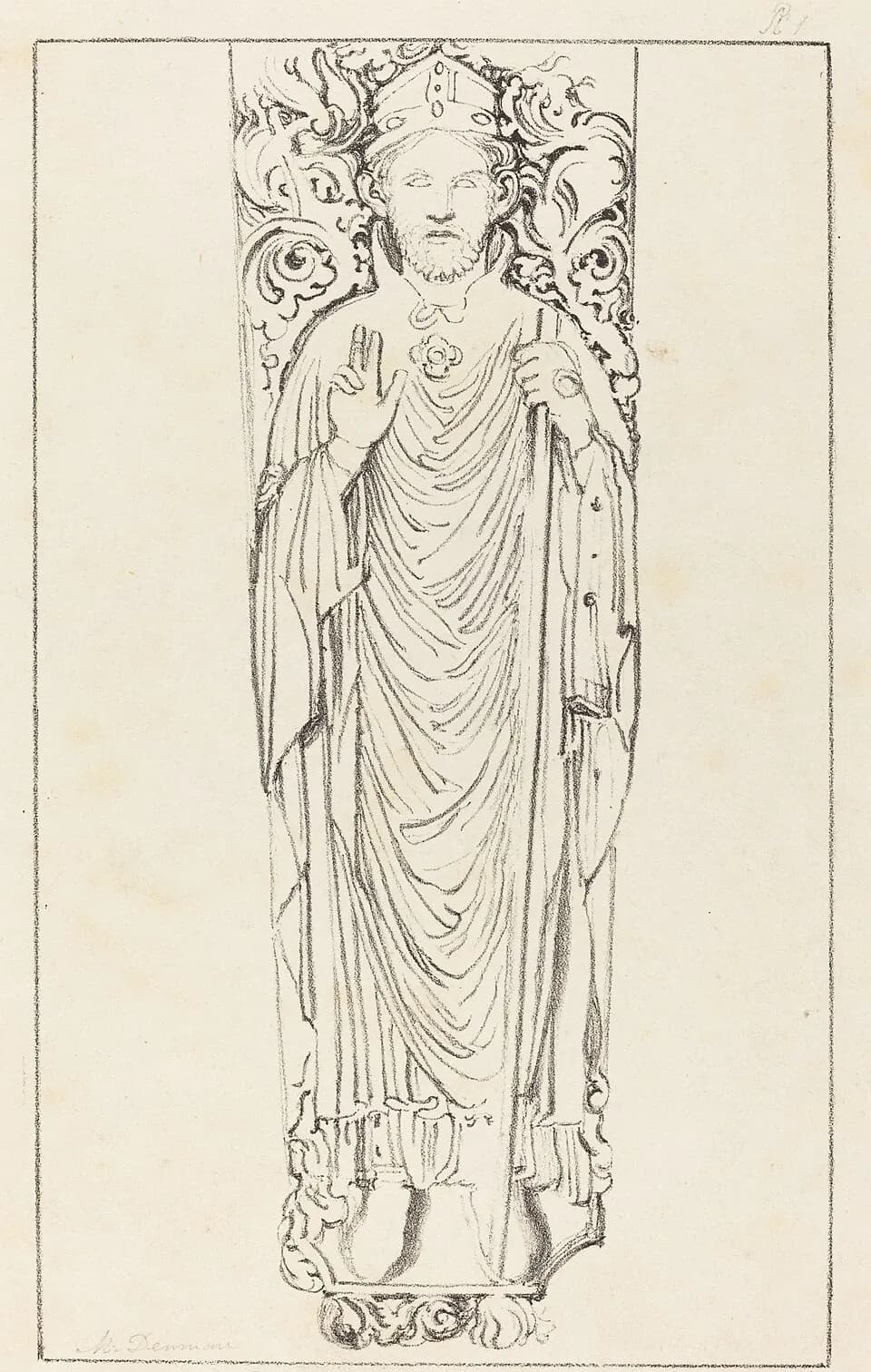
- Bishop of Worcester
- From September 8, 1062, until his death 1
- Known for
- Visiting his whole diocese, rebuilding the cathedral, and preaching down the Bristol slave trade 12
- Died
- January 19, 1095, at Worcester 1
Saint Wulfstan of Worcester was a Benedictine monk who became bishop of Worcester in 1062, four years before the Norman Conquest, and who was still its bishop when he died in 1095, one of the few Englishmen left in high office. 123 He rode his diocese parish by parish, rebuilt his cathedral, and preached against the trade that shipped slaves from Bristol to Ireland until it ended. 12 England keeps his feast on January 19. 3
The priest who turned down a rich church
He was born about 1008 at Long Itchington in Warwickshire. 13 Katolsk.no, the website of the Catholic Church in Norway, says about 1009 and adds that his parents were Anglo-Saxon. 2 He was schooled at the monasteries of Evesham and Peterborough, where, the same biography says, he stood out in piety and in sport alike. 12
As a young man he entered the household of the bishop of Worcester, about 1033 by the Norwegian account, and the bishop ordained him a priest; the 1913 Catholic Encyclopedia puts the ordination about 1038. 12 One story from those years survives. He had just celebrated Mass when the smell of meat roasting in the kitchen pulled his mind away, and he vowed never to eat meat again. 2
He was offered a richly endowed church and refused it. 12 He became a monk instead, in the cathedral priory at Worcester. 12 There he taught the boys, then served as cantor and sacristan, and about 1050 he was made prior of a community that numbered only twelve monks. 2 He got back land that had been confiscated, put the finances in order and tightened the observance. 2 The encyclopedia remembers him in that office "edifying all by his charity, holiness of life, and strict observance of the rule." 1
Bishop of Worcester
In 1062 Bishop Aldred of Worcester was promoted to York. He had hoped to keep both sees, as bishops sometimes had since Viking raids impoverished York, and Rome said no. 2 The encyclopedia says it was two Roman cardinals "who had been Wolstan's guests at Worcester during Lent" who recommended the prior to the king; katolsk.no calls them papal legates. 12 Saint Edward the Confessor and his council agreed, and a reluctant Wulfstan was consecrated by Aldred on September 8, 1062. 12
He is the first English bishop known to have made systematic visitations of his diocese. 2 The encyclopedia has him "visiting, preaching, and confirming without intermission." 1 He encouraged the building of parish churches on his own estates and on those of lay lords, enforced celibacy among his priests, and insisted that altars be made of stone and not of wood. 2 On the road he recited the psalter, and he never passed a church or chapel without going in to pray before the altar. 2 In the encyclopedia's words, "the Psalms were always on his lips," and he said the Divine Office aloud with his attendants as they rode. 1
How learned he was is disputed. The encyclopedia says he was not "a man of special learning or commanding intellect." 1 Katolsk.no answers that the story of an ill-educated bishop is a late legend and can be dismissed: he was no great scholar, but probably no more and no less of one than the other Anglo-Saxon bishops of his day, and under him Worcester became one of the chief centers of Old English literature and culture. 2 In his cathedral he took a full part in the liturgy and commented on the Latin readings in English. 2 He had a particular devotion to the English saints, to Bede, to whom he dedicated a church, to Dunstan, and to Oswald, his distant predecessor at Worcester. 2
The Danes had burned Worcester in 1041 and ruined the cathedral Oswald built. 5 Wulfstan rebuilt it between 1084 and 1089, "in the simple Saxon style," says the encyclopedia. 15 Katolsk.no dates the work to about 1086 and records that he loved the old building he had to pull down. The crypt of his church, somewhat altered, is still there. 2
After the Conquest
Politics found him anyway. After the battle of Hastings, which he recognized as decisive, he was among the first bishops to submit to William the Conqueror. 2 William put his own men into the English sees, but Wulfstan kept his. 2 "All the best elements in the Saxon hierarchy he retained and supported," Herbert Thurston wrote of the king in the encyclopedia. "St. Wulstan was confirmed in the possession of the See of Worcester." 7
A legend grew up around that survival, and the encyclopedia calls it one. Aelred of Rievaulx tells that Wulfstan was called upon to resign his bishopric and laid his crozier on the tomb of Edward the Confessor at Westminster, the king under whom he had received it. "The crozier remained immoveable," which was taken as a sign from heaven that he was to stay. 1
What he made of the new order depends on who is telling it. In the barons' revolts of 1074 and 1088, katolsk.no says, he was loyal to the crown and defended the castle at Worcester against the rebels, and when Englishmen complained to him of Norman oppression he would answer that it was a scourge from God for their sins and had to be borne with patience. 2 Abbot Paul of Belmont, writing on the feast in 2023, remembers a man "brave enough to stand up to the Norman conquerors" who denounced their injustices and refused to give up his see to a Norman favorite of the king. 8
The slave trade at Bristol
The care of his diocese was his chief interest, and one of the things he is most remembered for came out of it. Slaves were being shipped from Bristol to Viking Ireland. Wulfstan preached against the trade, tirelessly and persuasively, until it was abolished, while Archbishop Lanfranc of Canterbury worked toward the same end. 2
He restored the monastery at Westbury on Trym, and as far as a bishop could he went on living by the monastic rule. 12 The young men brought up in his household were taught to carry in the food and wait on the poor at table, and he did it himself to show them how. 2 The note in the English calendar sums him up as "renowned as a confessor, and for his care of the poor and the sick and for the high standards he demanded of his clergy." 3 The Roman Martyrology makes the same judgment in its own terms: a bishop raised from the cloister who joined a monk's habits to a pastor's zeal, visiting parishes, promoting the building of churches, fostering letters and condemning venality. 4
Death and shrine
The monk Coleman, who wrote his life, described a man of middle height, always in good health, neither lavish nor mean in his dress or in the way he lived. 2 He died at Worcester on January 19, 1095, at eighty-seven. 12 His body, "clothed in pontifical vestments," lay in the church for three days, and then his friend Robert, bishop of Hereford, to whom he was said to have appeared in a vision, came to bury him. 6
Cures were reported at the tomb almost at once. 2 King William Rufus had it covered in gold and silver, the relics were enshrined in 1198, and from 1200 full records of the healings were kept with a canonization in view. Pope Innocent III granted it in 1203. 26
King John held his memory especially dear and in 1216 was buried, as the encyclopedia puts it, "between the shrines of the two Worcester saints, Oswald and Wulstan." 25 The shrine lasted three centuries more. Wulfstan's tomb "was rifled of its treasures and despoiled by Henry VIII about the year 1539." 6
What is Saint Wulfstan the patron saint of?
None of the sources behind this page names Saint Wulfstan as the patron saint of anything. The encyclopedia does not, the Norwegian biography does not, and neither do the English calendar or the Roman Martyrology. 1234 Lists of patronages attached to his name circulate online, and this page does not repeat them without a source it can check.
Saint Wulfstan's feast day
Saint Wulfstan's feast is January 19 in the National Calendar for England, the day the encyclopedia gives for his death. 13 Katolsk.no gives the same day, and the Benedictines of Belmont keep it. 28 The current Roman Martyrology enters him a day later, on January 20. 4
There was once a second feast as well, on June 7, for the translation of his relics, and katolsk.no notes that his day was widely kept in monastic and diocesan calendars. 2
Praying with Saint Wulfstan
Most of what the sources say about him is routine. He visited parishes. He confirmed children. He said the psalms on horseback and stopped at every church he passed. 12 Nothing in that list is dramatic, and he did it for thirty-two years. 1
He was not, by the encyclopedia's account, a brilliant man, and he seems not to have needed to be. 1 He turned down the rich church, took the bishopric unwillingly, and went on eating and dressing like a monk after he had it. 12 The boys in his household learned humility by serving the poor at table beside him. 2
His response to the Conquest is harder to admire cleanly, and the sources do not agree about it. He submitted early, defended a Norman castle, and told his own people to bear what had come on them as a penance. 2 The abbot of Belmont remembers him denouncing the conquerors' injustices. 8 What is not in doubt is the trade at Bristol. That was an evil in front of him, inside his own diocese, and he preached against it until it stopped. 2
He also loved things that were passing. He honored the old English saints, glossed the Latin in English for his people, and grieved over the old cathedral even as he built the new one. 2 Abbot Paul calls him "a truly great Englishman." 8
Saint Wulfstan of Worcester, pray for us.
Sources
- 1.Oswald Hunter-Blair, "St. Wolstan," The Catholic Encyclopedia, Vol. 15 (New York: Robert Appleton Company, 1912).
- 2.Per Einar Odden, "Den hellige Wulfstan av Worcester (~1009 - 1095)," Den katolske kirke (the Catholic Church in Norway), last updated June 8, 1998 (in Norwegian).
- 3."National Calendar for England," entry for January 19, "St Wulstan, bishop, religious," Liturgy Office of the Catholic Bishops' Conference of England and Wales.
- 4.Roman Martyrology, entry for January 20, "San Vulfstano, vescovo," as printed in "Santo del giorno," Conferenza Episcopale Italiana (in Italian).
- 5.Edwin Burton, "Ancient Diocese of Worcester," The Catholic Encyclopedia, Vol. 15 (New York: Robert Appleton Company, 1912).
- 6.Peter Chandlery, "Shrines of Our Lady and the Saints in Great Britain and Ireland," The Catholic Encyclopedia, Vol. 13 (New York: Robert Appleton Company, 1912).
- 7.Herbert Thurston, "England (Before the Reformation)," The Catholic Encyclopedia, Vol. 5 (New York: Robert Appleton Company, 1909).
- 8.Abbot Paul, "Message of Abbot Paul - Thursday 19th January 2023," Belmont Abbey (Benedictine), January 19, 2023.
Saints to turn to next
Others in this collection who are turned to for some of the same things.
- Saint Anthony Mary ClaretDecember 23, 1807 - October 24, 1870Work and vocationCouragePrayer
- Saint Arnold JanssenNovember 5, 1837 - January 15, 1909Work and vocationCouragePrayer
- Saint Ferdinand III of Castilec. 1198 - May 30, 1252Work and vocationCouragePrayer
- Saint Hugh of Grenoble1053 - April 1, 1132Work and vocationCouragePrayer