Saint Ferdinand III of Castile
c. 1198 - May 30, 1252
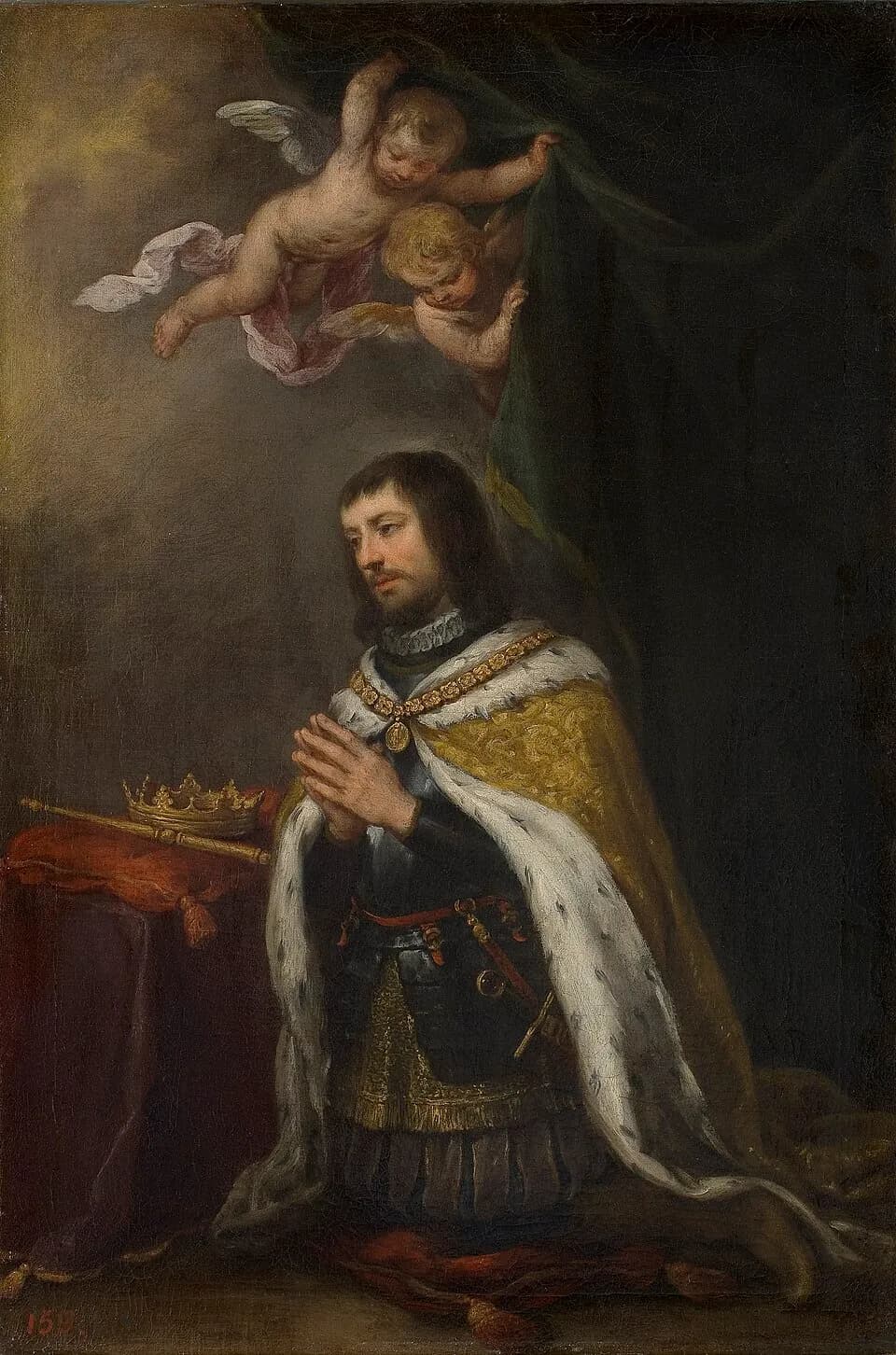
- Born
- 1198 near Salamanca, by the encyclopedia; 1199 or 1201 at Valparaíso, Zamora, by the Archdiocese of Seville 13
- King of Castile
- From 1217 1
- Married
- Beatrice of Swabia, 1219; seven children 1
- Canonized
- 1671, by Pope Clement X 1
- Patron of
- The city of Seville 3
Saint Ferdinand III became king of Castile in 1217 and of León in 1230, joined the two crowns for good, and took Córdoba and Seville from their Muslim rulers. 17 The Catholic Encyclopedia remembers him as a soldier who "lived like a religious in the cloister" in the middle of an army camp, fasting, wearing a hairshirt and praying through the night before battles. 1 He died at Seville on May 30, 1252, was canonized in 1671, and lies in a silver urn in the cathedral there. 15 His feast is May 30. 4
Heir to two kingdoms
Ferdinand was the son of Alfonso IX, king of León, and Berenguela, daughter of the king of Castile. 1 His mother's sister was Blanche, the mother of Saint Louis IX of France, so the two royal saints were first cousins. 1 The sources differ on his birth. The encyclopedia says 1198, near Salamanca; the Archdiocese of Seville says 1199 or 1201, at Valparaíso in Zamora; and the encyclopedia's article on Burgos settles for "c. 1200." 137
He came to the throne of Castile in 1217 through his mother, who, the encyclopedia says, renounced the crown in his favor. 1 The Archdiocese of Seville dates it from the death of King Henry I that year. 3 In 1230, when his father died, he succeeded to León as well, "though not without civil strife, since many were opposed to the union of the two kingdoms." 13 The union held. Under him, the Burgos article says, León and Castile "were definitely united," though each kept its own name for centuries afterward. 7
On his mother's advice he married Beatrice in 1219. She was the daughter of Philip of Swabia, king of Germany, and the encyclopedia calls her "one of the most virtuous princesses of her time." 1 They had seven children, six sons and a daughter. 1 One son was Alfonso X, called the Wise; another, Philip, was appointed archbishop of Seville. 23
How he governed
The encyclopedia's account of his rule is brief and admiring. He "took as his counsellors the wisest men in the State, saw to the strict administration of justice, and took the greatest care not to overburden his subjects with taxation." 1 It preserves one saying of his on that last point, that he feared "the curse of one poor woman more than a whole army of Saracens." 1
The cathedral of Burgos was begun in 1221, in his reign and Beatrice's, by Bishop Mauritius. 7 He is also credited with the University of Salamanca. The encyclopedia's article on Ferdinand says simply that he founded it; its article on the university explains that his father had set up schools there first, that the foundation did not last, and that Ferdinand "was in reality the founder." 18 On April 6, 1243, he took the professors, the students and their property under his protection and gave them a tribunal of their own for settling disputes. 8
Córdoba and Seville
His long wars were with the Muslim kingdoms of the south, and the encyclopedia states his purpose in the language of its day: "the propagation of the Faith and the liberation of Spain from the Saracen yoke." 1 The Archdiocese of Seville dates his campaigns from 1224 and counts their result as the whole valley of the Guadalquivir: Córdoba in 1236, Jaén in 1246, Seville in 1248. 3 The encyclopedia calls the taking of Córdoba and Seville "the greatest joys of his life." 1
Seville fell after a siege of fifteen months. 2 A fleet under Ramón Bonifaz, whom Ferdinand had charged with forming it, cut the city off by water and destroyed the bridge by which it was supplied. 37 The city surrendered on November 23, 1248. 2 The archdiocese notes that the campaign gathered legends, and labels them as such: that the Virgin appeared to the king to promise him the city, that he once slipped inside the walls alone and in disguise to study the defenses, and that the tailors' guild made him a master because he had sewn up with his own hands a banner of the Virgin torn by an arrow. 3
In both cities he turned the great mosque into a cathedral and dedicated it to the Blessed Virgin. 1 At Córdoba parishes were set up, convents were built for Dominicans, Franciscans and Mercedarians, and settlers were drawn in by the privileges he granted them. 6 At Seville the bishop of Córdoba prepared the mosque for worship on December 22, 1248, most of the city's other mosques became churches, and three were left to the Jews as synagogues. 2 The king placed in the new cathedral two images of Mary, one of them Our Lady of the Kings, which, the encyclopedia says, he "always carried with him in battle on his saddle bow." 2 He also obtained from the Holy See the restoration of the archbishopric and endowed it from his own property. 4
By the encyclopedia's reckoning, when he died "Granada and Alicante alone" remained in Muslim hands. 1 The Archdiocese of Seville names the district of Cádiz, which his son took later, and the kingdom of Granada. 3
The king in the camp
What made a saint of this king, in the encyclopedia's telling, was how he lived while he fought. He "watched over the conduct of his soldiers, confiding more in their virtue than in their valour, fasted strictly himself, wore a rough hairshirt, and often spent his nights in prayer, especially before battles." 1 It gives him two guiding motives, "the glory of the Church and the happiness of his people." 1 He founded bishoprics in the chief towns, built churches, founded monasteries and endowed hospitals. 1
The encyclopedia also calls him a member of the Third Order of Saint Francis, and says that he was buried, at his own request, in its habit. 1
Death and the silver urn
Ferdinand spent the four years after the conquest reorganizing Seville. He gave it the charter of Toledo, founded parishes and convents, and divided houses and land among his knights. 3 He died there on May 30, 1252, in the Alcázar according to the archdiocese, and was buried in the former mosque that was now the cathedral, before the image of the Blessed Virgin. 13
Many miracles were reported at his tomb, and Pope Clement X canonized him in 1671. 1 The encyclopedia says cautiously that his body, "it is said, remains incorrupt"; the archdiocese and the cathedral chapter say so without the qualification. 145 It rests in the Royal Chapel, at the feet of Our Lady of the Kings, in a silver urn by Juan Laureano de Pina that was finished in 1719. 5 The body was moved into it in 1729, while King Philip V was staying in Seville, and so many people came to see it that a royal decree of June 30 that year allowed the urn to be opened four days a year: May 14, May 30, August 22 and November 23, the anniversary of the conquest. 5
What is Saint Ferdinand III of Castile the patron saint of?
Saint Ferdinand is the patron saint of the city of Seville, as its archdiocese calls him. 3 The city has venerated him since his death as its Christian refounder, the archdiocese says, and from his canonization as its patron and protector. 3 None of the sources consulted for this page names him patron of a trade or profession, and the page does not supply one. 13
Saint Ferdinand III of Castile's feast day
His feast is May 30, the day of his death. The encyclopedia, in 1909, noted that it "is kept by the Minorites," the Franciscans, on that day. 1 The Archdiocese of Seville keeps it as a feast, with Mass and the opening of the urn in the Royal Chapel, and Vatican News lists "St. Ferdinand, King of Castilla" on May 30. 349
Praying with Saint Ferdinand III of Castile
Ferdinand is a saint of public life. He inherited two quarrelsome kingdoms, a frontier and an army, and his holiness, as the encyclopedia tells it, was worked out there: in choosing advisers, in giving judgment, in refusing to tax the poor into the ground. 1
The wars are the hard part for a modern reader, and the sources do not soften them. The encyclopedia counts conquests as the great joys of his life, and the great mosques of Córdoba and Seville became cathedrals. 1 The same account has him awake and praying on the nights before battle, and more concerned with how his soldiers behaved than with how well they fought. 1
The saying about the poor woman is the thing most worth keeping. A king with armies in the field said that her curse frightened him more than the enemy did. 1 It is a ruler's examination of conscience in one line.
He asked to be buried as a Franciscan tertiary, in the habit, in front of an image of Mary. 1 The statue he had carried on his saddle went into the cathedral, and his body still lies at the feet of Our Lady of the Kings. 25
Saint Ferdinand III of Castile, pray for us.
Sources
- 1.Ferdinand Heckmann, "St. Ferdinand III," The Catholic Encyclopedia, vol. 6 (New York: Robert Appleton Company, 1909).
- 2.Ramón Ruiz Amadó, "Seville," The Catholic Encyclopedia, vol. 13 (New York: Robert Appleton Company, 1912).
- 3."30 de mayo: festividad de San Fernando, patrón de Sevilla," Archidiócesis de Sevilla, May 30, 2015 (in Spanish).
- 4."Santoral sevillano," Archidiócesis de Sevilla (in Spanish).
- 5."¿Por qué se abre la urna de San Fernando hoy? Cuatro fechas para venerar al Rey Santo," Catedral de Sevilla, August 22, 2026 (in Spanish).
- 6.Manuel García Osuna, "Cordova," The Catholic Encyclopedia, vol. 4 (New York: Robert Appleton Company, 1908).
- 7.Tirso López Bardón, "Burgos," The Catholic Encyclopedia, vol. 3 (New York: Robert Appleton Company, 1908).
- 8.Ramón Ruiz Amadó, "University of Salamanca," The Catholic Encyclopedia, vol. 13 (New York: Robert Appleton Company, 1912).
- 9."St. Ferdinand, King of Castilla," Saint of the Day, 30 May, Vatican News.
Saints to turn to next
Others in this collection who are turned to for some of the same things.
- Saint Anthony Mary ClaretDecember 23, 1807 - October 24, 1870Work and vocationCouragePrayer
- Saint Arnold JanssenNovember 5, 1837 - January 15, 1909Work and vocationCouragePrayer
- Saint Hugh of Grenoble1053 - April 1, 1132Work and vocationCouragePrayer
- Saint Hugh of Lincolnc. 1135 or 1140 - November 16, 1200CouragePrayerWork and vocation