Saint Anthony Mary Claret
December 23, 1807 - October 24, 1870
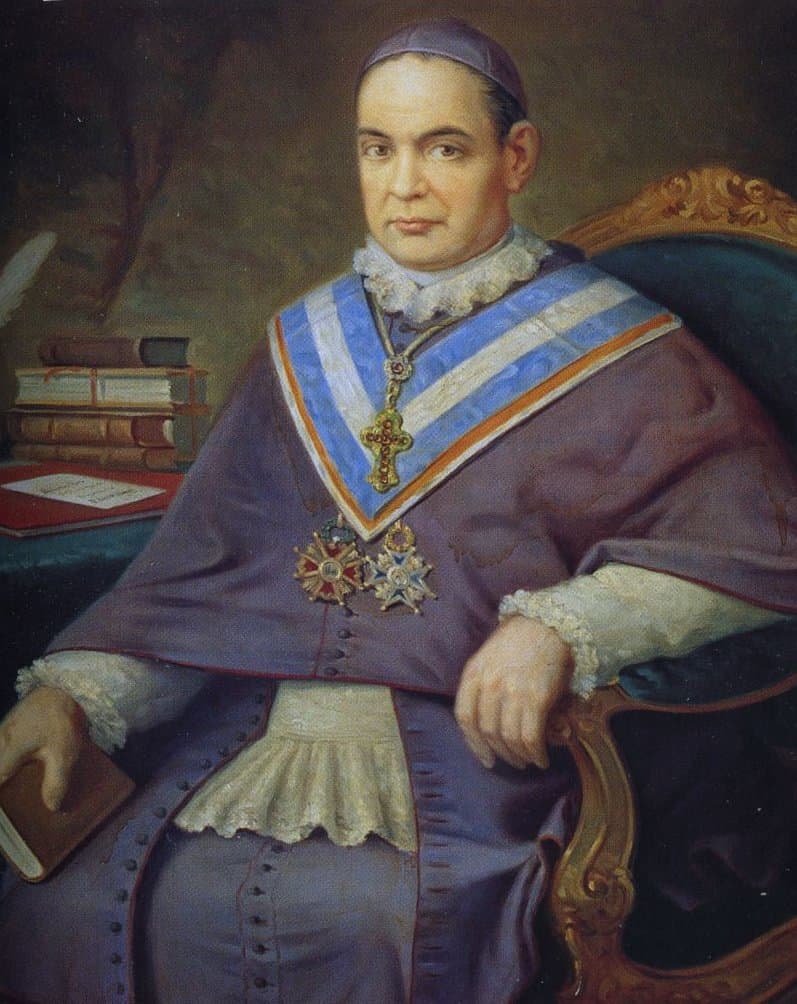
- Patron saint of
- Weavers 2
- Ordained
- June 13, 1835 1
- Founded
- The Missionary Sons of the Immaculate Heart of Mary (the Claretians), July 16, 1849, at Vich 14
- Archbishop
- Of Santiago de Cuba, appointed 1851 1
- Motto
- "Caritas Christi urget nos" 5
- Canonized
- 1950, by Pope Pius XII 1
Saint Anthony Mary Claret was a Catalan weaver who became a priest, one of the best-known preachers in Spain, Archbishop of Santiago de Cuba and confessor to Queen Isabella II. 12 He founded the Missionary Sons of the Immaculate Heart of Mary, known today as the Claretians, and a religious publishing house in Barcelona that put millions of cheap Catholic books into circulation. 124 Franciscan Media calls him "the spiritual father of Cuba," and lists the jobs he held as missionary, religious founder, social reformer, queen's chaplain, writer and publisher, archbishop, and refugee. 2
A weaver from Sallent
He was born at Sallent, near Barcelona, on December 23, 1807, the son of a small manufacturer of woolen cloth. 1 He had an elementary education in the village and at twelve became a weaver. 1 A little later he went to Barcelona to specialize in the trade and stayed there until he was twenty. 1 Franciscan Media describes him as a weaver and designer in the textile mills of the city. 2
He spent his spare time studying, and the encyclopedia says he became proficient in Latin, French and engraving; Franciscan Media says Latin and printing, and remarks that the future priest and publisher was already preparing. 12 The encyclopedia adds that he also enlisted in the army as a volunteer. 1
Priest and missionary in Catalonia
Recognizing a call to a different life, he left Barcelona and entered the seminary at Vich in 1829. 1 He was ordained on June 13, 1835, and held a benefice in his home parish while he went on studying theology until 1839. 1
He tried religious life twice, and the sources tell it differently. The encyclopedia says he wanted to become a Carthusian, then felt drawn to missionary work, went to Rome and entered the Jesuit novitiate there, and returned to Spain after finding himself unsuited to that way of life. 1 Franciscan Media says ill health prevented him from entering either order. 2
Back in Spain he worked at Viladrau and Gerona and drew notice for his efforts on behalf of the poor. 1 His superiors recalled him to Vich and sent him out on missions across Catalonia. 1 Franciscan Media says he spent ten years giving popular missions and retreats and became one of the most popular preachers in Spain, always putting great emphasis on the Eucharist and on devotion to the Immaculate Heart of Mary. 2 "It was said that his rosary was never out of his hand." 2 In 1848 he was sent to the Canary Islands, where he gave retreats for fifteen months. 1
The Claretians and the religious library
On July 16, 1849, back at Vich, he founded the Congregation of the Missionary Sons of the Immaculate Heart of Mary. 14 John Paul II, writing for its 150th anniversary, describes the day: he founded it "with five other young priests" in "a humble cell at the seminary of Vich." 4 The pope also gives his reason for founding a community at all: "Fr Claret wanted to do with others what he could not do on his own." 4 Pius IX gave the congregation its definitive approval on February 11, 1870, and by the time the encyclopedia was printed it had more than 110 houses and 2,000 members. 1 The encyclopedia also says he founded, or wrote the rules for, several communities of women. 1
The printed word mattered to him all his life. 2 He founded the religious library at Barcelona that bears his name, which the encyclopedia says issued several million cheap copies of the best Catholic books, old and new; Franciscan Media calls it the Religious Publishing House, a major Catholic publishing venture in Spain. 12 John Paul II names the press first among the ways he spread the Word of God, ahead of catechesis and preaching. 4
Archbishop of Santiago de Cuba
At the request of the Spanish crown, Pius IX named him Archbishop of Santiago de Cuba in 1851. 1 He was consecrated at Vich and sailed from Barcelona on December 28. 1 Franciscan Media calls the archdiocese "much-neglected." 2 He began reforming it at once: the seminary was reorganized, clerical discipline tightened, and more than nine thousand marriages were validated in the first two years. 1 He built a hospital and many schools, made a visitation of the whole diocese three times, and preached missions constantly. 1
Franciscan Media says the bitter opposition he met was mainly over two things: he opposed concubinage, and he gave instruction to Black slaves. 2 He also had a plan for the poverty of the island that put him at odds with the sugar interests. He wanted Cubans to farm their own land, growing a variety of food for their families and for the market rather than working a single cash crop. 2 He wrote two books on the subject in Cuba, Reflections on Agriculture and Country Delights. 2
The opposition turned violent. The encyclopedia counts fifteen attempts on his life, Franciscan Media fourteen. 12 At Holguin a would-be assassin attacked him with a knife; the encyclopedia says his cheek was laid open from ear to chin, and Franciscan Media says his face and wrist were slashed. 12 Franciscan Media adds that the attacker was a man whose release from prison he had obtained, and that he then succeeded in having the man's death sentence commuted to prison. 2
At the court of Isabella II
In February 1857 Isabella II recalled him to Spain and made him her confessor. 1 He was allowed to resign his see and was given the titular see of Trajanopolis. 1 Franciscan Media says it was a job he did not want, and that he accepted on three conditions: he would live away from the palace, come only to hear the queen's confession and teach the children, and be excused from court functions. 2 The encyclopedia says he lived frugally, took his lodging at an Italian hospice, and used his influence to help the poor and spread learning. 1
For nine years he was rector of the Escorial monastery, where he set up a scientific laboratory, a natural history museum, a library, a college, and schools of music and languages. 1 When Isabella recognized the new government of united Italy, he left the court and went to the pope; at the pope's command he went back to Madrid with faculties to absolve the queen from the censures she had incurred. 1
The revolution of 1868 ended his plans. 1 Franciscan Media says he fled to Paris with the queen's party and preached there to the Spanish community. 2 He went to Rome in 1869 for the First Vatican Council, where Franciscan Media says he was a firm defender of papal infallibility, and that Cardinal Gibbons of Baltimore said of him, "There goes a true saint." 12
Exile and death
His health was failing, and he withdrew to Prades in France, where, the encyclopedia says, his enemies in Spain still harassed him with slander. 1 Franciscan Media says the slander was so ugly that "the very name Claret became a byword for humiliation and misfortune." 2 He retired to the Cistercian abbey of Fontfroide, near Narbonne, and died there on October 24, 1870; Franciscan Media says he died in exile near the Spanish border. 12
His cause was opened in 1887, and Leo XIII declared him Venerable in 1899. 1 When his remains were moved to the mission house at Vich in 1897, his heart was found incorrupt. 1 He was canonized by Pius XII in 1950. 1 The encyclopedia counts his printed works at over 130 and says his sermons and writings did much to revive the Catalan language. 1 He also wrote an autobiography at the order of his spiritual director, which John Paul II calls "the Magna Carta of Claretian spirituality." 14
What is Saint Anthony Mary Claret the patron saint of?
Franciscan Media lists Saint Anthony Mary Claret as patron saint of weavers, the trade he learned at twelve and practiced in Barcelona until he was twenty. 12 None of the other sources consulted names a patronage. He founded a Catholic publishing house and is often associated with the Catholic press, but no source here calls him patron of printers or publishers, so this page does not either. 12
Saint Anthony Mary Claret's feast day
The feast of Saint Anthony Mary Claret is October 24, the day he died at Fontfroide in 1870. 12 Franciscan Media keeps him on that date, and the Vatican News calendar for October 24 lists "St. Antony Mary Claret, Bishop, Founder of the Congregation of the Missionaries Sons of the Immaculate Heart of Mary." 23
Praying with Saint Anthony Mary Claret
He chose for his coat of arms the words "Caritas Christi urget nos," the love of Christ urges us on, and Pope Francis pointed the Claretians back to that motto in 2015. 5 The life fits it. He preached in Catalonia, the Canary Islands, Cuba, Madrid and Paris, and when one place closed to him he went on preaching in the next. 12 John Paul II says his life "was consumed with apostolic zeal to make God known, loved and served." 4
Much of the work was ordinary and unglamorous: validating marriages, reorganizing a seminary, getting cheap books printed by the million, writing about crops. 12 He thought the misery of the Cuban poor had something to do with how land was farmed, and said so in print, which earned him the enmity of the interests that wanted everyone growing sugar. 2
The cost was real. He was attacked with a knife by a man he had helped get out of prison, and then pleaded for that man's life. 2 He spent his last years ill and abroad, with his name, by Franciscan Media's account, turned into a byword for misfortune. 12 None of the sources treat that ending as a reversal of what came before, and Cardinal Gibbons, meeting him in Rome in the last year of his life, saw a saint. 2
The founding is perhaps the plainest thing about him. A man who could preach to whole provinces gathered five young priests in a seminary cell, because, as John Paul II puts it, he "wanted to do with others what he could not do on his own." 4
Saint Anthony Mary Claret, pray for us.
Sources
- 1.Andrew MacErlean, "Ven. Antonio María Claret y Clará," The Catholic Encyclopedia, vol. 16 (New York: The Encyclopedia Press, 1914), with New Advent's note on his canonization.
- 2."Saint Anthony Mary Claret," Saint of the Day, Franciscan Media.
- 3."Saint of the Day: 24 October," Vatican News, Dicastery for Communication.
- 4.John Paul II, Letter to Fr Aquilino Bocos Merino, Superior General of the Claretians, on the 150th anniversary of the foundation, June 12, 1999.
- 5.Pope Francis, Address to participants in the General Chapter of the Missionary Sons of the Immaculate Heart of Mary (Claretians), September 11, 2015, prepared text.
Saints to turn to next
Others in this collection who are turned to for some of the same things.
- Saint John EudesNovember 14, 1601 - August 19, 1680PrayerWork and vocationCourage
- Saint Katharine DrexelNovember 26, 1858 - March 3, 1955Work and vocationPrayerCourage
- Saint Rose Philippine DuchesneAugust 29, 1769 - November 18, 1852PrayerCourageWork and vocation
- Saint Sylvester IDied December 31, 335CourageWork and vocationPrayer