Saint Sylvester I
Died December 31, 335
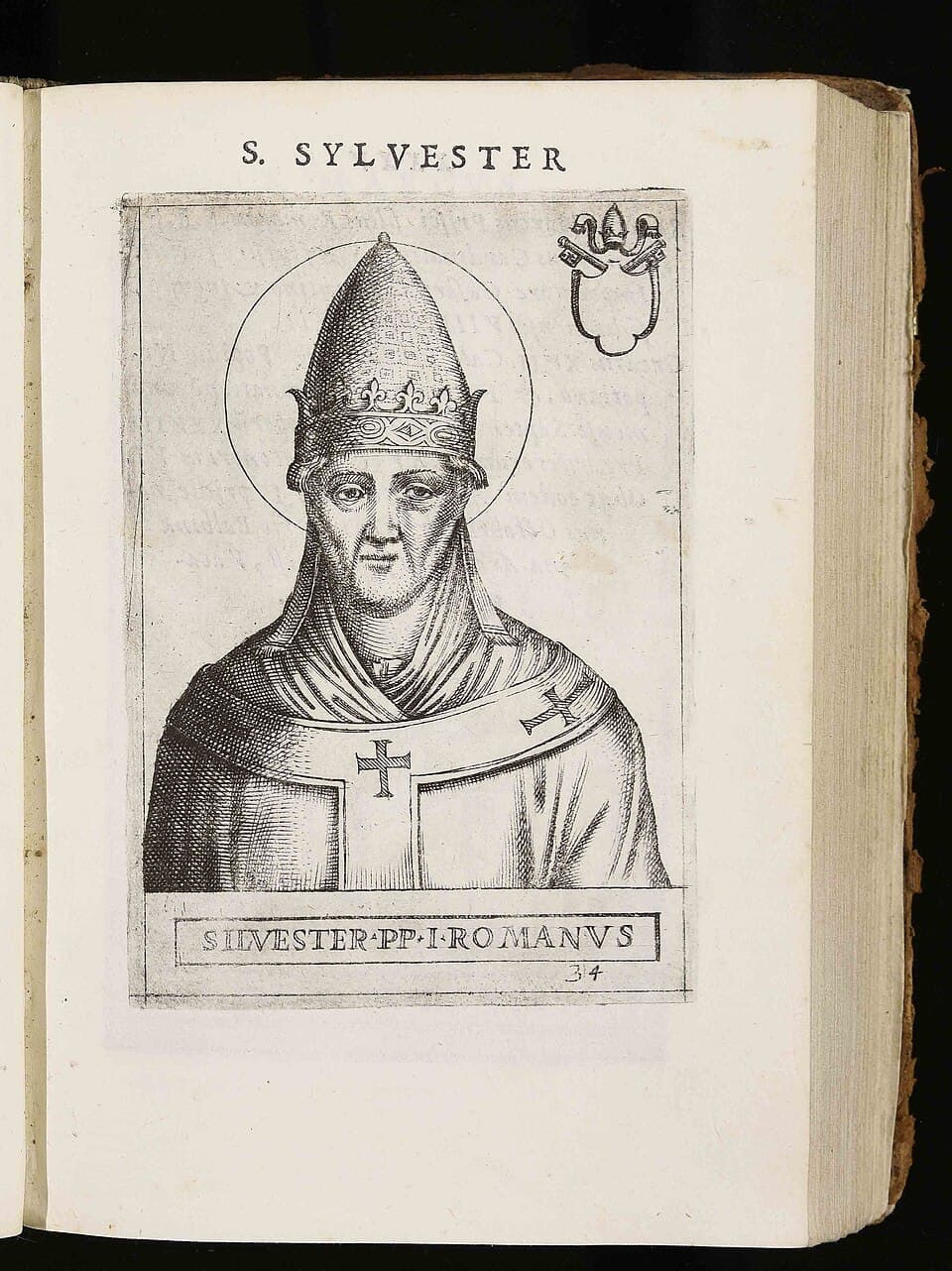
- Feast day
- December 31, from a burial list of the Roman bishops compiled about a year after he died 1
- Born
- Date unknown. The Liber pontificalis makes him the son of a Roman named Rufinus 1
- The Donation of Constantine
- A forgery. Kirsch calls the whole set of claims made in his name "entirely legendary" 1
- Nicaea
- He sent legates. The word homoousion "was probably agreed upon with him before the council" 1
- Buried
- In a church he built over the Catacomb of Priscilla on the Via Salaria 1
Saint Sylvester I was pope for twenty-one years across the most consequential period in the Church's history - the Edict of Milan, the first great basilicas, the Council of Nicaea - and almost nothing is known about what he did. 12 The famous documents about him, including the Donation of Constantine, are forgeries, and his own encyclopedia says so plainly. 1 What can be said is that the Church came out of that reign still independent of the emperor. 2
The most important pontificate nobody can describe
Kirsch opens with a blank: "Date of birth unknown; d. 31 December, 335." 1 The Liber pontificalis makes him the son of a Roman called Rufinus; a later legendary life supplies his mother's name. 1 He succeeded Miltiades and held the see for twenty-one years. 1
And then a frank complaint. "This was the era of Constantine the Great, when the public position of the Church so greatly improved, a change which must certainly have been very noticeable at Rome; it is consequently to be regretted that there is so little authoritative information concerning Sylvester's pontificate." 1
Franciscan Media lists what happened on his watch - "the Edict of Milan, the emergence of the Church from the catacombs, the building of the great basilicas - Saint John Lateran, Saint Peter's, and others - the Council of Nicaea" - and then adds the sentence that defines the problem: "But for the most part, these events were planned or brought about by Emperor Constantine." 2
The Church's greatest external change happened during his reign and was driven by somebody else.
The forgeries
Into that vacuum the legends poured, and Kirsch is unusually specific about where they came from. "At an early date legend brings him into close relationship with the first Christian emperor, but in a way that is contrary to historical fact." 1
He names three documents: the "Vita beati Sylvestri", which appeared in the East and survives in Greek, Syriac and Latin; the "Constitutum Sylvestri", an apocryphal account of a Roman council that "belongs to the Symmachian forgeries and appeared between 501 and 508"; and the "Donatio Constantini" - the Donation of Constantine. 1
Then the verdict, in one sentence covering all of it: "The accounts given in all these writings concerning the persecution of Sylvester, the healing and baptism of Constantine, the emperor's gift to the pope, the rights granted to the latter, and the council of 275 bishops at Rome, are entirely legendary." 1
It is worth being clear what is being dismissed there. The Donation of Constantine was the document on which the temporal authority of the papacy was argued for something like seven centuries: the story that Constantine, cured of leprosy and baptized by Sylvester, handed him Rome and the West. The Catholic Encyclopedia, in the entry about Sylvester himself, calls it legend and dates the related forgery to two hundred years after he died. 1
Franciscan Media reaches the same place more gently: "A great store of legends has grown up around the man who was pope at this most important time, but very little can be established historically. We know for sure that his papacy lasted from 314 until his death in 335." 2
What he actually seems to have done
Strip the forgeries out and a modest, real record is left.
On Nicaea: "The pope, however, took part in the negotiations concerning Arianism and the Council of Nicaea, and the expression homoousion was probably agreed upon with him before the council. The pontiff also sent legates to the first ecumenical council." 1 Kirsch is careful about the limits - it is not certain that Constantine arranged the convening with him, nor whether the decrees were confirmed by anything beyond his legates' signatures. 1
On the buildings: the Lateran basilica and baptistery, the basilica at the Sessorian palace now called Santa Croce, St Peter's in the Vatican, and several churches over martyrs' graves all went up in his reign, and "no doubt the pope helped towards the construction of these churches." 1
And a small, specific survival: the titular church of Equitius, near the baths of Diocletian, "still exists. Parts of the present building may date from the fourth century." 1 Something he knew is still standing.
Two other things are attributed to his reign and are easy to overlook. "During his reign, moreover, the first martyrology of Roman martyrs was probably drawn up." 1 And: "Sylvester is connected also with the establishment of the Roman school of singing." 1 The list of the martyrs and the school that taught the chant - two institutions, from a pontificate with no narrative.
On the Via Salaria he built a cemetery church over the Catacomb of Priscilla, "the ruins of which have lately been brought to light. In this church he was buried." 1
What he did not give away
The best case for him is made by Franciscan Media, and it is an argument from what did not happen.
"Reading between the lines of history, we are assured that only a very strong and wise man could have preserved the essential independence of the Church in the face of the overpowering figure of the Emperor Constantine." 2
Constantine was not a modest patron. He built the churches, convened the council, and took a close interest in the settlement of doctrine. A Church newly and enormously in his debt could very easily have become a department of his administration.
And then the detail that shows where the line still was: "In general, the bishops remained loyal to the Holy See, and at times expressed apologies to Sylvester I for undertaking important ecclesiastical projects at the urging of Constantine." 2
Bishops writing to apologize to the pope for doing something because the emperor asked them to. Whatever Sylvester was doing in those twenty-one years, that is the shape of the result.
What is Saint Sylvester I the patron saint of?
Neither Kirsch nor Franciscan Media assigns Saint Sylvester a patronage. 12 This page does not invent one.
He is invoked, where he is invoked at all, by people working in the shadow of a much larger personality, and by those whose contribution will not be recorded. Both follow from the entry rather than from any grant.
What he is genuinely connected with, on Kirsch's authority, is the machinery rather than the glory: the first martyrology of the Roman martyrs, the Roman school of singing, and a church over the Catacomb of Priscilla that he was buried in. 1 A patron for archivists, choirmasters and builders would not be a stretch.
Saint Sylvester I's feast day
The feast of Saint Sylvester I is December 31, the day he died in 335.
It is among the best-attested dates in this library, and Kirsch explains exactly why. "His feast is given under 31 December in the 'Depositio episcoporum', or list of the burial days of the Roman bishops, which was compiled barely a year after his death; the same date is given in the 'Calendar' of Philocalus. This day, therefore, is doubtless the day of his burial." 1
A burial list drawn up within a year, and a Roman calendar of 354 agreeing with it. For a saint about whom almost nothing else can be established, the date is certain.
Praying with Saint Sylvester
He is the patron, unofficially, of everyone whose work is invisible because somebody louder was in the room. The Edict of Milan, the basilicas, Nicaea - all of it happened in his twenty-one years and all of it is credited to Constantine, fairly enough. 2 Sylvester left no writings, no famous sayings and no narrative. What he left was a Church that had not been absorbed.
The forgeries are their own lesson. Because the record was thin, people filled it in - and what they filled it with was a story that gave the papacy enormous property and power. 1 The gap in the evidence was not left alone; it was exploited, for centuries, by men who needed a document to exist. That his own Church's reference work now states this flatly, in his own entry, is worth more to his memory than the Donation ever was.
The two institutions attributed to his reign are the sort of thing that outlasts a biography: a list of the martyrs, so the names would not be lost, and a school to teach the singing. 1 Neither is dramatic. Both were still working long after everyone who set them up was forgotten.
And the apologizing bishops are the detail to keep. 2 They did what the emperor asked, and then wrote to Rome to say they were sorry - which means they still knew which authority was which. Nobody had to be martyred to keep that distinction alive during those twenty-one years. Somebody simply had to hold it, quietly, while the most powerful man in the world was being generous.
Saint Sylvester I, pray for us.
Sources
Saints to turn to next
Others in this collection who are turned to for some of the same things.