Saint Rose Philippine Duchesne
August 29, 1769 - November 18, 1852
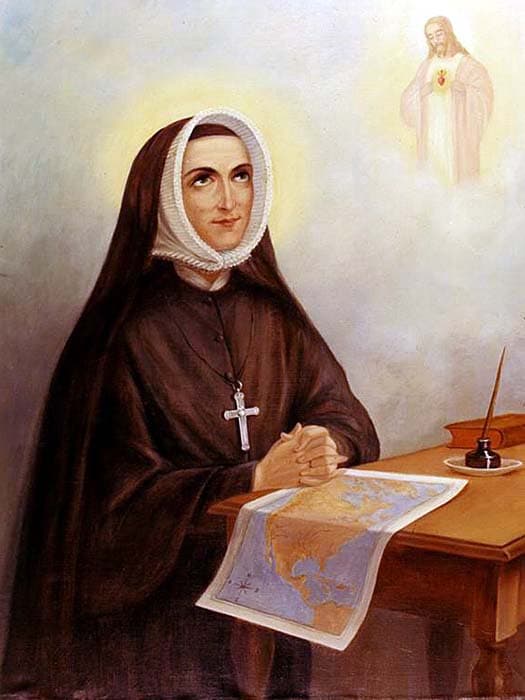
- Founded
- The first house of the Society outside France, at St. Charles, Missouri, 1818 1
Saint Rose Philippine Duchesne was a French nun of the Society of the Sacred Heart who sailed for America at 49, founded the Society's first house outside France in a log cabin at St. Charles, Missouri, and spent the rest of her life on the frontier. 12 At 72, retired and in poor health, she finally reached the mission she had wanted since childhood, among the Potawatomi at Sugar Creek, Kansas, where they called her "Woman-Who-Prays-Always." 12 John Paul II canonized her in 1988. 45
Grenoble and the Revolution
She was born in Grenoble on August 29, 1769, and baptized in the Church of St. Louis with the names of Philip the apostle and Rose of Lima, the first saint of the New World. 1 The 1913 Catholic Encyclopedia says her father was an eminent lawyer and her mother a Périer, of the family that later gave France a president. 3 Franciscan Media describes the household as among the new rich, and says she learned political skills from her father and a love of the poor from her mother. 2 It names the dominant feature of her temperament as "a strong and dauntless will," which it calls both the material and the battlefield of her holiness. 2
She was educated by the Visitation nuns at Ste. Marie d'en Haut, above Grenoble, and was drawn to their contemplative life. 13 The Holy See's biography says she became a novice there at 18; Franciscan Media says she entered at 19, and stayed despite her family's opposition. 12
Then the Revolution closed the convent. 12 Back in her family home, the Holy See says, she spent her time nursing prisoners and helping others who suffered. 1 Franciscan Media adds that she cared for the poor and sick, opened a school for homeless children, and risked her life helping priests in the underground. 2
Into the Society of the Sacred Heart
When things settled after the Concordat of 1801, she tried with a few companions to bring the old monastery back to life. 1 Franciscan Media says she rented the building herself, by then a shambles, and that the spirit was gone; soon only four nuns were left. 2 In 1804 she offered herself and the house to a new congregation, the Society of the Sacred Heart of Jesus, and its foundress, Mother Madeleine Sophie Barat, came to Ste. Marie and received her and several companions as novices. 13 Franciscan Media calls Barat her lifelong friend. 2
She was soon a superior and in charge of a novitiate and a school. 2 But the call to the missions, which she had felt since her youth, grew more urgent. 1 In a letter to Mother Barat she described a night of adoration before the Eucharist on Holy Thursday: "I spent the entire night in the new World ... carrying the Blessed Sacrament to all parts of the land." 1 She told Barat that when the word came, "I will respond quickly 'I go'." 1 The Holy See adds, dryly, that she then waited another 12 years. 1
St. Charles, Missouri
In 1818 she set out with four companions. 13 Franciscan Media says she was 49, and that the crossing took 11 weeks at sea to New Orleans and seven more on the Mississippi to St. Louis. 2 Bishop Dubourg welcomed them in New Orleans, and the little group settled at St. Charles. 3
The sources tell the arrival differently. The Holy See says the bishop of the Louisiana territory had asked for educators to help him evangelize the Indian and French children of his diocese. 1 Franciscan Media calls it one of the many disappointments of her life: the bishop had no place for the sisters to live and work among Native Americans, and sent them instead to what she called "the remotest village in the U.S." 2
There, in a log cabin, she founded the first house of the Society outside France. 1 The Holy See says she opened the first free school west of the Mississippi in 1818; Franciscan Media calls it the first free school for girls west of the Mississippi. 12 The conditions were hard: extreme cold, hard work, no money, an English she struggled to learn, and letters from France that came slowly or not at all. 1 Franciscan Media quotes her biographer Louise Callan, who lists poor lodging, "shortages of food, drinking water, fuel and money, forest fires and blazing chimneys," and "the privation of all privacy." 2 From St. Charles she wrote, "Poverty and Christian heroism are here." 3
Cold and hunger drove them from St. Charles to Florissant, Missouri, where Franciscan Media says she founded the first Catholic Indian school. 2 By 1828 she had founded six houses, the Holy See says, for the young women of Missouri and Louisiana. 1 The encyclopedia names foundations at Florissant, Grand Côteau, New Orleans, St. Louis and St. Michael, and notes that Pope Leo XII approved the Society in 1826. 3
The Potawatomi at Sugar Creek
All this time, the Holy See says, she yearned to serve the American Indians. 1 When she was 72 and no longer superior, a school for the Potawatomi was opened at Sugar Creek, Kansas. 12 Many thought she was too sick to go. The Jesuit in charge of the mission insisted: "She must come; she may not be able to do much work, but she will assure success to the mission by praying for us." 1
She could not learn their language, and while others taught, she prayed. 2 Her long hours of contemplation led the Potawatomi to name her Quah-kah-ka-num-ad, "Woman-Who-Prays-Always." 1 Franciscan Media passes on a story, which it introduces as legend, that children crept up behind her as she knelt, scattered bits of paper on her habit, and came back hours later to find them undisturbed. 2 John Paul II quoted what she wrote to Mother Barat once she had reached that mission: "to go to teach the Indian children is a grace – a gift of God, not just a service." 4
She stayed only a year. 1 Her health could not bear the life of the village, and in July 1842 she went back to St. Charles. 1 The encyclopedia says the stories of the Jesuit Father De Smet had turned her eyes toward the Rocky Mountain missions, and the Holy See quotes her: "I feel the same longing for the Rocky Mountain missions and any others like them, that I experienced in France when I first begged to come to America." 13
She died at St. Charles on November 18, 1852, at the age of 83. 12 The encyclopedia counts thirty-four years of mission work and says the success of it was "hidden from her eyes," seen only later in the spread of her order across North and South America. 3 Pope John Paul II canonized her on July 3, 1988, together with Simón de Rojas. 45 The next day he told the pilgrims she had been "a woman of lively faith and constant prayer," still at seventy "a valiant pioneer of the Gospel, traveling across the plains of Missouri and Kansas." 4
What is Saint Rose Philippine Duchesne the patron saint of?
None of the sources consulted for this profile names a patronage for Saint Rose Philippine Duchesne, so this page does not claim one. 123 What they record is the work: schools for girls on the Missouri frontier, the Society of the Sacred Heart planted in America, and a late mission among the Potawatomi. 123
Saint Rose Philippine Duchesne's feast day
Her feast is November 18, the day she died in 1852. 12 Franciscan Media says her liturgical feast is celebrated on November 18, although its Saint of the Day carries her story on November 20. 2 Vatican News lists her as a saint of the day for November 18. 6 In the United States she appears on November 18 in the proper calendar for the dioceses of the country, and the USCCB's liturgical calendar for 2026 lists her on that day for the USA beside the Dedication of the Basilicas of Saints Peter and Paul. 7
Praying with Saint Rose Philippine Duchesne
Most of her life was spent waiting for something, and much of what she got was not what she had asked for. She wanted the missions as a girl and was sent at 49. 12 She wanted the Native peoples and was given a log cabin and a school for settlers' daughters in a village she called the remotest in the country. 12 She got her mission at 72 and could stay a year. 1 The sources do not make those years a detour. The encyclopedia calls them the opening of a road that others would walk. 3
Prayer runs through every account of her, from the Holy Thursday night spent in imagination carrying the Blessed Sacrament across the New World to the old woman at Sugar Creek who could not speak to the people she had come for. 12 The Jesuit who brought her there did not want her for her teaching. He wanted her to pray, and he said so. 1 It is an unusual job description for a missionary, and she accepted it.
Franciscan Media does not hide the harder edges. It speaks of her iron will, of a priest who in an argument over a small change in the sanctuary threatened to remove the tabernacle, and of younger nuns who criticized her for not being progressive enough, which she bore patiently. 2 The encyclopedia calls hers "a stern character." 3
Near the end, back at St. Charles, she wrote that she still felt the same longing for the far missions that she had felt in France as a young nun. 1 She did not get there, and she died in St. Charles ten years after leaving Sugar Creek. 1
Saint Rose Philippine Duchesne, pray for us.
Sources
- 1."Rose-Philippine Duchesne (1769-1852)," biography published by the Holy See for the canonization of July 3, 1988.
- 2."Saint Rose Philippine Duchesne," Saint of the Day, Franciscan Media.
- 3.Catherine Lowth, "Philippine-Rose Duchesne," The Catholic Encyclopedia, vol. 5 (New York: Robert Appleton Company, 1909).
- 4.John Paul II, Address to the Pilgrims Who Have Come to Rome for the Canonization of Simón de Rojas and of Rose Philippine Duchesne, July 4, 1988 (English section).
- 5.John Paul II, Homily at the Canonization of Simón de Rojas and Rose Philippine Duchesne, July 3, 1988 (Italian; cited for the date only).
- 6."St. Rose-Philippine Duchesne," Saint of the Day, 18 November, Vatican News.
- 7.Liturgical Calendar for the Dioceses of the United States of America 2026, United States Conference of Catholic Bishops, including the Proper Calendar for the Dioceses of the United States of America.
Saints to turn to next
Others in this collection who are turned to for some of the same things.
- Saint Ambrosec. 340 - April 4, 397PrayerStudy and teachingCourage
- Saint Anthony Mary ClaretDecember 23, 1807 - October 24, 1870Work and vocationCouragePrayer
- Saint ClementDied c. 101PrayerStudy and teachingCourage
- Saints Cyril and MethodiusCyril c. 827 - 869; Methodius c. 826 - April 6, 885Study and teachingCourageWork and vocation