Saints Cyril and Methodius
Cyril c. 827 - 869; Methodius c. 826 - April 6, 885
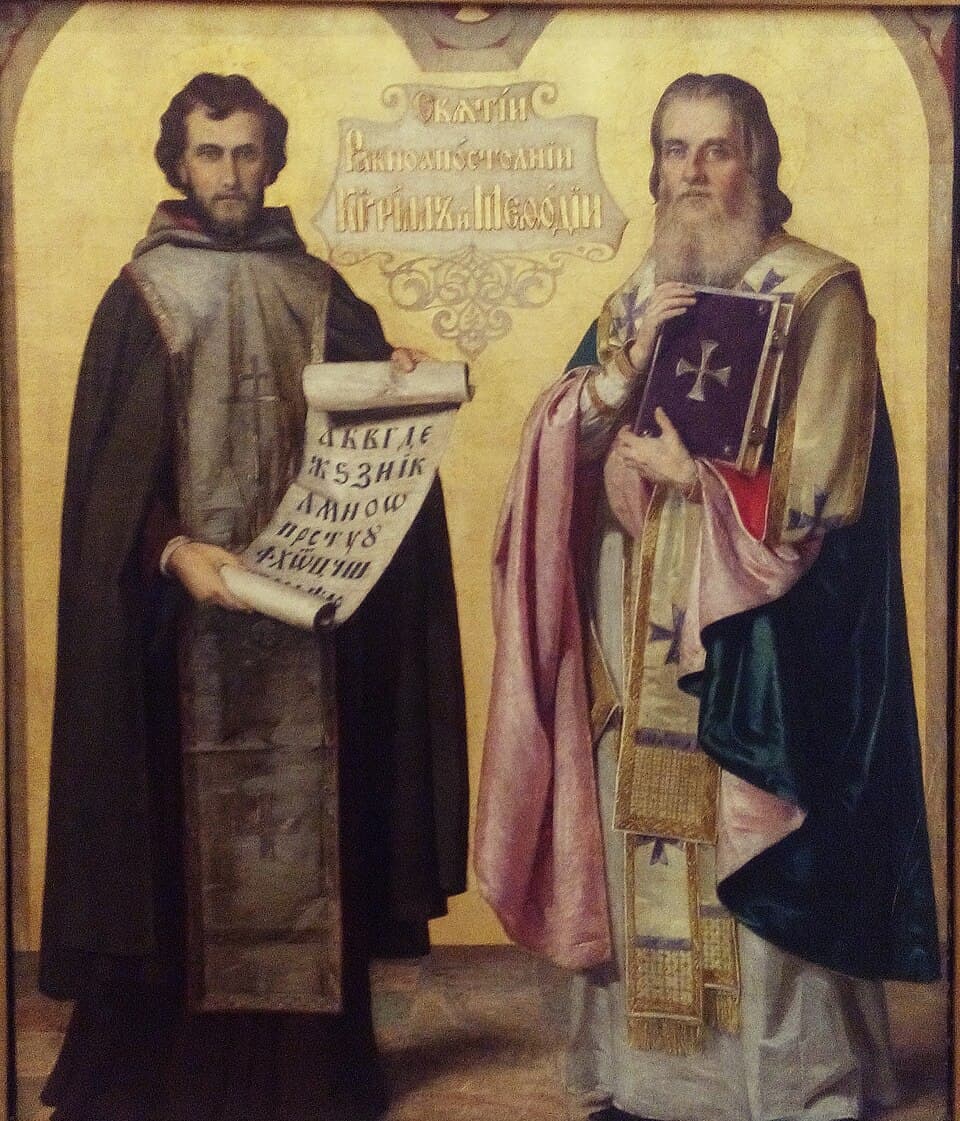
- Born
- Thessalonica, in 827 and 826, into a senatorial family 1
- The alphabet
- Cyril invented one for Slavonic so the Gospels and the liturgical books could be translated 1
- Moravia
- They arrived in 863 and worked there four and a half years 1
- Methodius imprisoned
- Deposed and jailed by a German synod at Ratisbon in 870, freed after three years by John VIII 1
- Co-patrons of Europe
- Declared so by John Paul II, and kept as such for almost forty years 2
Saints Cyril and Methodius were two brothers from Thessalonica who were asked for by name because the Moravians wanted a teacher who could hold the services in their own language. 1 Cyril invented an alphabet so that it could be done, and the two of them translated the Gospels into Slavonic before they went. 1 For that, German bishops had Methodius deposed and imprisoned for three years. 1
A request, and an alphabet
They were born at Thessalonica in 827 and 826. "Though belonging to a senatorial family they renounced secular honours and became priests." 1 They were living in a monastery on the Bosphorus when the Khazars sent to Constantinople asking for a Christian teacher; Cyril was chosen and his brother went with him, and "they learned the Khazar language and converted many of the people." 1 That is the pattern, and it repeats.
Soon afterward the Moravians asked for a preacher. German missionaries "had already laboured among them, but without success." 1 Abraham states the Moravians' condition plainly, and it is the hinge of the whole story: "The Moravians wished a teacher who could instruct them and conduct Divine service in the Slavonic tongue." 1 Cyril and Methodius were picked because they already knew the language.
Then the sentence that made them who they are: "In preparation for it Cyril invented an alphabet and, with the help of Methodius, translated the Gospels and the necessary liturgical books into Slavonic." 1 They did not adapt an existing script or improvise. They built a writing system for a language that had none, and translated the books before setting out.
They reached Moravia in 863 and worked there four and a half years. 1
Rome, twice, and a synod at Ratisbon
Their success made them suspect. The Germans distrusted them "first because they had come from Constantinople where schism was rife, and again because they held the Church services in the Slavonic language." 1 The brothers were summoned to Rome by Nicholas I, who died before they arrived. His successor Adrian II "received them kindly", was convinced of their orthodoxy, "sanctioned the Slavonic Liturgy, and ordained Cyril and Methodius bishops." 1
Cyril never went back. He died in Rome - the encyclopedia gives February 4, 869, and Franciscan Media gives February 14 of that year. 12 The feast follows the fourteenth.
Adrian II made Moravia and Pannonia an archdiocese independent of the German Church and appointed Methodius its archbishop. 1 In 870, King Louis and the German bishops summoned him to a synod at Ratisbon, where "he was deposed and condemned to prison." 1 He was there three years, until John VIII ordered his release and reinstated him. 1
It did not stop. A German priest named Wiching "impugned his orthodoxy, and objected to the use of Slavonic in the liturgy", and Methodius was called to Rome again. John VIII held an inquiry and sanctioned the Slavonic liturgy once more, "decreeing, however, that in the Mass the Gospel should be read first in Latin and then in Slavonic." 1 Wiching was then made one of Methodius's own suffragan bishops, and went on opposing him, "going so far as to produce spurious papal letters." 1 The pope had to write to Methodius to tell him the letters were forged. 1
Through all of it he kept translating. With several priests he "completed the translation of the Holy Scriptures, with the exception of the Books of Machabees", and translated the "Nomocanon", the Greek ecclesiastical and civil law. 1 Abraham's verdict on the end is short: "His health was worn out from the long struggle, and he died 6 April, 885." 1
What is Saints Cyril and Methodius the patron saint of
They are co-patrons of Europe. Vatican News states it and gives the reason: they "were responsible for the spread of the Christian message, especially in Eastern Europe, prompting John Paul II to declare them co-patrons of Europe", and "for almost forty years they have protected the Europe that they helped to evangelize more than a thousand years ago." 2
The encyclopedia calls them "the Apostles of the Slavs". 1 They belong in particular to translators, and to anyone whose work is making something sayable in a language that does not yet have the words.
Saints Cyril and Methodius's feast day
The feast of Saints Cyril and Methodius is February 14. 12 Vatican News keeps their day page there, under the heading "Sts. Cyril, Monk and Methodius, Bishop - Patrons of Europe". 2
The date has moved more than once. Abraham records that the feast "was celebrated in Bohemia and Moravia on 9 March; but Pius IX changed the date to 5 July", and that Leo XIII extended it to the universal Church by the encyclical "Grande Munus" of September 30, 1880. 1 New Advent's own note gives the current date: February 14 in the Latin Church. 1
Praying with Saints Cyril and Methodius
The Moravians did not ask for missionaries. They asked for a teacher who could conduct the service in their own language, which is a much more specific and much harder request. 1 Germans had already been there and had got nowhere, and the reason is sitting in that sentence.
What the brothers did about it is the model. They did not arrive and start explaining. They learned the language, found it had no alphabet, made one, translated the Gospels and the liturgical books into it, and only then went. 1 The preparation was the mission. Everything after it was delivery.
And it was treated as a scandal. The objection was never that they taught error - Rome examined them twice and cleared them twice - it was that they held the services in Slavonic. 1 For that, a synod deposed an archbishop and put him in prison for three years, and a suffragan bishop forged letters from the pope. 1 It is worth being clear that the opposition came from inside the Church, from men who were not heretics, and that it lasted the whole of Methodius's life.
He kept translating anyway, and finished the Scriptures except for Maccabees. 1 Abraham says his health was worn out from the long struggle. 1 The alphabet outlived all of them, and most of Eastern Europe still writes in a version of it.
Saints Cyril and Methodius, pray for us.
Sources
- 1.Ladislas Abraham, "Sts. Cyril and Methodius," The Catholic Encyclopedia, Vol. 4 (New York: Robert Appleton Company, 1908), with New Advent's editorial note on the current feast day.
- 2."Sts. Cyril, Monk and Methodius, Bishop - Patrons of Europe," Saint of the Day, 14 February, Vatican News (Dicastery for Communication).
Saints to turn to next
Others in this collection who are turned to for some of the same things.
- Saint Bonifacec. 675 - June 5, 754CourageWork and vocation
- Saint Marianne CopeJanuary 23, 1838 - August 9, 1918CourageWork and vocation
- Saint Peter CanisiusMay 8, 1521 - December 21, 1597Study and teachingWork and vocation
- Saint Albert the Greatc. 1206 - November 15, 1280Study and teachingWork and vocation