Saint Arnold Janssen
November 5, 1837 - January 15, 1909
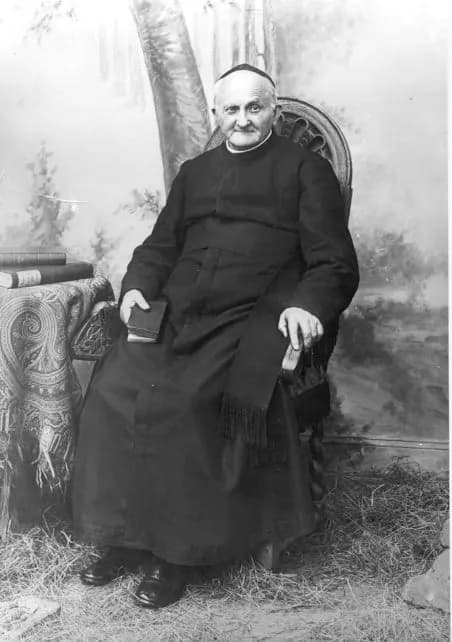
- Founded
- The Society of the Divine Word, at Steyl, September 8, 1875; the Missionary Sisters Servants of the Holy Spirit, December 8, 1889; the Servants of the Holy Spirit of Perpetual Adoration, 1896 1
- Canonized
- October 5, 2003, by John Paul II, with Daniel Comboni and Joseph Freinademetz 2
Saint Arnold Janssen was a German diocesan priest and schoolteacher who, in the middle of Bismarck's campaign against the Catholic Church, crossed into the Netherlands and opened a mission house at Steyl in 1875. 13 From it grew the Society of the Divine Word and two congregations of sisters. 12 Canonizing him in 2003, John Paul II said simply: "Obstacles did not dismay him." 2
A teacher from Goch
He was born on November 5, 1837, at Goch, a small town in the lower Rhineland. 1 The Holy See biography makes him the second of ten children; the Society's US mission office says the second of eleven. 16 The mission office describes the family's evening prayer as a rosary followed by the opening of the Gospel of John, "In the beginning was the Word," and says the Society he later founded took its name from that devotion. 6
He studied at Gaesdonck, Münster and Bonn, according to the 1914 Catholic Encyclopedia. 4 Father Stanley Plutz, SVD, vice postulator of his cause, says he turned down a well-paid teaching post in Berlin to enter the seminary. 5 He was ordained for the Diocese of Münster on August 15, 1861, and sent to teach natural sciences and mathematics at a secondary school in Bocholt, where, the Holy See biography says, he was known as strict but just. 1
Father Plutz records a habit from his youth: every quarter hour, at the stroke of a clock, he prayed acts of faith, hope and charity, and at Steyl he later bought a chiming clock so the whole community could do the same. 5
The Apostleship of Prayer, and a magazine
His devotion to the Sacred Heart led to his appointment as diocesan director of the Apostleship of Prayer, and the Holy See biography says the work opened him to Christians of other denominations. 1 Father Plutz says that during school vacations he walked from parish to parish until the apostleship had a foothold in 300 of the diocese's 350 parishes. 5
He left teaching in 1873. The Holy See biography says he did so to devote his life to awakening the German Church's missionary responsibility. 1 Father Plutz tells a smaller story alongside it: a years-long quarrel with the school board over money he had raised for a statue of the Virgin, ending in his resignation with the bishop's permission. 5 He became chaplain to the Ursulines at Kempen and began The Little Messenger of the Sacred Heart, a monthly that carried news of the missions to German-speaking Catholics. 145
Steyl, and the Kulturkampf
The Holy See biography describes Bismarck's Kulturkampf as a series of anti-Catholic laws that led to the expulsion of priests and religious and the imprisonment of many bishops. 1 Janssen's first thought was that some of the expelled priests might go to the foreign missions, or help train missionaries; with what the biography calls "a little prodding" from the Apostolic Vicar of Hong Kong, he came to believe the task was his. 1
Many people told him he was the wrong man, or that it was the wrong time. 1 The SVD mission office quotes Bishop J. A. Paredis of Roermond: "He wants to build a mission house and he is penniless. He’s either a fool or a saint." 6 The Holy See biography gives his answer: the Lord challenges our faith to do something new precisely when so many things are collapsing in the Church. 1
Because such a seminary was illegal in Germany, Father Plutz writes, he went across the border and found an inn for sale at Steyl, on the river Maas, for about what his benefactors had given. 56 He opened it as a mission house on September 8, 1875. 14 John Paul II, addressing pilgrims the day after the canonization, said he "showed courage by opening a missionary house in Steyl, in The Netherlands, when the Church was going through difficult times because of the so-called 'Kulturkampf'." 3
Four months later he had a printing press, bought, Father Plutz says, because his printer had given notice. 15 On March 2, 1879, the first two missionaries left for China; one of them was Joseph Freinademetz. 1
Three congregations
From the start the community at Steyl was made up of priests and brothers, and the volunteers who kept the house running included women, among them Blessed Maria Helena Stollenwerk, who wanted to serve the missions as sisters. 1 Father Plutz says Janssen had not expected to found a congregation of women, and took the first of them on as kitchen maids while he prayed over it. 5 On December 8, 1889, he founded the Missionary Sisters Servants of the Holy Spirit, and the first of them left for Argentina in 1895. 1
In 1896 he chose some of those sisters to form an enclosed branch, the Servants of the Holy Spirit of Perpetual Adoration, whose work for the missions was to keep adoration of the Blessed Sacrament going day and night and to pray for the two active congregations. 1 Father Plutz says the two came to be known by their habits as the Blue Sisters and the Pink Sisters. 5
The Society spread fast. Father Plutz lists missions in southern Shandong, Argentina and elsewhere in South America, Togo, New Guinea and Japan, a house near Vienna for which Janssen took Austrian citizenship, and a Philippine mission he accepted but did not live to staff. 5 It received canonical approval in 1901, according to the 1914 encyclopedia. 4
The Society in the United States
In 1895 Brother Wendelin Meyer went to the United States to sell the Steyl publications to German immigrants and, Father Plutz says, to look for a place for a foundation; Janssen approved a site near Chicago, where the brothers opened a technical school. 56 The SVD mission office says the work led to a seminary north of Chicago for training missionary priests and brothers, carried on today at Divine Word College in Epworth, Iowa. 6 Father Plutz counts the approval to make the school at Techny, Illinois, a mission seminary among the last official acts of Janssen's life; the 1914 encyclopedia dates the opening of St. Mary's Mission House there to February 2, 1909, a few weeks after his death. 45
Brother Wendelin also told him about African Americans in the South, and Janssen allowed a mission to begin. 5 The first attempt failed when Father Aloysius Heick, facing whites violently opposed to a school for African Americans, had to be smuggled out, "in a piano box some say while others say in a coffin." 5 Janssen's councilors wanted to give up; he answered that his own beginning had been hard, and that Father Heick should try again elsewhere. 5 Father Plutz says the second attempt succeeded, and that St. Augustine Seminary, before integration, saw more than a hundred African American priests ordained, nine of whom became bishops. 5
His death
Father Plutz says a stroke left him weak and partly paralyzed, that he resigned as superior general and handed his responsibilities to his assistant, Father Nicholas Blum, and that his last word was "Jesus." 5 He died at Steyl on January 15, 1909. 14
He was beatified by Paul VI in 1975. 67 John Paul II canonized him on October 5, 2003, together with Daniel Comboni and Joseph Freinademetz. 2 The Holy See then counted more than 6,000 Divine Word Missionaries in 63 countries; the SVD mission office gives more than 6,000 in over 80, and Radio Veritas Asia, citing the Society's catalog for January 2024, more than 5,754 in 79. 167
What is Saint Arnold Janssen the patron saint of?
Saint Arnold Janssen's feast day
His feast is January 15. The Divine Word Missionaries' US mission office calls it "the feast day of this little known saint (January 15th)," and Radio Veritas Asia speaks of him as the saint "whose feast is on January 15." 67 It is also the day he died, in 1909. 14 No source consulted places him on the General Roman Calendar or the calendar for the dioceses of the United States.
His religious family keeps a second day, which is not a liturgical feast: Father Plutz says that in 1906 Janssen made his name day, July 18, a Family Feast for every member of his congregations. 5
Praying with Saint Arnold Janssen
He never went to the missions himself. Father Plutz says he thought himself too old and unwell to go, and unfit to lead a seminary, until Monsignor Raimondi, the Apostolic Vicar of Hong Kong, pointed out that twelve years of teaching had prepared him for exactly that. 15 He spent the rest of his life at Steyl, in a mission house with a printing shop, sending other people.
The means were ordinary. He prayed by a clock, bought an inn because it cost about what he had been given, and printed his own magazine because his printer quit. 5 John Paul II praised him for using "the new mass media, especially the press," and quoted him as saying, "Proclamation of the Good News is the first and most significant expression of love for one's neighbour." 2
Nor do the sources make it smooth. People told him he was the wrong man at the wrong time, and a bishop wondered aloud whether he was a fool. 16 The first mission to African Americans in the South ended with a priest smuggled out of town, and his own council wanted to quit. 5 He told them the man should try again somewhere else.
The Holy See biography sums up his life as one "filled with a constant search for God's will, a great confidence in divine providence, and hard work." 1 By his death in 1909, the house at Steyl had sent missionaries to China, Africa, New Guinea, Japan and the Americas. 5
Saint Arnold Janssen, pray for us.
Sources
- 1."Arnold Janssen (1837-1909)," biography published by the Holy See for the canonization of October 5, 2003.
- 2.John Paul II, Homily for the Canonization of Daniel Comboni, Arnold Janssen and Joseph Freinademetz, October 5, 2003.
- 3.John Paul II, Address to the Pilgrims Gathered in Rome for the Canonization of Three New Saints, October 6, 2003.
- 4.Herman Richarz, "Arnold Janssen," The Catholic Encyclopedia, vol. 16 (Index) (New York: The Encyclopedia Press, 1914).
- 5.Stanley Plutz, SVD, "St. Arnold Janssen," Divine Word Missionaries, Chicago Province.
- 6."Celebrating St. Arnold Janssen: Here's What You Need to Know About This Catholic Missionary Priest," The Mission Post, Divine Word Missionaries (US mission office).
- 7."St. Arnold Janssen: The father of missionary congregations," Radio Veritas Asia.
Saints to turn to next
Others in this collection who are turned to for some of the same things.
- Saint Anthony Mary ClaretDecember 23, 1807 - October 24, 1870Work and vocationCouragePrayer
- Saint Ferdinand III of Castilec. 1198 - May 30, 1252Work and vocationCouragePrayer
- Saint Hugh of Grenoble1053 - April 1, 1132Work and vocationCouragePrayer
- Saint Hugh of Lincolnc. 1135 or 1140 - November 16, 1200CouragePrayerWork and vocation