Saint Willibald
700 - July 7, 787 (or 781)
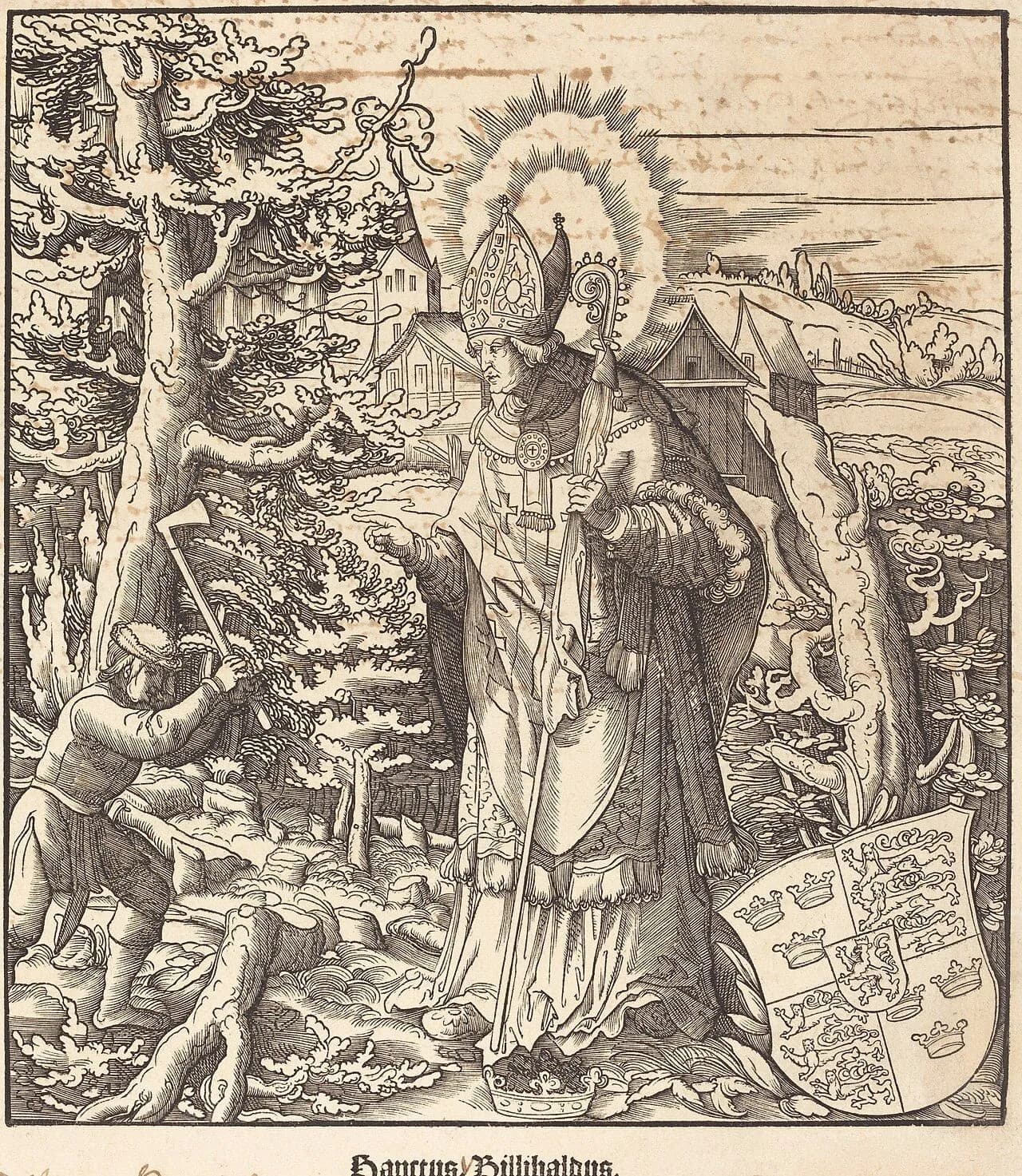
- Born
- October 21, 700 (or 701), probably in Wessex 2
- Pilgrimage
- Seven years in the Holy Land, Syria and Constantinople; in Jerusalem from November 11, 725 12
- Patron of
- The Diocese of Eichstätt, which he founded 4
Saint Willibald was an English monk who traveled to Jerusalem in the 720s, spent seven years among the holy places of Palestine, Syria and Constantinople, and ended his life as the first Bishop of Eichstätt in Bavaria, sent there by his kinsman Saint Boniface. 12 His journey survives because, as an old bishop, he told it to a nun of his family at Heidenheim, who wrote it down. 1 Her book, the Hodoeporicon, is the only narrative of a pilgrimage to the Holy Land to come down from the eighth century. 1
An English boy promised to God
Willibald was born, according to the 1912 Catholic Encyclopedia, on October 21, 700 or 701, probably in Wessex. 2 He was the brother of Wunibald, later abbot of Heidenheim, and of Walburga; their father is remembered as Saint Richard, "commonly called the King," and their mother was a relative of Saint Boniface. 25
Huneberc, who wrote his life, begins with a sickness. At three he was so ill that his parents thought he would die. They laid him at the foot of the cross that Saxon nobles set up on their estates for daily prayer, and promised that if he lived he would be tonsured and given to the monastic life. He recovered. 1 At five they handed him to Abbot Egwald at the monastery of Waltham, in Hampshire, where he was taught the psalms and the Scriptures. 12
Setting out
As a young monk he wanted to go on pilgrimage, and he talked his father into coming with him. Huneberc says his father first refused, on the ground that he could not leave his wife and small children, and gave in only after "long and urgent entreaties." 1 Father and sons sailed from the mouth of the Hamble, near the port of Hamwih, landed on the Seine near Rouen, and walked on toward Rome. At Lucca the father fell ill and died, and the brothers buried him in the church of Saint Frigidian. 12 Mershman dates the journey to Rome 722. 2
The brothers wintered in Rome, from Martinmas to Easter, keeping the monastic rule. Then both fell desperately ill, with what Talbot's translation of Huneberc calls "the black plague" and Mershman calls malaria, and nursed each other a week at a time. 12 Willibald left after Easter, in 724, with two companions, for Jerusalem; Wunibald stayed behind in a monastery at Rome. 12
Prisoner, pilgrim, smuggler
The route went by Naples, Sicily, Ephesus and the coast of Asia Minor, a winter at Patara, and Cyprus. 12 On the Syrian coast the party, eight men by then, were arrested by the Saracens as spies and put in prison. A merchant fed them and took them to church on Sundays; a Spaniard whose brother was chamberlain at court took their case to the king of the Saracens, who asked why they should be punished at all: "They have done us no harm. Allow them to depart." 1
From Damascus they went to Nazareth, Cana, Mount Tabor, Capernaum and the springs of the Jordan, and Willibald bathed in the river at the place of Christ's baptism. 1 He reached Jerusalem on the feast of Saint Martin, November 11, 725 by Mershman's dating, and fell ill at once until a week before Christmas. 12 Huneberc's descriptions of the Holy Sepulchre, the three memorial crosses outside the church of Calvary and the church of Holy Sion are, Talbot says, of real archaeological value. 1 At the church of Saint Matthias, beyond Gaza, he went blind during Mass and stayed blind for two months, until his sight came back in the church where the Cross had been found. 1 In all he visited Jerusalem four times. 1
One episode Huneberc tells with plain pleasure. In Jerusalem Willibald bought balsam, which the customs men at Tyre would have punished him for carrying. He filled a gourd with it, put inside it a hollow reed full of petroleum, cut the reed flush with the mouth and sealed it. At Tyre the customs men opened the gourd, smelled petroleum, and let him go. 1 He then sailed for Constantinople, lived there two years with an alcove in the church where he could look at the tombs of the saints, and visited Nicaea, where he studied the church in which the council had met. 1
Sacristan and porter at Monte Cassino
He came back to Italy and arrived at Monte Cassino in the autumn of 730, seven years after leaving Rome and ten after leaving England. 12 The abbey had only a few monks, under Abbot Petronax, and Willibald stayed ten years. In the first he was sacristan; in the second, a dean; and for eight more years he was porter, four in the monastery on the hilltop and four in the one below by the river. 1
John Paul II, writing to the Diocese of Eichstätt in 1987, took those two jobs as an image of the Christian life. The sacristan, he wrote, is at home in the house of God and gives thanks there; the porter opens the doors and lets in everyone who is searching for the truth. The Church, the Pope added, is not a sealed fortress but a house with doors and windows open to the world. 4
Eichstätt
In 740 Willibald took a Spanish priest to Rome, and Pope Gregory III, hearing he was there, sent for him and asked about his travels. Then the Pope told him that Boniface wanted him in the land of the Franks. Willibald said he would go if his abbot allowed it. The Pope answered, as Huneberc reports, "If I am free to transfer the abbot Petronax himself to any other place, then certainly he has no permission or power to oppose my wishes." 1 Willibald went.
Boniface sent him to look at Eichstätt, a piece of land given by a nobleman named Suitgar. Huneberc says there was not a single house there, only a small church of Saint Mary. 1 Boniface ordained him priest there on July 22, 741. 12 A year later Boniface called him to Thuringia, where he saw his brother Wunibald for the first time in eight and a half years, and consecrated him bishop that autumn, at forty-one. 1 Mershman gives the place as Sülzenbrücken near Gotha and the date as October 21, 741 or 742; Huneberc, in Talbot's translation, says Thuringia and then "Salzburg." 12 The Diocese of Eichstätt was organized a few years later, in 745, according to Hollweck's article on the diocese. 5
He built a monastery at Eichstätt and ran it on the pattern he had learned at Monte Cassino, borrowing from the other houses he had seen on his travels; Huneberc compares him to a bee gathering the best of every meadow. 1 Hollweck says he founded a flourishing school there and taught in it himself. 5 With Wunibald he founded the double monastery of Heidenheim in 752, with Wunibald as abbot of the men and their sister Walburga over the women, and he blessed its new church in 778. 2
The nun who wrote it down
Huneberc calls herself "an unworthy sister of Saxon origin" and a "humble relative" of the bishop. 1 She says she heard the story from his own lips, on June 20, in the presence of two deacons who could vouch for it. 1 For centuries she was anonymous. Talbot explains that the scholar B. Bischoff found her name hidden in a cryptogram in an early manuscript, between the lives of the two brothers. 1 Willibald died, by Mershman's dating, on July 7, 781 or 787, and a costly reliquary for his remains was finished in 1269. 2 His grave is in Eichstätt Cathedral. 4
What is Saint Willibald the patron saint of?
Saint Willibald is the founder and patron of the Diocese of Eichstätt in Bavaria. John Paul II called him the diocese's "great patron" in 1987. 4 None of the other sources read for this page names a patronage for him.
Saint Willibald's feast day
Saint Willibald's feast day is July 7. The current Roman Martyrology enters him on that day, and Mershman in 1912 said the same, adding that in England his feast was kept on July 9 by concession of Leo XIII. 23 In Eichstätt July 7 is a solemnity. 4 John Paul II wrote in 1987 that it was also the day of his death twelve hundred years before, which puts his death in 787; Hollweck's article on the diocese gives 781. 45
Praying with Saint Willibald
Willibald's pilgrimage began as a young man's restlessness. Huneberc says plainly that he wanted to see foreign lands and "find out all about them." 1 What he brought home included careful information as well as devotion: how the Holy Sepulchre was built, where the crosses stood, how a church in Nicaea was laid out. 1 Curiosity is not usually listed among the virtues, but his was put to use, and an entire diocese was built partly on what he had looked at carefully.
He also paid for it. He was jailed as a spy, went blind for two months, was sick in Rome, in Jerusalem and again in Syria, and buried his father on the road. 1 None of this appears in his story as complaint.
The image John Paul II chose is worth keeping. After seven years of travel Willibald spent ten in a monastery opening doors and keeping a sacristy. 1 The Pope read that as the shape of every Christian life: at home in God's house, and keeping the door open for whoever comes looking. 4
Saint Willibald, pray for us.
Sources
- 1.Huneberc of Heidenheim, "The Hodoeporicon of St. Willibald," in C. H. Talbot, trans., The Anglo-Saxon Missionaries in Germany (London and New York: Sheed and Ward, 1954), with Talbot's introduction, Internet Medieval Sourcebook, Fordham University.
- 2.Francis Mershman, "Sts. Willibald and Winnebald," The Catholic Encyclopedia, Vol. 15 (New York: Robert Appleton Company, 1912).
- 3.Roman Martyrology, entry for July 7, "San Villibaldo, vescovo," as printed in "Santo del giorno," Conferenza Episcopale Italiana (in Italian).
- 4.John Paul II, Message to Bishop Karl Braun of Eichstätt on the 1200th anniversary of the death of Saint Willibald, June 26, 1987, Libreria Editrice Vaticana (in German).
- 5.Joseph Hollweck, "Eichstätt," The Catholic Encyclopedia, Vol. 5 (New York: Robert Appleton Company, 1909).
Saints to turn to next
Others in this collection who are turned to for some of the same things.