Saint Wenceslaus
c. 903 - September 28, 935
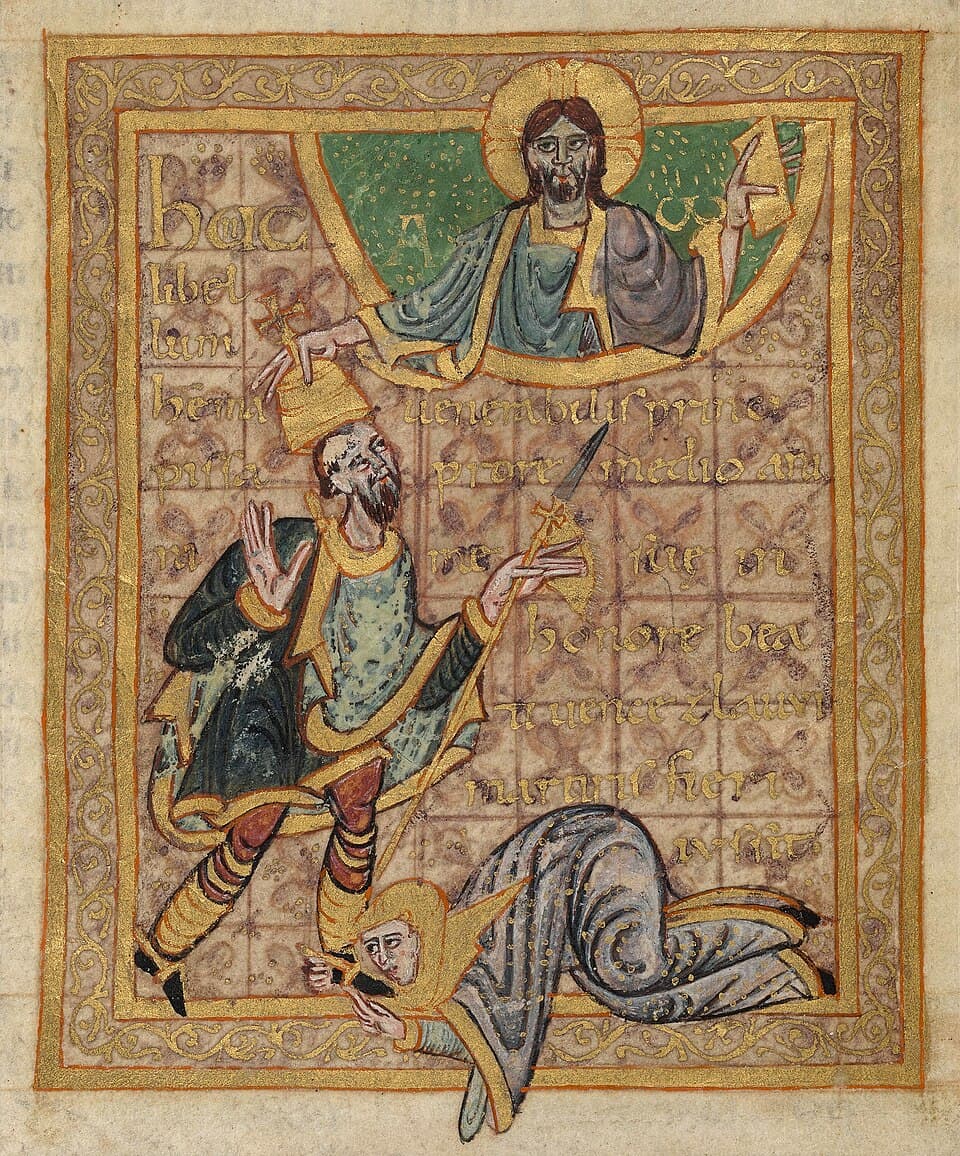
- Patron saint of
- Bohemia, in Mershman's words; Benedict XVI preached of him as patron saint of the Czech nation 12
- Born
- Probably 903, son of Duke Wratislaw, a Christian, and Dragomir, a heathen 1
- Died
- Alt-Bunzlau, September 28, 935, murdered by his brother Boleslaw 1
- Buried
- At the place of the murder; moved three years later to the Church of St Vitus in Prague by the repentant Boleslaw 1
Saint Wenceslaus was killed by his brother, who took the throne of Prague by doing it - and the crown his successors wore was named after the man he murdered, not after him. 12 He was a duke rather than a king, he ruled for about a decade, and the reason his own family wanted him dead was as much political as religious. 1 Three years after the killing, his brother repented and had the body moved to Prague. 1
A Christian father, a heathen mother
Mershman gives the household in a single line that contains the whole problem: his father Duke Wratislaw was a Christian, his mother Dragomir was not. 1 He was born probably in 903, and his Christian education came from his grandmother - Saint Ludmilla, who was herself killed for the faith - and at Budweis. 12
When Wratislaw died, Dragomir acted as regent and "opposed Christianity," and Mershman says Wenceslaus took the reins of government because the people urged him to. 1 A young ruler installed against his own mother's policy, in a duchy where the religious question and the succession were the same question.
What he did next is where the sources begin to look at the same facts differently. Mershman: he "placed his duchy under the protection of Germany, introduced German priests, and favoured the Latin rite instead of the old Slavic, which had gone into disuse in many places for want of priests." 1 Benedict XVI, preaching at Stara Boleslav in 2009: before committing himself to "build peaceful relations within his lands and with neighbouring countries, he took steps to spread the Christian faith, summoning priests and building churches." 2
Both are describing the same decisions. Mershman adds the qualifier that explains the ending: Wenceslaus was murdered "for religious and national motives, and at the instigation of Dragomir." 1 National motives. Aligning a Slavic duchy with German protection and the Latin rite was not a neutral act, and there were people at his own court who understood exactly what it cost.
What the old narration says he did
Benedict quotes the first Old Slavonic account of him, and it is worth having in full because it is the earliest picture anyone has. "He assisted God's ministers and he also adorned many churches," and "he was benevolent to the poor, clothed the naked, gave food to the hungry, welcomed pilgrims, just as the Gospel enjoins. He did not allow injustice to be done to widows, he loved all people, whether poor or rich." 2
The grandmother deserves her own sentence, because she is the reason there was anything to raise him into. Mershman names her as Saint Ludmilla and Benedict calls her "his saintly grandmother, the martyr Ludmila." 12 She was killed too. The faith Wenceslaus died for reached him through a woman who had already died for it, in the same family and within his own lifetime, and the household that produced two martyrs also produced the mother who instigated the second killing.
Mershman notes two other things about him. He had taken a vow of virginity, and the Emperor Otto I conferred on him "the regal dignity and title." 1 He is called a king in a great many places and was a duke; the royal title was a grant, late, and from outside.
The royal title is worth a word, since it is the thing most people get wrong about him. Mershman says the Emperor Otto I "conferred on him the regal dignity and title," which is how a Bohemian duke came to be called a king at all. 1 It was a grant from outside and it came late; in his own country and in his own lifetime he was a duke.
Benedict's account adds a detail with no parallel in the encyclopedia article, and it changes the shape of the ending: animated by the Gospel, Wenceslaus "was even able to pardon his brother who tried to kill him." 2 Tried. On this telling the murder in 935 was not the first attempt, and Wenceslaus had already forgiven one.
The murder, and the crown
Mershman gives the murder its cause without dressing it: Boleslaw killed him, and Dragomir - their mother - had instigated it. 1 A duke killed by his brother at his mother's urging, over religion and the national question together. Whatever else the tenth century was, it was not sentimental about families.
He was killed at Alt-Bunzlau on 28 September 935. 1 Mershman does not spare the detail: "The body, hacked to pieces, was buried at the place of murder." 1
Then the part that is stranger than the killing. "Three years later Boleslaw, having repented of his deed, ordered its translation to the Church of St. Vitus in Prague." 1 The brother who took the throne by murder moved the body of the man he murdered into the principal church of his capital, and the shrine is still there.
Benedict makes the observation that gives the story its point, and it is a historical one rather than a devotional one. By killing him, Boleslaus did take possession of the throne of Prague - "but the crown placed on the heads of his successors did not bear his name. Rather, it bears the name of Wenceslaus." 2 Every later ruler of that country was crowned with the Crown of Saint Wenceslaus. The murderer won the throne and lost his name to his victim.
There is a reason the shrine mattered so much afterward. Benedict, preaching a thousand years later, mentions almost in passing that he had venerated the relics in the basilica dedicated to Wenceslaus before the Mass began, and that the saint is the one the Czechs call the "eternal" Prince. 2 A duke who ruled for about ten years and was murdered before he was thirty-five became the figure a nation kept measuring its rulers against.
Benedict reads this through a line from the Legend of Saint Wenceslaus: "the conquered innocent defeated the cruel conqueror just as Christ did on the cross." 2 And he draws out what the martyrdom did not produce: "the blood of the martyr did not cry out for hatred or revenge, but rather for pardon and peace." 2
What is Saint Wenceslaus the patron saint of?
Saint Wenceslaus is the patron saint of Bohemia, the country now called the Czech Republic. Mershman calls him "Duke, martyr, and patron of Bohemia" in his opening words, and the heading over Benedict XVI's homily names him patron saint of the Czech nation. 12 Benedict, addressing the country on its national feast, reports what they call him themselves: the "eternal" Prince of the Czechs, and the "heir" of the nation, invoked in a well-known song that asks him not to let it perish. 2 His eagle, he notes, "constitutes the historical emblem of the noble Czech nation." 2
Saint Wenceslaus's feast day
The feast of Saint Wenceslaus is September 28, the day he was murdered. 12 It is one of the rare dates in this library that needed no correction against a modern source: Mershman prints it in 1912, and Benedict XVI preached the homily cited here on that day in 2009, on what he calls "this national feast." 12 Mershman also records two other days attached to him, which are not his feast and are easy to mistake for it - the gathering of his relics on 27 June and their translation on 4 March. 1
Praying with Saint Wenceslaus
The life is short and the sources are thin, and what survives is mostly a list: he fed people, clothed people, took in travelers, and would not let widows be cheated. 2 That is the earliest description anybody wrote of him, and it is made of ordinary administration done honestly by a man with the power to do otherwise.
What makes him worth attention is the position he was in. His mother opposed his religion, his brother wanted his throne, and the policy he chose - German protection, Latin priests - was the one most likely to get him killed by his own people. 1 He did it anyway, and Mershman is clear that this is what got him killed. He is not a saint who suffered from strangers.
Benedict put a hard question to the congregation at Stara Boleslav and did not soften it: "in our day, is holiness still relevant? Or is it now considered unattractive and unimportant? Do we not place more value today on worldly success and glory? Yet how long does earthly success last, and what value does it have?" 2 He was standing near where the man was killed, in a country that had spent forty years under a government that answered those questions differently.
The forgiveness is the part that resists sentiment. If Benedict's account is right, Wenceslaus had already pardoned the brother who tried to kill him, and was then killed by him. 2 Nothing about that reads as a reward. What the sources record instead is a crown that carried his name for a thousand years and a brother who could not live with what he had done and moved the body to Prague. 12
Saint Wenceslaus, pray for us.
Sources
Saints to turn to next
Others in this collection who are turned to for some of the same things.