Saint Christopher
Third century, traditionally
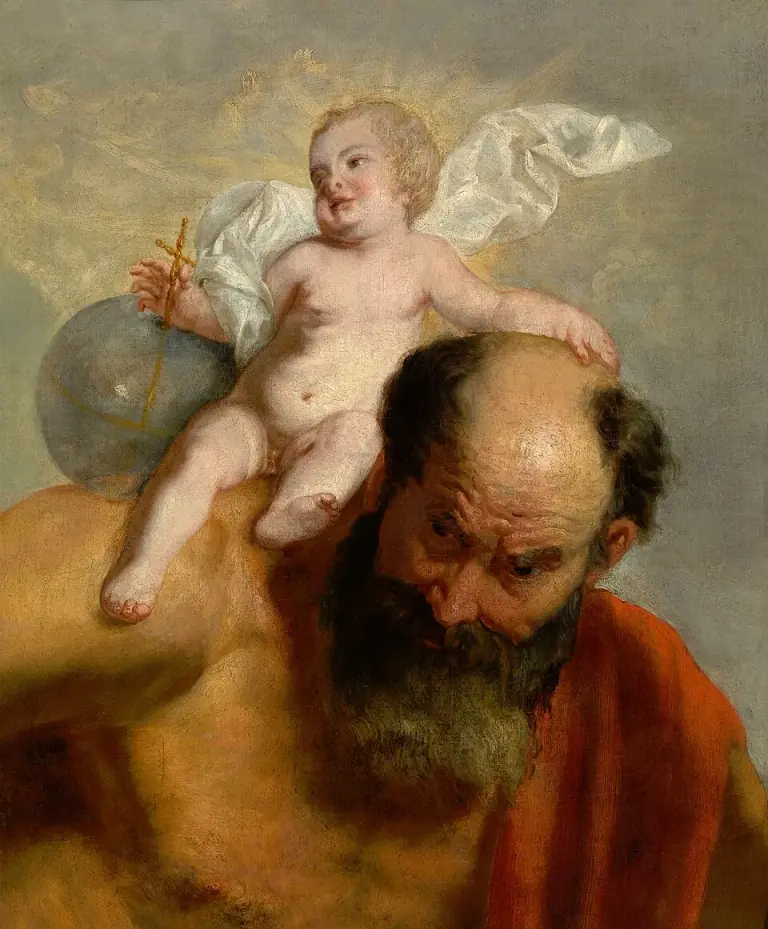
- Patron saint of
- Travelers, says Franciscan Media; the encyclopedia lists bookbinders, gardeners and mariners, and does not name travelers 12
- Feast day
- July 25 in the West, and March 9 among the Greeks 1
- Removed from the calendar
- He was "ousted from the Roman calendar in 1969" 2
- Historical record
- "Almost nothing certain is known about his life or death" 1
- Invoked against
- Lightning, storms, epilepsy and pestilence 1
- Name
- Christopher means Christ-bearer, from the Greek christos and pherein 1
Saint Christopher is on more dashboards than any other saint and his own encyclopedia says in its second sentence that "almost nothing certain is known about his life or death." 1 The story of the giant who carried a child across a river, and found he was carrying the weight of the world, is introduced there as legend and is treated that way here. He was dropped from the Roman calendar in 1969 and it has made no difference at all to how many people carry him. 2
What the legend says
The encyclopedia sets it out and labels it: "The legend says." A heathen king had a son called Offerus, of extraordinary size and strength, who resolved to serve only the strongest and bravest master he could find. He bound himself first to a mighty king, who turned out to dread the name of the devil, and then to Satan, who turned out to be frightened by a cross at the roadside. 1
His search failed until he met a hermit, who told him to offer his allegiance to Christ, instructed him and baptized him. Christopher would not promise to fast or to pray, but he willingly took on the work of carrying people across a raging stream for God's sake. One day the child he was carrying grew heavier and heavier, until it seemed he had the whole world on his shoulders; the child said he was the Creator and Redeemer of the world, and told him to fix his staff in the ground. By morning it was a palm tree in fruit. The miracle converted many, and Christopher was imprisoned, tortured and beheaded. 1
Franciscan Media adds the frame the encyclopedia leaves out: he was born in the third century in Asia Minor, the son of a king, and "the early years of his life were spent in search of riches, of purpose, of a cause worthy of his allegiance." He built a hut by an untamed river and set up "with a new purpose - to be a boatman to the world." 2 After the crossing the child told him to plant his staff, "telling the ferryman that life would spring forth," and by morning it had taken root and put out flowers and fruit. 2 One account has him imprisoned under the Emperor Decius in Lycia, shot with arrows, burned and then beheaded around 251. 2
Franciscan Media preserves the exchange on the bank. "Child, thou hast put me in great peril; thou weighest almost as if I had all the world upon me: I might bear no greater burden." And the answer: "Christopher, thou hast not only borne all the world upon thee, but thou hast borne Him that created and made all the world, upon thy shoulders." 2
What can be said
Very little, and the encyclopedia is direct about it. He was "a martyr, probably of the third century," one of the most popular saints in both East and West, and beyond that the record does not reach. The Greek legend may belong to the sixth century; by the middle of the ninth it had spread through France, and the simple early passio "soon gave way to more elaborate legends," including the version in the Golden Legend. 1
Franciscan Media puts the question to a historian rather than answering it. Lawrence Cunningham of Notre Dame: "It's not clear, but there probably was a martyr during the period of Decius with whom all kinds of stories got identified. And one of the ones that lasted was that he was a person who took people across a river and was given a name that means 'one who bears Christ.'" 2
That is a careful sentence and it is about as far as anyone can go: a real martyr underneath, and a name that attracted a story good enough to outlast the facts.
How old the devotion is
The veneration, unlike the biography, leaves traces. Gregory the Great, who died in 604, mentions a monastery of St Christopher. The Mozarabic Breviary and Missal ascribed to Isidore of Seville contains a special office in his honor. 1 Franciscan Media adds a picture of him in a monastery on Mount Sinai dating from the time of Justinian, and his image struck on coins in Bohemia. 2
In 1386 a brotherhood was founded under his patronage in Tyrol and Vorarlberg, to guide travelers over the Arlberg pass. In 1517 there were St Christopher temperance societies in Carinthia, Styria, Saxony and Munich. He was venerated at Venice and along the Danube and the Rhine, where floods and ice-jams did frequent damage. 12
His statues stood at bridges and on buildings, often with an inscription promising that "Whoever shall behold the image of St. Christopher shall not faint or fall on that day." 1 Chaucer has a pilgrim wearing one in the Canterbury Tales - "A Cristofre on his breast of silver shene." 2
What is Saint Christopher the patron saint of?
Franciscan Media calls him, without qualification, "patron of travelers." 2 That is the answer most people are looking for and it is properly sourced.
It is worth knowing that the 1908 encyclopedia's own list does not say it. Christopher "has been chosen as patron by Baden, by Brunswick, and by Mecklenburg, and several other cities, as well as by bookbinders, gardeners, mariners, etc. He is invoked against lightning, storms, epilepsy, pestilence, etc." 1 Travelers are not named - though the brotherhood of 1386 existed to get them over an Alpine pass, and the statues stood at bridges. 1
So the travel patronage is real and attested, and it is not in the place a reader would first check. Both are printed here.
Saint Christopher's feast day
The feast of Saint Christopher is July 25 in the West; among the Greeks it is kept on March 9. 1 His emblems are the tree, the Christ Child and a staff. 1
Franciscan Media records that he was "ousted from the Roman calendar in 1969." 2 That is not a judgment that he never existed - Cunningham's reading in the same article is that a real martyr lies underneath - and it plainly did not dislodge him. His image is still "inside of cars, on the walls of churches, and around the necks of safety-seeking travelers." 2
Praying with Saint Christopher
He is the saint you are most likely to own and least likely to be able to describe. The encyclopedia gives him two sentences of fact and then several pages of what other people have said about him. 1 If that troubles you, it should trouble you less than it does: the same article is equally frank about a dozen early martyrs, and the Church has never claimed the medal is a historical document.
The story people keep is about work he took on because he was not much good at the other kind. He would not promise to fast or to pray; what he could do was carry people across a river, so he did that instead, for God's sake. 1 There are a great many people whose service to God is going to look like manual labor rather than devotion, and this is their patron.
The weight is the point of the legend. He was the strongest man available and the child nearly put him under. 12 Anyone carrying something that keeps getting heavier the further in they get - a job, an illness, somebody else's child - is inside the story rather than looking at it.
He was removed from the universal calendar in 1969 and nothing happened to the devotion. His image is still "inside of cars, on the walls of churches, and around the necks of safety-seeking travelers." 2 Whatever the Church can and cannot verify about him, people keep setting out with his name somewhere on them and asking to arrive.
Saint Christopher, pray for us.
Sources
Saints to turn to next
Others in this collection who are turned to for some of the same things.