Saint Bernard of Menthon
Died at Novara in 1008, or in 1081 by another account
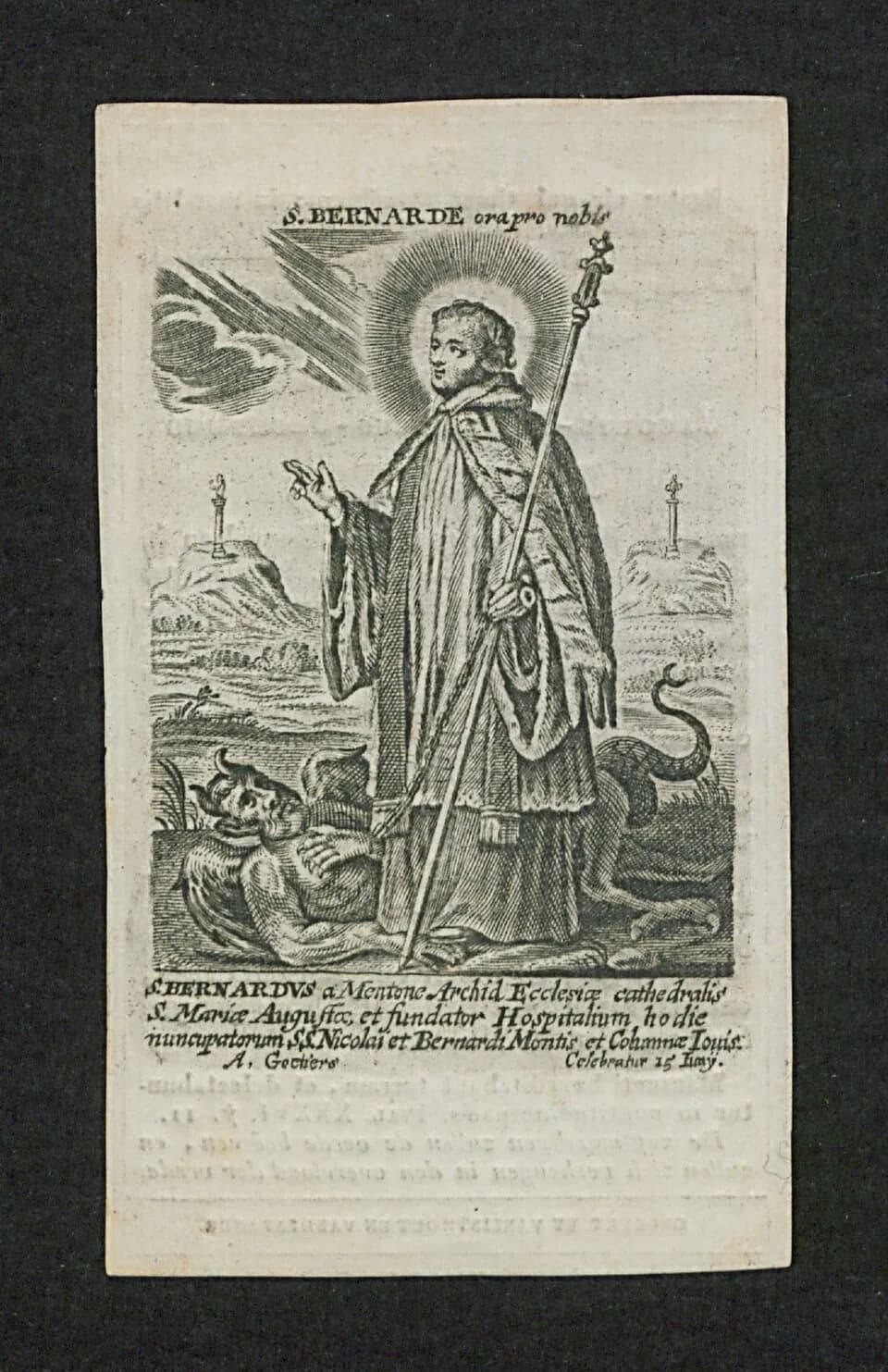
- Patron saint of
- The people of the Alps, travelers in the Alps, and those who climb their peaks, as named by Pius XI in 1923 2; alpinists, mountain climbers, mountaineers and skiers 46
- Feast day
- June 15 134; May 28 according to Loyola Press, and historically according to Catholic Culture 56
- Founded
- The hospices on the Great and Little St. Bernard passes 126: in 962 according to the 1907 Catholic Encyclopedia 1, in the eleventh century according to Catholic Culture and Loyola Press 46
- Died
- At Novara in 1008 according to the 1907 Catholic Encyclopedia 1; on May 28, 1081, at the age of eighty-five, according to the text Catholic Culture excerpts 4
- Canonized
- In 1681 by Innocent XI, after veneration from the twelfth century, according to the 1907 Catholic Encyclopedia 1
Saint Bernard of Menthon was a priest of Aosta who built shelters at the top of the two great Alpine passes that now carry his name, the Great and the Little St. Bernard. 16 For centuries the canons who kept them went out into the snow to find travelers who would otherwise have died there, and the dogs that went with them took his name too. 1246 Almost everything else about him is uncertain, and the Church has said so: when Pius XI named him patron of the people of the Alps and of mountaineers in 1923, he regretted in the same letter how little of Bernard's life has come down free of doubt. 2
A life told in more than one version
The 1907 Catholic Encyclopedia gives the version that was standard for centuries. Bernard was born in 923, probably in the castle of Menthon near Annecy in Savoy, to a rich and noble family, and was well educated. 1 When his father proposed an honorable marriage, he refused it and gave himself to the Church instead. 1 He put himself under Peter, archdeacon of Aosta, was ordained a priest, and in 966 became archdeacon himself, governing the diocese under the bishop. 1
Pius XI tells the same story in his letter to the bishop of Annecy, with more color: the marriage already arranged, the young man leaving home without warning and making his way to Aosta by steep and out-of-the-way roads, and a penance so strict that he refused wheat bread and drank only water from the stream. 2 In the Pope's account he served first as a canon of Aosta and then for more than forty years, until his death, as archdeacon. 2
Catholic Culture is far more cautious. It says Bernard may have been the son of Count Richard of Menthon, but that he was more likely Italian by birth, and that "nothing is really known of his parentage and early life." 4 The flight from the marriage it calls a tradition. 4 It names his office as vicar general of the diocese of Aosta. 4 Pius XI himself, for all the detail he gives, opens his account by saying that his best-known biographers did not keep carefully to the facts of history, and that only a little about him can be stated without doubt. 2
The Apostle of the Alps
All the sources agree on what he did with his priesthood. The encyclopedia says he saw how much ignorance and idolatry remained among the mountain people and resolved to convert them, preaching among them for forty-two years and carrying the faith into many cantons of Lombardy. 1 Catholic Culture describes him visiting the remotest Alpine villages and extending his journeys into the neighboring dioceses of Geneva, Novara and Tarentaise. 4 It adds that he had a reputation for enforcing clerical discipline and that he built several schools. 4 Loyola Press says he celebrated the sacraments in every village and valley of his diocese, gave instruction in the faith, and built churches. 6
Pius XI lists the same dioceses, adds Sion and Ivrea, and says his labors in those valleys and passes earned him the name Apostle of the Alps. 2 He also connects the work to the Saracen raiders who had made the passes dangerous and brought back pagan worship there. In his account Bernard drove them from the passes and raised the cross over the ruins of a Roman temple to Jupiter that had stood on the summit, at the place then called the Mount of Jupiter. 2
The hospices on the passes
An old road crossed the Pennine Alps from the valley of Aosta to the Swiss Valais over what is now the Great St. Bernard pass. 1 The encyclopedia describes snow lying seven to eight feet deep there all year and drifts reaching forty feet, with avalanches making the spring especially dangerous. Even so, French and German pilgrims on their way to Rome used it often. 1 Loyola Press adds the other danger: travelers ambushed by robbers. 6
For their protection Bernard founded a monastery and hospice at the highest point of the pass, about 8,000 feet up, and a few years later a second hospice on the Little St. Bernard in the Graian Alps. 1 The encyclopedia dates the first to 962. 1 Catholic Culture and Loyola Press put the hospices in the eleventh century instead. 46 Catholic Culture also notes that a system of hospices had been tried in the ninth century and had long since lapsed by Bernard's time. 4 Both passes, the encyclopedia says, are called after him in honor of the founder, and the houses on them became known for the hospitality they gave to every traveler who crossed. 1
The houses were first staffed by clerics and laymen, according to Catholic Culture, and the community later became Augustinian. 4 The encyclopedia says Bernard obtained papal approval for them on a visit to Rome and placed them in the care of Augustinian religious. 1 Catholic Culture adds that he also sought permission to receive novices. 4 Pius XI addresses his congratulations to the provost and canons regular of Saint Augustine who still kept the hospice in 1923, and says he had more than once experienced their hospitality himself. 2
Writing in 1907, the encyclopedia describes what the work had become: in every season, and above all in snowstorms, "the heroic monks accompanied by their well-trained dogs" went out looking for anyone overcome by the weather, gave food, clothing and shelter to the living, and buried the dead. 1 Pius XI also praises the canons' dogs, skilled at searching and quick to help. 2 Loyola Press says it was the monks who eventually bred the large dogs now called Saint Bernards. 6 Catholic Culture is gently skeptical of the picture that grew up around them, with a cask of brandy on every collar, and says that "romance was not what Bernard's life was about." 4
Death and veneration
According to the encyclopedia, the last act of his life was to reconcile two noblemen whose quarrel threatened to end in bloodshed. He died at Novara and was buried in the cloister of St. Lawrence. 1 Catholic Culture also places his death at the monastery of St. Lawrence in Novara. 4
The encyclopedia says he was venerated as a saint from the twelfth century in Aosta, Novara, Brescia and other places in Piedmont, but not canonized until 1681, by Innocent XI. 1 Pius XI gives a more exact beginning. His letter treats 1923 as the eight hundredth year since the bishop of Novara, following the custom of the time, gave Bernard the honors of a saint, which the Holy See later ratified. 2
What is Saint Bernard of Menthon the patron saint of?
On August 20, 1923, in a letter to the bishop of Annecy for the celebrations of Bernard's thousandth anniversary, Pius XI named him heavenly patron of the people who live in the Alps, of those who travel through them, and of those who climb their peaks. 2 Mountain climbing, the Pope wrote, does good to soul and body alike, provided recklessness is avoided. 2 The hard effort of the ascent renews a person's strength and makes him readier for the hard duties of life, and the view from the summits lifts the soul easily to God, the author of nature. 2 He knew this firsthand: he says in the same letter that before his election he used to climb the high peaks to recover from the strain of study, and had often walked the places where Bernard worked. 2
Loyola Press puts it as patron of alpinists and mountain climbers, and adds that he is also claimed by skiers. 6 Catholic Culture lists alpinists, mountain climbers, mountaineers, skiers, travelers in the mountains, and the Alps and the people who live there. 4
Saint Bernard of Menthon's feast day
His feast is June 15. 134 That is the date the 1907 encyclopedia gives, the date under which Vatican News lists him, and the date on which Catholic Culture lists him among the commemorations of the Roman Martyrology. 134
Loyola Press gives his feast as May 28. 6 Catholic Culture explains the older date: May 28 is the day on which his feast was "historically" kept. 5 The text it excerpts also gives May 28, 1081 as the day he is believed to have died. 4
Praying with Saint Bernard of Menthon
The sources disagree about when he was born, when he died, whose son he was and when his hospice was built. 124 They agree on the work. A priest of Aosta spent four decades walking the mountain valleys to preach, and then put a house where people were dying, at the top of a pass, in snow that never fully melts. 14
Francis de Sales, whom Pius XI quotes from his Treatise on the Love of God, counted that as the best kind of hospitality: better than welcoming travelers who come to the door, or going out to the crossroads to invite them in, is to live in a dangerous place in order to shelter and serve whoever passes. 2 He gave Bernard as his example. 2
The hospice did not end with its founder. The encyclopedia describes canons living there in 1907 on gifts and collections, most of them at the hospice and some serving the parishes below. 1 Pius XI, who had stayed with them, wrote of the people they had pulled back from death over the centuries, people of every faith and condition. 2
Pius XI made him patron of climbers knowing what the mountains cost. In the same letter he asks where else anyone had been found willing to settle himself and his companions on the pass for good, putting health and life at risk every day so that travelers would not die of hunger, cold or exhaustion. 2 He attached one condition to his praise of climbing: that recklessness be avoided. 2
Saint Bernard of Menthon, pray for us.
Sources
- 1.Barnabas Dieringer, "St. Bernard of Menthon," The Catholic Encyclopedia, Vol. 2 (New York: Robert Appleton Company, 1907).
- 2.Pius XI, Letter "Quod sancti" to Florent du Bois de la Villerabel, Bishop of Annecy, August 20, 1923 (Italian text). The Holy See.
- 3."15 June," Saint of the Day, Vatican News.
- 4."St. Bernard of Montjoux," Liturgical Year, June 15, 2026, Catholic Culture (excerpting Christ in the Desert).
- 5.Liturgical Year, May 28, 2019, Catholic Culture.
- 6."Bernard of Montjoux," Saints Stories for All Ages, Loyola Press (from Saints and Feast Days, Sisters of Notre Dame of Chardon, Ohio).
Saints to turn to next
Others in this collection who are turned to for some of the same things.