Saint Ulrich of Augsburg
890 - July 4, 973
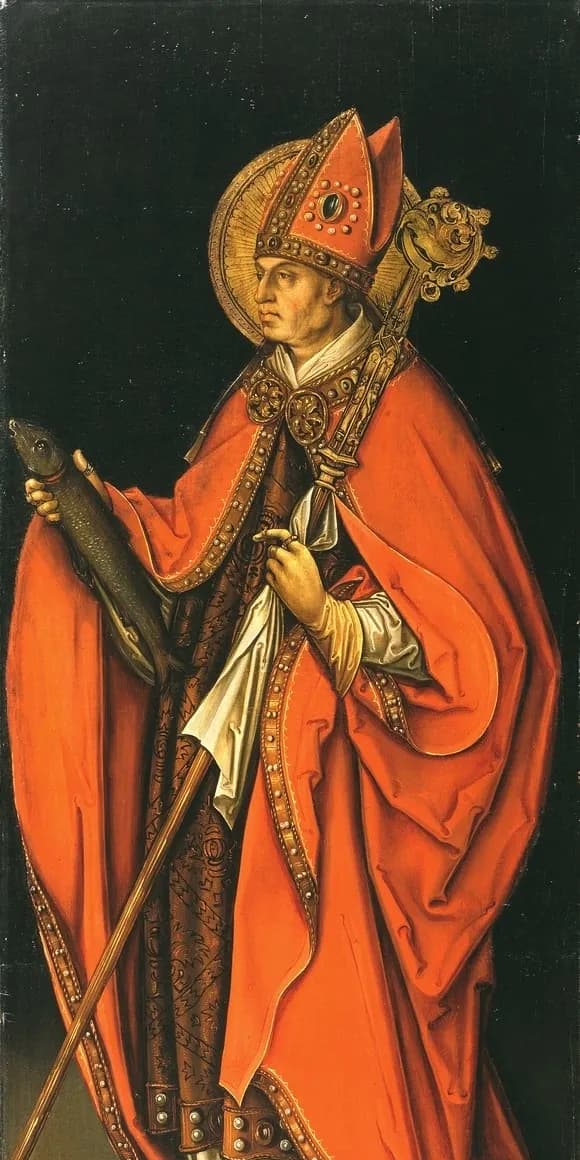
- Born
- 890 16, at Kyburg near Zurich according to the 1912 Catholic Encyclopedia 1, at Augsburg according to the Diocese of Augsburg's biography 6, at Wittislingen according to its saint-of-the-day calendar 7
- Canonized
- 993, by Pope John XV 126; the 1910 Catholic Encyclopedia calls it the first solemn canonization by a pope 2
- Patron saint of
- Augsburg, winegrowers, fishermen, weavers, the dying, travelers and wanderers; invoked in difficult childbirth, illness, fever, weakness, rabies, plagues of rats and mice, and dangers from water and floods 7; also in eye diseases and against dog bites 6
- Shown with
- Bishop's vestments, a fish, a book and a crozier, often on horseback 7
Saint Ulrich was Bishop of Augsburg for fifty years in the tenth century, the man who kept his city standing against the Magyars until Otto I could arrive and win the battle of the Lechfeld in 955. 16 He is remembered just as much for what happened twenty years after his death: in 993 Pope John XV canonized him at a synod in the Lateran, which the 1910 Catholic Encyclopedia calls "the first time that a solemn canonization had been made by a pope." 2
A sickly child at St. Gall
He was born in 890, but the sources do not agree where. The 1912 Catholic Encyclopedia says Kyburg, near Zurich. 1 The Diocese of Augsburg's biography, by Peter Rummel, says Augsburg, on Ulrich's own statement, and places the family seat at Wittislingen; the diocese's saint-of-the-day calendar says Wittislingen itself. 67 The encyclopedia names his parents Count Hucpald and Thetbirga and connects the family with the dukes of Alamannia and the imperial house; Rummel spells them Hupalt and Dietpirch, Alemannian nobility. 16
The encyclopedia says he was sickly as a child. 1 At about ten he was sent to the Benedictine abbey school of St. Gall, where he proved an excellent scholar and could not decide whether to become a monk there or a secular priest. 16 He was sent instead to Adalbero, Bishop of Augsburg, who made him his chamberlain; the encyclopedia dates this before April 910, Rummel around 908, and the diocesan calendar 909, adding that Adalbero was his uncle. 167
When Adalbero died in 910, Ulrich left. The encyclopedia says simply that he went home and stayed there until the next bishop, Hiltine, died in 923. 1 Rummel gives a reason: he was unwilling to serve Hiltine, a man of low birth, and spent the years managing his family's estates. 6 The calendar puts it the other way round, saying he had been passed over for the succession. 7
Bishop of Augsburg
In 923 he became bishop. The encyclopedia says King Henry appointed him through the influence of his uncle, Duke Burchard of Alamannia, and that he was consecrated on December 28. 1 Rummel says the cathedral clergy elected him, perhaps under Burchard's influence, and that Henry confirmed the choice. 6
The encyclopedia describes him as a ruler "who united severity with gentleness." 1 He set out to raise the moral and social standard of his clergy by regular visitations and by building as many churches as he could, so that ordinary people could reach the sacraments, and it credits his success mostly to his own example. 1 Rummel fills in the detail: synods every spring and autumn, a cathedral school to train priests better, and visits to parishes on horseback or by oxcart as far as the remote valleys of the Allgäu. 6 He rebuilt the burned cathedral and the ruined church of Saint Afra. 6
Rummel also records that the Maundy Thursday washing of feet, which Ulrich performed in the Augsburg poorhouse, was more than a ceremony to him; that he had a number of poor people fed in the bishop's residence every day; and that he left what little he owned at the end to people at the mercy of the rich. 6 He went to Rome to bring back relics, in 910 and again in 952 or 953 by the encyclopedia's count. 17
A century after his death a letter in his name surfaced, arguing against clerical celibacy. The encyclopedia calls it a forgery that counted on his reputation for strict morals to persuade ordinary people. 1
The siege and the Lechfeld
As a prince of the empire he was loyal to the Ottonian kings, and the encyclopedia calls him one of the main props of their policy. 1 When Duke Ludolf of Swabia rose against his father, Otto I, Ulrich held to the king and suffered for it. 16 In the summer of 954 father and son faced each other with their armies at Illertissen, and at the last moment Ulrich and Bishop Hartbert of Chur were able to mediate. 1 The encyclopedia dates the reconciliation to December 17, 954; Rummel to around Christmas. 16 The diocesan calendar thinks this was his largest contribution to what followed, because the Magyars found a united army waiting for them. 7
They came in 955, burning as they went, and besieged Augsburg. 1 The encyclopedia says it was due to Ulrich's ability and courage that the city held out until the king arrived. 1 Rummel adds that Ulrich had already given it a stone wall, and that he rode among the defenders without armor, carrying only his stole, while they beat back the attacks of August 8 and 9. 6 The calendar says he commanded the defense. 7
The battle was fought on the Lechfeld on August 10, 955, and the invaders were defeated. 16 The encyclopedia calls the later claim that Ulrich fought in it incorrect, since the Magyars lay between him and the emperor; Rummel agrees he took no part, and notes that his brother Dietpald and his nephew Reginbald were killed in it. 16
The last years and his death
He wanted to end his life as a Benedictine. In the encyclopedia's account, he made his nephew Adalbero his coadjutor because of illness and his wish to retire to an abbey, and at a diet on September 20, 972 he had to defend himself against a charge of nepotism. 1 Rummel says a synod at Ingelheim refused to let him hand the see to his nephew; the calendar says the emperor refused. 67 Adalbero died suddenly in April 973. 6
The encyclopedia describes the end. At dawn on July 4, 973, he had ashes strewn on the floor in the shape of a cross, sprinkled with holy water, and was laid on it. 1 As the sun rose his nephew Richwin arrived with a greeting from Emperor Otto II, and "immediately upon this, while the clergy sang the Litany, St. Ulrich passed away." 1 Bishop Wolfgang of Regensburg buried him in Saint Afra. 16 In 1187, Rummel writes, Frederick Barbarossa himself helped carry his copper coffin to a new crypt. 6
The first canonization
The encyclopedia says many miracles were reported at his grave and that John XV canonized him in 993. 1 Its article on that pope is more precise: at a Roman synod in the Lateran on January 31, 993, Ulrich "was solemnly canonized," and the pope announced it to the bishops of France and Germany in a bull dated February 3. 2 A 1952 Catholic Truth Society pamphlet by P. E. Hallett is more cautious: before then, local bishops approved the cult of saints, and "the first formal decree of canonization seems to be that of St. Ulrich." 3 Franciscan Media says he is the first person for whom we have a record of canonization. 4
Augsburg itself is careful. Rummel calls it probably the first canonical canonization and says it came at the request of Ulrich's third successor, Liutolf. 6 The diocesan calendar says his cult was approved on February 3, 993 at a meeting of the Roman clergy with the pope in the Lateran palace, and that this does not quite match the claim of a first canonization at a synod. 7
What is Saint Ulrich the patron saint of?
The Diocese of Augsburg's calendar names him patron of Augsburg, winegrowers, fishermen, weavers, the dying, travelers and wanderers, and lists him as a helper in difficult childbirth, illness, fever, weakness, rabies, plagues of rats and mice, and danger from water and floods. 7 Rummel says medieval and Baroque Christians called on him in fever, eye disease, dog bites and before dangerous journeys, and above all for protection against floods. 6
That is the source of the fish he holds in so many paintings. Rummel explains it as a sign of his protection against water, which later generations no longer understood and reinterpreted with a legend. 6 The well-known story of the fish itself is not told by any source used here, so this page leaves it there.
Saint Ulrich's feast day
His feast is July 4, the day he died. 157 Vatican News lists him among the saints of that day, and the Diocese of Augsburg keeps a solemnity in his honor as its patron. 58 Since 1955 the diocese has also held an Ulrich Week every year, with pilgrimages. 7
July 4 is a crowded date. Catholic Culture gives the universal calendar's optional memorial that day as Saint Elizabeth of Portugal's, transferred in the United States to July 5 because of Independence Day, and does not mention Ulrich. 9
Praying with Saint Ulrich
Most of what is remembered about him is public: a prince of the empire at the king's courts, a negotiator between a father and son with armies drawn up, a bishop on a horse among frightened defenders. 16 Underneath that the sources keep finding the same plain work. Synods twice a year, parishes visited by oxcart, poor people fed in his own house every day. 6
He did not get the ending he asked for. He wanted to give up his office and die a monk, and he was refused, then lost the nephew he had hoped would succeed him a few months before his own death. 16 He died as he had lived for fifty years, still the bishop, lying on a cross of ashes while his clergy sang the litany. 1
The siege is the part people know, and the sources are careful with it. He did not fight on the Lechfeld, and his own brother and nephew died there. 16 What they credit him with is holding a city together until help came, and, in one reading, having made peace in the royal family the year before so that help could come at all. 17
People in his diocese have gone on asking him for help with floods, fevers, journeys and a difficult birth for more than a thousand years. 67 Those are ordinary dangers, and his own life was spent largely on ordinary things.
Saint Ulrich of Augsburg, pray for us.
Sources
- 1.Ulrich Schmid, "St. Ulrich," The Catholic Encyclopedia, Vol. 15 (New York: Robert Appleton Company, 1912).
- 2.Johann Peter Kirsch, "Pope John XV (XVI)," The Catholic Encyclopedia, Vol. 8 (New York: Robert Appleton Company, 1910).
- 3.P. E. Hallett, The Canonization of Saints (London: Catholic Truth Society, 1952), reproduced in the EWTN Library.
- 4.Jack Wintz, OFM, "The Catholic Saints and Us," Franciscan Spirit Blog, Franciscan Media, 2022.
- 5."04 July," Saint of the Day, Vatican News.
- 6.Peter Rummel, "Hl. Ulrich - Bischof von Augsburg von 923 - 973," Diocese of Augsburg (in German).
- 7."Ulrich," Heilige des Tages, Diocese of Augsburg (in German).
- 8."Hochfest des hl. Ulrich, Bischof von Augsburg, Patron des Bistums Augsburg," readings, Diocese of Augsburg (in German).
- 9."July 4, 2026," Liturgical Year, Catholic Culture.
Saints to turn to next
Others in this collection who are turned to for some of the same things.
- Saint FlorianMartyred at Lorch in 304, or about 303 by one accountCourageProtectionWork and vocation
- Saint ErasmusDied c. 303, or in the late second century by one accountProtectionCourage
- Saint Agathac. 230 - c. 251CourageProtection
- Saint Bernard of MenthonDied at Novara in 1008, or in 1081 by another accountProtectionCourage