Saint Florian
Martyred at Lorch in 304, or about 303 by one account
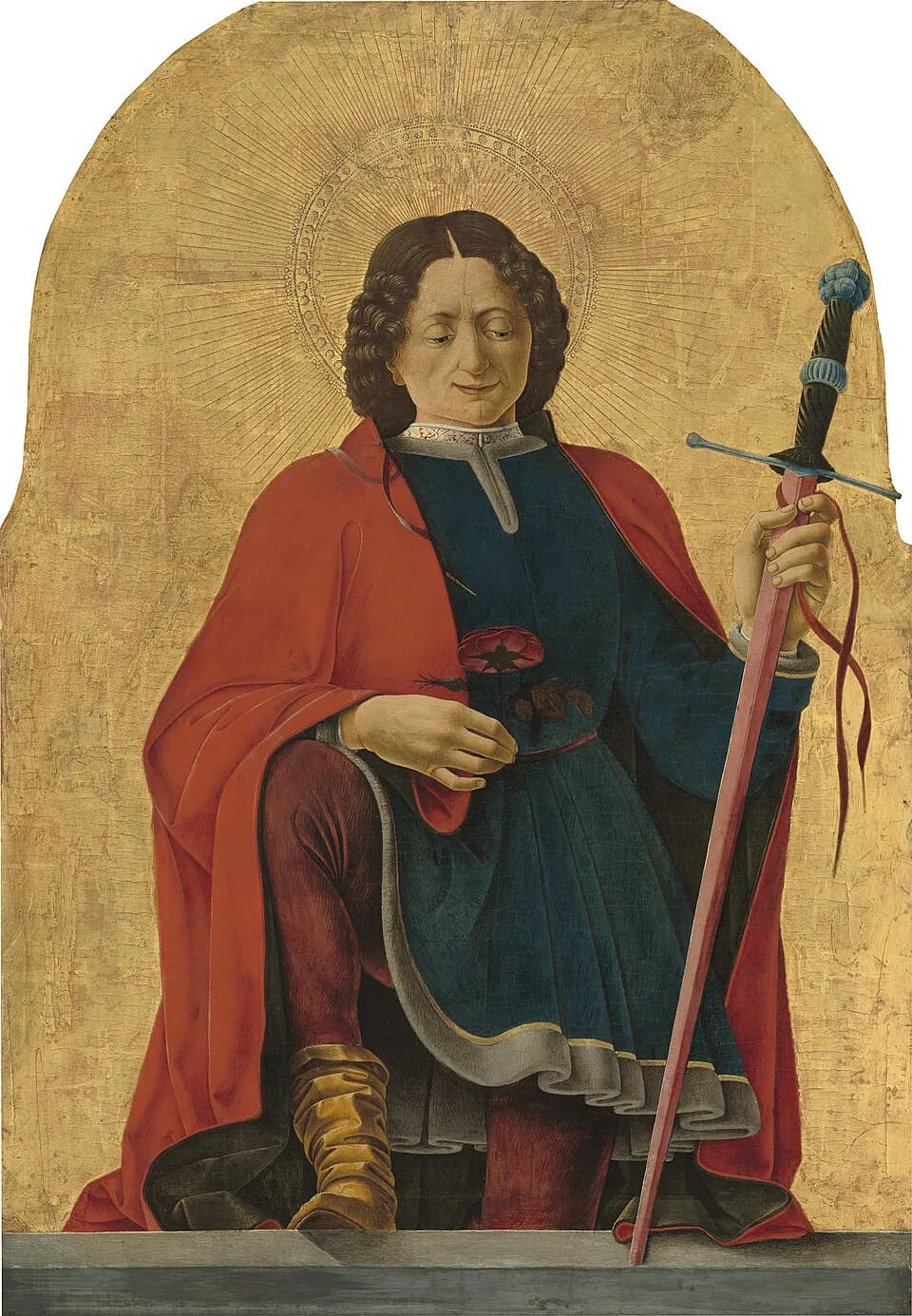
- Patron saint of
- Firefighters and Poland 12; Linz and Upper Austria 1; steelworkers and chimney sweeps 2; Catholic Culture adds brewers, coopers, harvests, and protection against fire, flood and drowning 1
- Born
- Probably at Cannabiaca, today Zeiselmauer in Austria, according to Vatican News 2
- Died
- In 304 under Diocletian, drowned in the Enns at Lorch, according to Wolfsgrüber, Catholic Culture and Vatican News 123; about 303 under Galerius, according to Lins 4
- Relics
- Partly given to Kraków by Pope Lucius III: in 1138 according to Catholic Culture, in 1184 according to Vatican News 12
- Historical record
- Catholic Culture calls his Acts "legendary," but the tradition of his martyrdom near the Enns "ancient and reliable" 1
Saint Florian was a Roman army officer in what is now Austria who, in the persecution under Diocletian, declared himself a Christian and was thrown into the river Enns with a stone around his neck. 123 He died at Lorch, the Roman Lauriacum, in 304, and the abbey of Sankt Florian stands where he is believed to be buried. 13 Relics carried to Kraków in the twelfth century made him a patron of Poland, and he is the patron of firefighters. 12 His feast is May 4. 12
What the sources can say
There is no article on Florian in the old Catholic Encyclopedia. He turns up there in passing, in the histories of Austria and of Vienna, and both mentions are a sentence long: a martyr of the great persecution, at the turn of the fourth century. 34 Wolfsgrüber adds the river, the place and the grave. 3 Cölestin Wolfsgrüber's sentence is the plainest: "During the persecution of the Christians under the Emperor Diocletian, in 304, the soldier Florianus was thrown into the Ems at Lauriacum (Lorch)." 3
The fuller story comes from his Acts, and Catholic Culture is clear about what kind of document they are, calling them his "legendary 'Acts.'" 1 It is equally clear that the core does not depend on them. The tradition of his martyrdom "not far from the spot where the Enns flows into the Danube," it says, "is ancient and reliable." 1
Joseph Lins, writing on Vienna in 1912, treats the martyrdom as evidence in its own right. He dates it "about 303," places it "during the persecution of Galerius," and says it "proves that as early as the third century Christianity had gained entrance into Vienna." 4 The other sources give 304 and name Diocletian. 123 This page records both dates.
An officer at Lorch
Catholic Culture describes him as an officer of the Roman army "who occupied a high administrative post in Noricum," a province that is now part of Austria. 1 Vatican News says he was probably born at Cannabiaca, the present Zeiselmauer, and that his legion was stationed at Lauriacum, today Lorch near Enns. 2
When the persecution reached the province, Catholic Culture's account has Florian give himself up at Lorch to the soldiers of the governor, Aquilinus, who were rounding up Christians. 1 Vatican News tells it through forty soldiers who had already been arrested. Florian went to Aquilinus to speak for them, and in doing so said that he was a Christian too. 2
Vatican News presents the governor as reluctant. He did not want to lose good legionaries, and tried to persuade the men to sacrifice to the gods, the one way under the emperor's order that they could save their lives. When persuasion failed he had them tortured, and when torture failed he sentenced them to be beheaded. 2
The river Enns
Florian was not beheaded with the others. According to Vatican News, the governor singled him out for a more shameful death and had him thrown into the nearby Enns with a stone tied to his neck. 2 The legendary Acts, as Catholic Culture summarizes them, add more before the river: he made "a bold confession," was "twice scourged, half-flayed alive, set on fire, and finally thrown into the river Enns with a stone around his neck." 1 Catholic Culture's shorter note gives the place as a bridge, from which he "was precipitated" into the water with a boulder at his neck. 1
His body was recovered. Catholic Culture says it was "recovered and buried by a pious woman." 1 Vatican News says that when the water gave up the body it was buried with great honor, and that after the persecutions ended a church and a monastery were built over the grave. 2 Wolfsgrüber says the house of Augustinian canons at Sankt Florian, in Upper Austria, "now stands on the spot where the body of this saint was buried." 3
That abbey is still there. In 1910 Lins counted it among the two houses of Canons Regular of Saint Augustine in the diocese of Linz, with its own theological school, and called its collegiate church, built between 1636 and 1745, one of the two most important Baroque churches in the diocese. 5
Rome, Kraków and the fire of 1528
Part of the body did not stay in Austria. Catholic Culture says it "is said to have been at a later date translated to Rome." 1 Vatican News gives a reason: when the garrison at Lorch was posted to Rome, the Christian soldiers took their commander's relics with them. 2
From Rome some of them went to Poland. Both sources credit Pope Lucius III, but they disagree on the year. Catholic Culture says that "in 1138" he gave relics "to King Casimir of Poland and to the Bishop of Cracow." 1 Vatican News gives Lucius's pontificate as 1181 to 1185 and dates the solemn deposition of the relics in Wawel Cathedral to 1184. 2 Both dates are recorded here.
Vatican News explains why Poland wanted them. The relics of Saint Adalbert and the Five Martyr Brothers had been carried off in a Bohemian raid in 1038, and the country, which did not yet have saints of its own, asked Rome for new ones. Prince Casimir pressed the request, and the chronicler Jan Długosz records that Poles began to give the name Florian to their children at baptism. 2 By the fifteenth century he was reckoned among the principal patrons of the kingdom. 2 His relics are kept today in Wawel Cathedral, in the basilica of Saint Florian in the Kleparz district of Kraków, and at Sankt Florian. 2
The link with fire came from the manner of his death. Because he died in water, Vatican News says, he was very early taken as a protector against fire, war and flood. 2 In Poland the devotion grew after 1528, when a fire destroyed much of Kraków and the church of Saint Florian at Kleparz alone survived. People read it as his doing, and his figure began to appear on city gates, market squares and houses. 2 The Holy See's biography of Pope John Paul II records that after returning from his studies in Rome in 1948, the young Father Wojtyła served as a curate at Niegowić, near Kraków, and then at Saint Florian's in Kraków. 6
What is Saint Florian the patron saint of?
Both main sources name him patron of firefighters. 12 Vatican News adds steelworkers and chimney sweeps. 2 Catholic Culture says that since the relics reached Kraków he "has been regarded as a patron of Poland as well as of Linz, Upper Austria and of firemen," and that "he is invoked as a powerful protector in danger from fire or water." 1 Its longer list includes brewers, coopers, soap-boilers and harvests, and protection against fire, flood, drowning and battle, and it notes that he is especially popular with firefighters and brewers. 1
In art, the same source says, he is often shown as a young man, sometimes in armor, pouring water from a tub onto a burning church, or with a millstone, the stone of his death. 1 No source used here tells the burning church as an event in his life, so this page treats it as a picture of his patronage.
Saint Florian's feast day
Praying with Saint Florian
What is solid in his story is small. A soldier, a persecution, a river and a grave, and a tradition Catholic Culture calls ancient and reliable even while it calls the Acts legendary. 13 Vatican News traces his protection against fire and flood to that one death in the Enns. 2
In the account Vatican News gives, his confession came on behalf of other people. Forty men were already under arrest, and he went to the governor to speak for them, which is how he came to say what he was. 2 He was not the one in custody when he spoke. Whatever he expected from that conversation, the sources do not say.
The patronage itself was built by the people who needed it. A city watched a fire take most of Kraków and leave his church standing, and they put his figure on their gates. 2 Their patron against fire is a man who died in a river, and the sources make no attempt to smooth that over. 12
Vatican News closes its page by setting Lorch beside Mauthausen, the quarries a short distance from where he died, where thousands were killed in the Second World War and many, it says, gave their lives for their faith as he did. 2 It notes that his cult weakened once fires became less of a threat, and reads the nearness of the two places as a reminder that Christians in any generation may be faced with a choice for or against Christ. 2
Saint Florian, pray for us.
Sources
- 1."St. Florian," Liturgical Year, May 4, Catholic Culture.
- 2.Arkadiusz Nocoń, "Patron Dnia: Święty Florian, męczennik związany z Polską," Vatican News (Polish edition), May 4, 2024.
- 3.Cölestin Wolfsgrüber, "The Austro-Hungarian Monarchy," The Catholic Encyclopedia, Vol. 2 (New York: Robert Appleton Company, 1907).
- 4.Joseph Lins, "Vienna," The Catholic Encyclopedia, Vol. 15 (New York: Robert Appleton Company, 1912).
- 5.Joseph Lins, "Linz," The Catholic Encyclopedia, Vol. 9 (New York: Robert Appleton Company, 1910).
- 6."Biographical Profile of His Holiness Pope John Paul II," The Holy See.
Saints to turn to next
Others in this collection who are turned to for some of the same things.