Saint Barbara
Unknown; venerated as a martyr from the seventh century
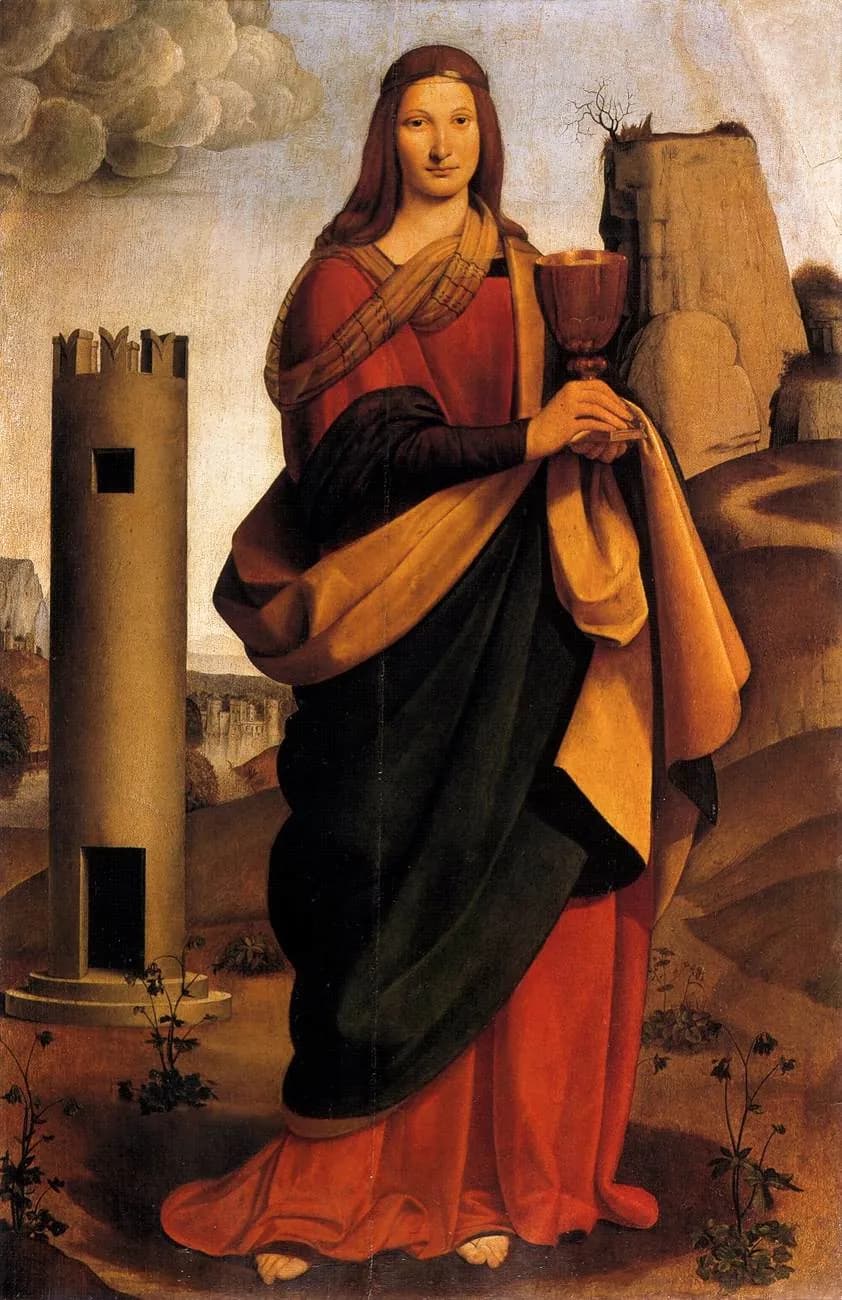
- Patron saint of
- Firefighters 3; artillerymen and miners, and those in danger from thunderstorms and fire 1; those who fear dying without the sacraments 15. A 1966 encyclopedia adds gunners, military engineers, foundry workers, fireworks makers and bell-ringers 4
- Historical record
- The 1907 Catholic Encyclopedia finds no mention of her in the early historical authorities and calls her Acts legendary 1
- Place of martyrdom
- Heliopolis in Egypt or Nicomedia, depending on the version; the early martyrologies also name Tuscany, Rome and Antioch 1
- Liturgical calendar
- Removed from the General Roman Calendar at its revision because of historical difficulties; still kept locally 45
- Emblems
- A tower with three windows, a martyr's palm, a chalice and host, sometimes a cannon 1
- Also
- One of the Fourteen Holy Helpers 5
Saint Barbara is a virgin martyr of the early Church, invoked for centuries against lightning and fire, and her life cannot be recovered as history. The 1907 Catholic Encyclopedia finds no reference to her in "the authentic early historical authorities for Christian antiquity," and calls the story of a girl shut in a tower by her father "legendary." 1 What is certain is the devotion: she was publicly venerated in both East and West before the ninth century and "was very popular with the Christian populace." 1 Artillerymen and miners took her as their protector, Pope Francis has called her the patroness of firefighters, and December 4 is still her day. 123
What the record does and does not hold
Johann Peter Kirsch, writing the encyclopedia article, starts with an absence. Barbara does not appear in the early authorities, and her name is missing from the original recension of the martyrology attributed to Saint Jerome. 1 Veneration of her was common "from the seventh century," and at about that time Acts of her martyrdom were in circulation. They were taken into the collection of Symeon Metaphrastes and used by Ado, Usuard and the other compilers of the enlarged Western martyrologies of the ninth century. 1
Those Acts do not agree on where she died. Symeon Metaphrastes and a Latin version printed by Mombritius put her martyrdom at Heliopolis in Egypt; other accounts, which the historian Baronius preferred, put it at Nicomedia. 1 The oldest Latin martyrology to name her, from about the year 700, says "In Tuscia," in Tuscany, and later additions to the martyrologies say Rome or Antioch. 1 Kirsch reads this scatter as evidence of something other than her biography: these statements "prove, however, only the local adaptation of the veneration of the saintly martyr concerning whom there is no genuine historical tradition." 1
The emperor is just as unsettled. Some versions name Maximinus and some Maximianus, and Kirsch declines to take sides, since "owing to the purely legendary character of the accounts" there is no good basis for working out which ruler is meant. 1 A Catholic Culture page for her nameday reports the verdict of Butler's Lives of the Saints in similar terms: the legend is "in all probability spurious." 5
The legend of the tower
Kirsch says the surviving narratives are "essentially the same," and summarizes them. 1 Barbara is the daughter of a rich pagan named Dioscorus, who keeps her shut up in a tower to preserve her from the outside world. She refuses an offer of marriage that comes to her through him. Before leaving on a journey, he orders a bath-house built for her near the tower, and while he is away she has three windows put in it instead of the two he intended, as a symbol of the Holy Trinity. 1
When he returns she tells him she is a Christian. He mistreats her and drags her before the prefect of the province, Martinianus, who has her tortured and condemns her to be beheaded. Dioscorus carries out the sentence himself, and on his way home he is struck by lightning and his body consumed. 1 A Christian woman named Juliana is martyred with her, and a devout man called Valentinus buries them both. At their grave, the legend goes on, the sick were healed and pilgrims found help and consolation. 1
Later tellings grew. Caxton's version of the Golden Legend, as Catholic Culture quotes it, has Dioscorus build her "a strong two-windowed tower" so that no man should see her beauty, and has Barbara explain the third window to him as "the Father, the Son and the Holy Ghost." 5 A 1966 Encyclopedia of Catholic Saints, reprinted by Catholic Culture, goes much further: a teacher sent by Origen of Alexandria to instruct her in the tower, an escape through a rock that opened for her, shepherds who betray her hiding place, and lightning that strikes the prefect as well as the father. 4 None of those details is in the encyclopedia's summary of the Acts. 1
How the devotion spread
Kirsch traces her patronages back to the end of the story. The father struck by lightning "caused her, probably, to be regarded by the common people as the patron saint in time of danger from thunder-storms and fire," and from there, by analogy, as the protector of artillerymen and miners. 1 She was also called on to obtain the sacraments of Penance and the Eucharist at the hour of death. 1 Catholic Culture connects that to a prayer she is said to have made before her execution. 5
One episode did a great deal for her cult, in Kirsch's telling. In 1448 a man named Henry Kock was nearly burned to death in a fire at Gorkum. He called on Saint Barbara, to whom he had always been devoted; she helped him out of the burning house and kept him alive until he could receive the last sacraments. 1 A similar story was added to the Golden Legend. 1
Artists gave her a recognizable set of emblems. She stands in or beside a tower with three windows and holds a martyr's palm, and she often carries a chalice and sacramental wafer. Sometimes cannon are shown near her. 1 She is also numbered among the Fourteen Holy Helpers. 5
What is Saint Barbara the patron saint of?
The 1907 encyclopedia names her patron in time of danger from thunderstorms and fire, and protector of artillerymen and miners. 1 It also records that she was invoked so that the dying would receive Penance and the Eucharist. 1 Catholic Culture describes her as invoked "against fire and lightning" and as a "protectress of those in danger of dying without the sacraments." 5
Firefighters still count her as theirs. When Pope Francis received Italy's firefighters and their families in December 2022, he ended by entrusting them "to the intercession of your patroness, Saint Barbara." 3
The 1966 retelling offers a longer list of "all those who use powder or play with fire": fireworks makers, saltpeter miners, foundry workers, artillerymen, gunners, cooks and military engineers, along with bell-ringers and carillon players. It adds that sailors invoked her against storms. 4 That list belongs to the popular tradition rather than to any formal act of the Church, and it is given here as that source gives it.
Saint Barbara's feast day
Her feast is December 4. Vatican News lists "St. Barbara, Martyr" under that date 2, and the 1907 encyclopedia says that "in the Greek and present Roman calendars the feast of St. Barbara falls on 4 December." 1 The same article notes an older reading: the martyrologies of the ninth century, except that of Rabanus Maurus, place her on December 16. 1
December 4 is no longer her day in the universal calendar. Catholic Culture says it "was the universal feast of St. Barbara, until the revision of the General Roman Calendar," because she "presented historical difficulties," and that her feast is still December 4 "but only celebrated locally in various areas." 4 Its liturgical calendar continues to list her on December 4 as a commemoration from the Roman Martyrology, alongside the optional memorial of Saint John Damascene. 6
For American readers, the nameday page has a local suggestion: a child named Barbara living near Santa Barbara, California, might visit the old Franciscan mission there, which bears her name. 5
Praying with Saint Barbara
Start where the encyclopedia starts. There is no early record of her, and the story of the tower survives only in Acts that the encyclopedia calls legendary. 1 Yet Christians in the East and the West were venerating her publicly before the ninth century, and she was very popular with ordinary believers. 1 The page reports both of those facts and does not make either cancel the other.
The legend, read as a legend, is about a daughter whose faith costs her everything at the hands of her own father. 1 She refuses the marriage he brings her, puts a third window in the bath-house he built, and tells him what it means when he comes home. 1 The story asks what loyalty is owed to God when the person who stands against it is family.
The devotion that grew around her is a practical one. People asked her for protection from storms and fire, and also, in Kirsch's account, for the chance to receive Penance and the Eucharist before they died. 1 Henry Kock's story at Gorkum holds both requests together: she got him out of the burning house and kept him alive until he could receive the last sacraments. 1
Pope Francis, speaking to firefighters about the Good Samaritan, said their work has "the nature of a mission," and then handed them over to her intercession. 3 People who pray to her today are joining a long line of workers who did the same, while knowing that almost everything told of her life is a story.
Saint Barbara, pray for us.
Sources
- 1.Johann Peter Kirsch, "St. Barbara," The Catholic Encyclopedia, Vol. 2 (New York: Robert Appleton Company, 1907).
- 2."St. Barbara, Martyr," Saint of the Day, 04 December, Vatican News.
- 3.Pope Francis, Address to the firefighters, with family members, Paul VI Audience Hall, December 10, 2022.
- 4."St. Barbara, December 4," Catholic Activity, Catholic Culture (Trinity Communications), with text from Encyclopedia of Catholic Saints (Philadelphia: Chilton Books, 1966).
- 5."Nameday Ideas for the Feast of St. Barbara, Virgin and Martyr," Catholic Activity, Catholic Culture (Trinity Communications).
- 6."December 4," Liturgical Calendar, Catholic Culture (Trinity Communications).
Saints to turn to next
Others in this collection who are turned to for some of the same things.