Saint Oswald
c. 605 - August 5, 642
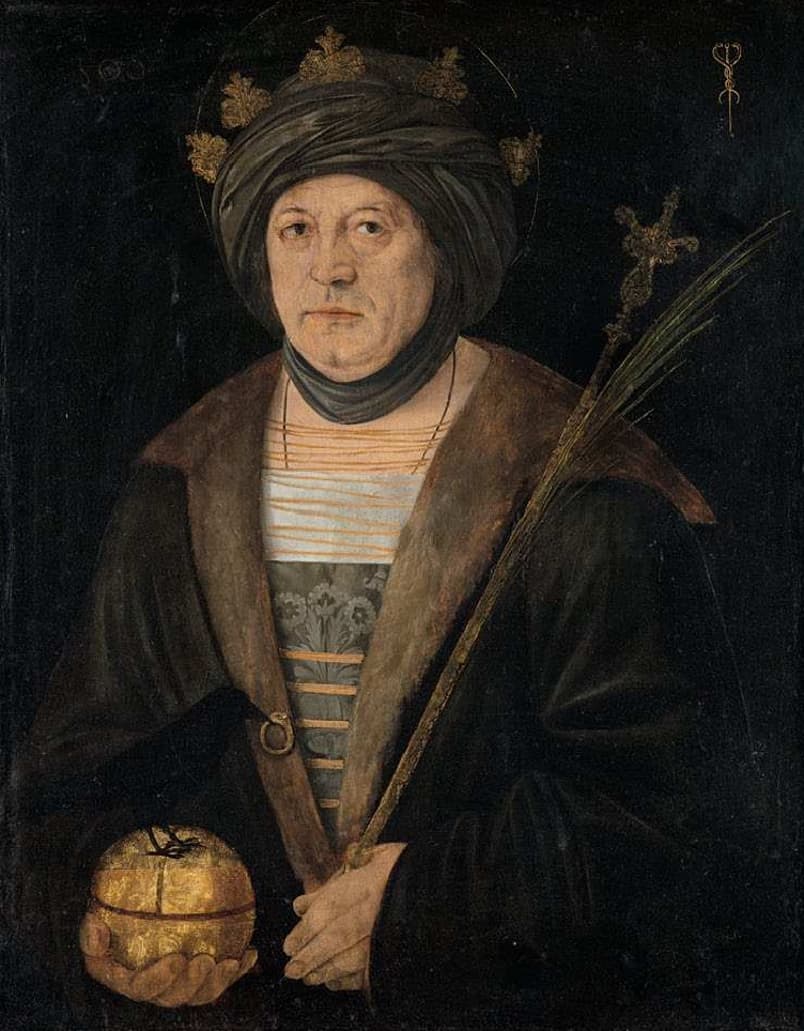
- King of
- Northumbria, for eight years, from 635 to 642 1
- Raised
- In exile at Saint Columba's monastery on Iona, after his father was killed in battle in 617 1
- Brought Aidan north
- The monk-bishop who founded Lindisfarne in 635 1
- Interpreter
- He translated for the Irish missionaries at his own court, because they had no English 1
Saint Oswald was a king of Northumbria who came back from exile with twelve Christian companions and a wooden cross, and spent eight years making a pagan kingdom Christian before Penda of Mercia killed him. 1 Vatican News puts the paradox in one line: he was "famous as a skilled warrior - but even more as a lover of peace." 2 The Roman Martyrology has him at August 5, the day he fell. 3
Heaven's Field
His father Ethelfrid was killed in battle in 617, and Oswald and his brothers fled north to the Scots and were cared for at Columba's monastery on Iona. 1 He grew up there. That single fact shapes everything after it: when he needed missionaries he "naturally looked to the North", because the North was where he had been formed. 1
He came back in 635, to a kingdom that had split in two and "relapsed into paganism" after his uncle Edwin died. 1 His elder brother had been murdered by the British king Cadwalla. A small band gathered around him near the Roman Wall, seven miles north of Hexham, at a place afterward called Hevenfelt - Heaven's Field. 1
There he "set up a cross of wood as his standard the first Christian symbol ever raised in Bernicia and gave battle to the Britons." 1 He had been encouraged, the article says, by a vision and a promise of victory from Saint Columba, "who shrouded with his mantle all his camp." 1 The Britons were routed and never took the offensive again. 1
Twelve Christians and an interpreter
The scale of what he was starting from is easy to miss. Of the men who returned from exile with him, "but twelve nobles" were Christians. 1 Edwin had accepted the faith in 627, but "his example was followed only by the people of Deira." 1 Oswald's own half of the kingdom had gone back to Woden.
The first preacher sent from Iona gave up and went home, "having found the Northumbrian people too barbarous and stubborn." 1 The second was Aidan - "a man of singular meekness, piety and moderation" - who established his see at Lindisfarne in 635. 1 Between them the land filled with churches and monasteries, and the church at York that Edwin had begun was finished. 1
Then the detail that says the most about him, and it is one sentence: "We are told that the king in his Court acted as the interpreter of the Irish missionaries who knew not the language of his thanes." 1 The overlord of Britain stood at the front of his own hall and put an Irish monk's sermon into English for his nobles, because otherwise nobody would have understood it.
Bede reports that he "brought under his sway all the nations and provinces of Britain, which are divided into four languages, namely the Britons, the Picts, the Scots, and the English", and Adamnan of Iona called him "The Emperor of the whole of Britain". 1 The encyclopedia is careful that some of this was nominal. 1
Maserfeld
Penda of Mercia was still pagan and still in the middle of the map, and Oswald needed the East Angles to keep his northern and southern holdings joined. "War was therefore inevitable." 1
At Maserfeld, about seven miles from Shrewsbury, "on the border of Wales, near Offa's dyke", Oswald was killed on August 5, 642, "in the eighth year of his reign and in the flower of his age." 1 Vatican News names the place by what it became: he "was martyred in England, at Maserfield, later named Oswestry in his memory." 2
His last words were for his soldiers rather than himself, and they turned into a proverb that outlived the kingdom: "God have mercy on their souls, as said Oswald when he fell." 1
Penda had the body mutilated and the limbs set on stakes, where they stayed a full year before Oswy took them down. 1 What followed is one of the strangest afterlives in the English calendar. The head went to Bamburgh, then to Lindisfarne, and in 875, for fear of the Danes, it was placed in the coffin of Saint Cuthbert - which came to rest at Durham in 998, was opened in 1104 with the head still in it, and was thought to hold it still when the tomb was opened again in 1828. 1
What is Saint Oswald the patron saint of
He is invoked by soldiers, which follows from a life spent in the field, and he belongs to anyone whose work is putting the faith into a language other people can actually hear. 1 The encyclopedia gives no formal list. 1
Vatican News states the thing worth taking: he "worked strenuously to spread the faith, and was killed out of hatred for Christ while fighting against the pagans." 2 A warrior king who is remembered as a lover of peace is not a contradiction the sources try to resolve, and this page does not either.
Saint Oswald's feast day
The feast of Saint Oswald is August 5, the day he was killed at Maserfeld in 642. 123 The Roman Martyrology lists him at that date and Vatican News keeps his day page there. 23
A caution worth stating, because it caught this page during research: there is a second Saint Oswald, archbishop of Worcester and York, who died on February 29, 992. He is a different man, two centuries later, and not the subject here.
Praying with Saint Oswald
He is the saint for arriving with far less than the job requires. Twelve Christians. A kingdom that had already abandoned the faith once. A first missionary who took one look at the people and left, calling them too barbarous and stubborn to bother with. 1 Oswald did not respond by lowering the aim; he asked Iona for somebody else.
The interpreting is the detail to sit with. Aidan could preach and could not be understood, so the king did the translating. 1 There is no dignity in it and no strategy - it is simply the gap between what was being said and what could be heard, and Oswald standing in it because he was the only one who could.
Then Maserfeld, which the record does not soften. He was killed at the height of his power, his body was cut apart and displayed for a year, and the kingdom he had built lasted eight years. 1 The proverb that survives is not about his courage. It is about what he was thinking about at the end, which was other people: God have mercy on their souls. 1
And then the long, absurd, faithful business of the relics - a head moved from battlefield to fortress to island, hidden from the Danes inside another saint's coffin, carried to Durham, still there when they opened the tomb four hundred years later. 1 Nobody planned that. People simply kept refusing to leave him behind.
Saint Oswald, pray for us.
Sources
Saints to turn to next
Others in this collection who are turned to for some of the same things.