Saint Isidore of Chios
Died May 14, probably 251
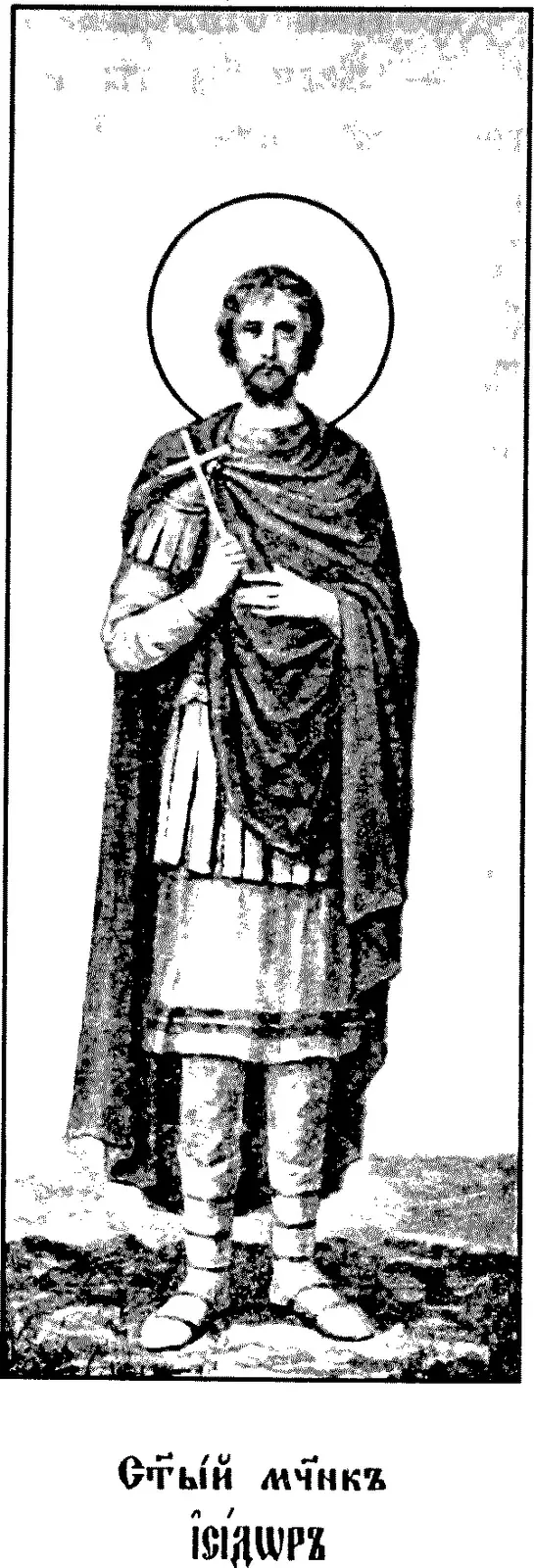
- Also called
- Isidoros in Greek, Isidorus in Latin 2
- Relics
- On Chios; most taken to Saint Mark's, Venice, in the twelfth century; brought back to Chios in 1967 12
- Patron saint of
- Venice, Chios, Mollerussa in Catalonia, and sailors 2
Saint Isidore of Chios was a Roman soldier who refused to sacrifice to the gods while his unit was stationed on the Aegean island of Chios, and was beheaded there under the emperor Decius, probably in 251. 12 His body was thrown into a well, by one tradition, and the well became a place of healing inside his own basilica; nearly nine centuries later the Venetians carried his relics to Saint Mark's. 123 His feast is May 14. 3 He is a different man from Isidore of Seville and Isidore the Farmer, and far earlier than either.
What the sources are
The Roman Martyrology says very little. It enters him on Chios as a martyr who is believed to have been thrown into a well, and no more. 3 The older story is told in Acts that survive in Greek and in Latin. The Bollandist Daniel Papebroch printed them in the Acta Sanctorum from a Greek manuscript in the Vatican, compared with two old Latin manuscripts and a later Greek paraphrase. 1
Papebroch thought well of them. He judged that they were written on Chios itself, before part of the relics went to Constantinople, and that the paraphrase was a later reworking done in the capital. 1 He also noted that they call the emperor "Flavius" Decius, a style the Greeks used only after Constantine, so they cannot be earlier than the fourth century. 1 The Norwegian bishops' saints database (katolsk.no) is more skeptical: the details of the passion do not seem authentic, it says, and it dates the text to Chios in the first half of the fifteenth century. 2
The optio and the centurion
In the Acts, a ship puts in at Chios in the first year of Decius to raise troops under a new decree, and Isidore is enrolled. 1 He serves as optio, the officer who drew and shared out the soldiers' rations, and he shares them fairly. 1 katolsk.no puts him in the fleet under the commander Numerius and calls him a quartermaster. 2
A second decree orders Christians to give up their faith. A centurion named Julius, jealous of Isidore's post, goes to Numerius and accuses him of refusing to sacrifice. 1 Numerius at first brushes him off: the levy is finished, Isidore has not refused to serve, and the emperor's edicts have been carried out. Julius presses until the commander sends for the man. 1 katolsk.no tells it differently: the centurion who denounced him was Lucius, and Julius was his captain, who handed him over. 2
Where he came from is uncertain. katolsk.no gives Alexandria, with a question mark. 2 Papebroch thought the detail came from a Latin manuscript that speaks of troops being carried in ships from Alexandria, which the paraphrase and the Greek service books read as the birthplace of Isidore. 1
The trial
Julius and three soldiers seize him, and the Acts have Isidore answer that the time of the contest has come and he will go gladly. 1 Before Numerius he refuses to sacrifice to gods who, he says, do not exist. 1 The commander tries flattery: Isidore is young, handsome and well born, and could be honored almost as a god himself. 1 Isidore answers with the faith from the beginning, the creation, the fall, and Cain killing Abel out of envy, and tells Numerius that the same envy is now working on him through Julius. 1 Threatened with the lash and the sword, he says his judge has power over the body and none over the soul. 1
Then Numerius orders his tongue cut out. In the Greek Acts the commander himself falls to the ground and loses his speech, and has to write the sentence of death on tablets; Isidore reads it and gives thanks. 1 Papebroch notes that the tongue is missing from the Vatican Latin text and from the paraphrase, which simply have Numerius pass sentence by the sword after consulting his advisers. 1
He was led to a place the Acts call the Ravine, or the Pit, knelt, signed himself with the cross, and prayed to be given a share among the saints before he bent his neck to the sword. 1 The Acts date his death to the day before the Ides of May, which is May 14, under the commander Numerius and the emperor Decius. 1 The Latin manuscripts name the consuls as Gallus and Ulpianus, and Papebroch, after a long argument, settles on 251; katolsk.no also gives 251 as probable. 12
Ammonius and Myrope
The Acts say that a God-fearing man named Ammonius, who had been his companion, took up the body and buried it with other brethren, and later sailed to the Hellespont and was martyred himself at Cyzicus. 1 The Greek Menaia for December 2 tell it another way. The body was thrown into a gorge for the birds and guarded; a woman named Myrope came by night with her maids, anointed it and laid it in a better place; and when the guards were threatened she confessed to taking it, was beaten and imprisoned, and died there after Isidore appeared to her. 1
katolsk.no names both Myrope and a fellow soldier Ammonius as the ones who drew him out of the well and buried him, and says Myrope was later buried beside him. 2 It adds a legend: that the trees on the south of the island wept for him, and that this was the origin of the mastic resin still gathered on Chios. 2 Papebroch found the same mastic story in the Acts of Petrus de Natalibus, which he did not consider genuine. 1
The well on Chios
The earliest witness to the well whom Papebroch quotes is Gregory of Tours, in the first book of his Miracles. 1 Isidore rests on the island of Chios, Gregory says, and there is a well in his basilica into which he is said to have been thrown; the possessed, the feverish and other sick people who drink from it are often cured. 1 People said they often saw a light in it like a burning candle, and Gregory himself met a priest who said he had seen it from the mouth of the well. 1
From Gregory the well passed to the martyrologies of Ado and Usuard, and from them to the Roman Martyrology. 1 The 1897 English edition still has it: on Chios the birthday of blessed Isidore, martyr, "in whose church is a well into which he is said to have been thrown. By frequently drinking of the water of this well, the sick are cured." 4 katolsk.no says a chapel was raised over the grave of Isidore and Myrope, and then a church in the fifth century, which may be the one whose ruins can still be seen in the town of Chios. 2
Constantinople and Venice
Part of the relics went early to Constantinople. A Greek account Papebroch prints says that Saint Marcian, a priest who later became steward of the great church, was told by the martyr in a dream to build him a church, and laid the relics he had in a shrine at the church of Saint Irene by the sea. 1 The shrine became known for healing, for driving out evil spirits, and for keeping sailors from shipwreck. 1 Papebroch puts it around 460, and says the cult spread from Constantinople to Russia, where Isidore was kept on May 14. 1
The rest of the body stayed on Chios until the twelfth century. 12 Papebroch tells how the Venetian fleet under Doge Domenico Michiel, coming home from the East, sacked Rhodes and then Chios and carried the saint's body off to Venice. 1 He quotes the inscription over the tomb in Saint Mark's: the body was brought from Chios by the doge in 1125, stayed hidden in the church until a chapel was begun for it under Doge Andrea Dandolo, and the chapel was finished on July 10, 1355, under Doge Giovanni Gradenigo. 1
katolsk.no tells it somewhat differently: most of the relics, all but the head, were stolen in 1124 and reached Constantinople, and merchants brought them to Venice about 1125, with the doge behind the theft at the urging of Cerbano Cerbani, who wrote the story down. 2 The head followed centuries later, and in 1967 his relics were taken back to Chios, to the cathedral there. 2
What is Saint Isidore of Chios the patron saint of?
katolsk.no names Saint Isidore of Chios patron of Venice and of Chios, of the town of Mollerussa in Catalonia, and of sailors, and says he was widely invoked along the Mediterranean coasts as their protector. 2 The Greek account of his Constantinople shrine already credits him with saving those at sea from storm and shipwreck. 1 katolsk.no also describes a sixth-century Byzantine pilgrim's stamp in the Walters Art Museum in Baltimore, showing his well on one side and a ship on the other. 2
Saint Isidore of Chios's feast day
Saint Isidore of Chios's feast day is May 14. 23 The current Roman Martyrology, as the Italian bishops print it, commemorates him on that day. 3 It is also the day the Acts give for his death, and the day the Greeks and Russians have long kept. 12
In the older Roman calendar he was on May 15, and the 1897 English Martyrology has him there. 4 Papebroch thought Ado and Usuard had put him a day late by a simple error in the numbering, and that the error then passed to the Roman book. 1 The same Martyrology also has, on February 5, a martyr Isidore at Alexandria beheaded under Decius by Numerian, "general of the army"; katolsk.no reports that the Bollandists take him to be the same man. 24 Venice kept the arrival of his relics on April 16 with a solemn procession, which its Senate tied to the day the Republic was delivered from the conspiracy of Doge Marino Faliero. 12
Praying with Saint Isidore of Chios
Very little of Isidore's story can be checked, and the sources say so. 12 What holds steady across them is short: a soldier on Chios, a refusal to sacrifice, a death by the sword, and a well that people went on visiting. 123
The Acts make the conflict about something ordinary. A centurion wanted another man's post, and used the emperor's edict to get it. 1 Isidore had done his job and fed his men fairly; he was denounced for the one thing he would not do. 1
His remains were divided and carried to Constantinople and to Venice and, in the end, back to Chios, and wherever they went people asked his help for the sick and for sailors in bad weather. 12 Gregory of Tours passed on what a priest had told him about a light in the water, and left it there. 1
Saint Isidore of Chios, pray for us.
Sources
- 1.Daniel Papebroch, "De S. Isidoro martyre in insula Chio," commentary, with the Acts from a Greek Vatican manuscript collated with two Latin manuscripts, May 15, Acta Sanctorum, Maii tomus III (Antwerp, 1680; reprinted Paris and Rome: Victor Palmé, 1866), pp. 445-450, Internet Archive (in Latin).
- 2."Den hellige Isidor av Khíos (d. ~251)," Den katolske kirke, the saints database of the Catholic Church in Norway, katolsk.no (in Norwegian).
- 3.Roman Martyrology, entry for May 14, "Sant'Isidoro, martire," Santo del giorno, Conferenza Episcopale Italiana (in Italian).
- 4.The Roman Martyrology, February 5 and May 15 (Baltimore: John Murphy Company, 1897), Internet Archive.
Saints to turn to next
Others in this collection who are turned to for some of the same things.