Saint Faith of Agen
d. c. 305
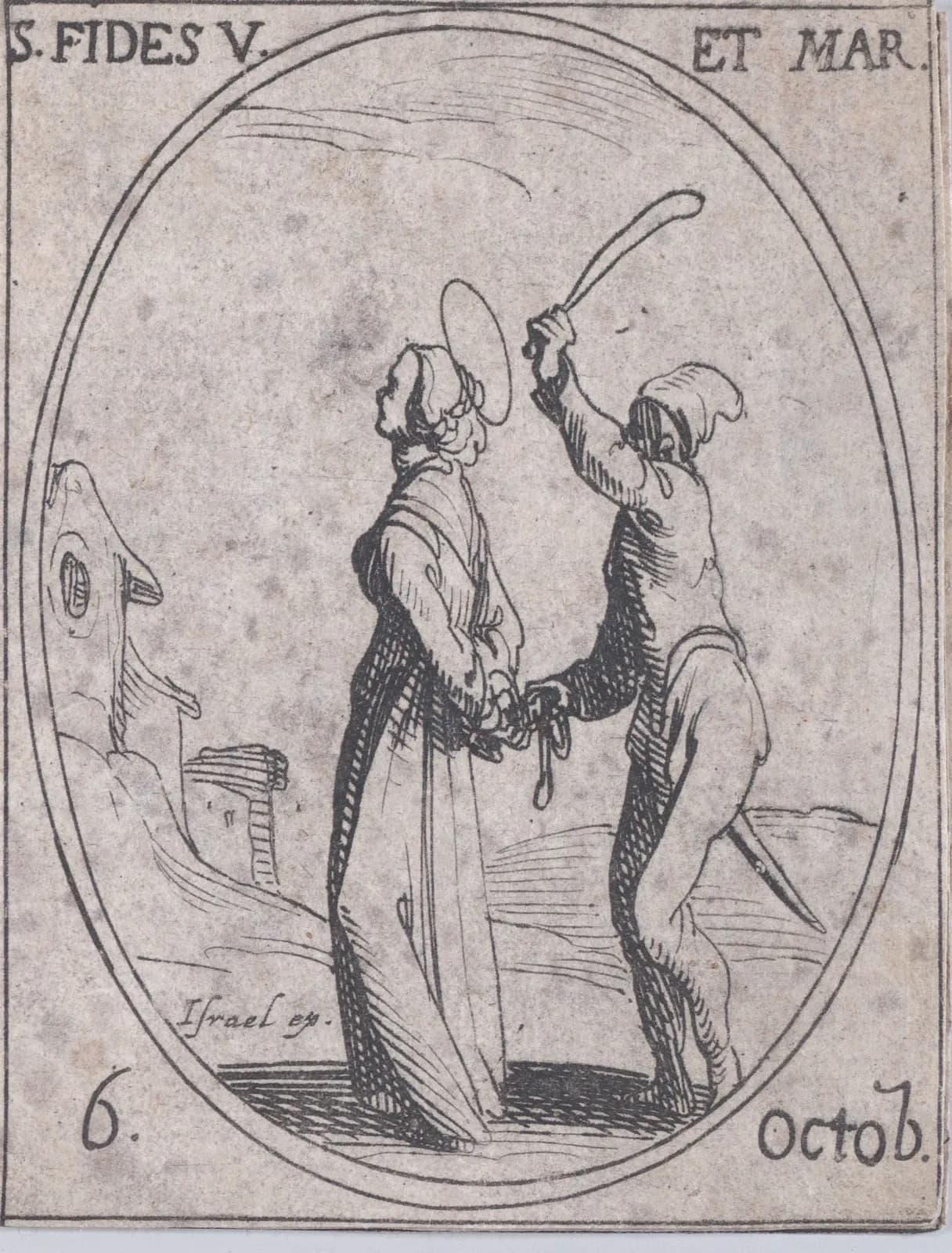
- Emblems
- A sword, a bundle of rods, a bronze bed, a martyr's palm 2
- Invoked by
- Soldiers, prisoners and pilgrims 2
Saint Faith was a young Christian woman martyred at Agen, in southwest France, at the start of the fourth century. 25 Her story as it is usually told is a later legend, but her death at Agen is recorded early enough that she very probably lived. 23 Her relics were stolen in the ninth century by the monks of Conques, and the golden statue that holds them made her one of the best-loved saints of medieval Europe. 24
What is known, and what is legend
Faith, Fides in Latin and Foy in French, is entered in the current Roman Martyrology on October 6 in a single line: at Agen in Aquitaine, now in France, Saint Faith, martyr. 1 The Norwegian bishops' saints database (katolsk.no) says her death at Agen is recorded in the martyrology attributed to Saint Jerome, which makes it likely that she really existed. 2 Beyond that, it says, the dating is a problem and the legend is unhistorical. 2
Georges Goyau, writing on the diocese of Agen in the 1907 Catholic Encyclopedia, is as blunt. The stories of the hermit Caprasius, "martyred with St. Fides by Dacianus, Prefect of the Gauls, during the persecution of Diocletian," are legends "which do not antedate the ninth century." 3 katolsk.no dates her passio no earlier than the eleventh century, and Catholic.net calls the familiar account unreliable, saying it has become tangled in places with the story of Caprasius. 25 katolsk.no adds that she is often confused with another Faith, one of the three allegorical sisters Faith, Hope and Charity, daughters of a Saint Sophia of Rome. 2
She is placed in the great persecution of the early fourth century. katolsk.no gives about 305, under the co-emperor Maximian, while allowing that she may have died in the third century under a prefect named Dacian; Catholic.net says only the fourth century. 25
The legend of her martyrdom
The legend is worth telling as a legend. In the version katolsk.no summarizes, she was a girl of noble family, called before Dacian at the age of twelve and ordered to sacrifice to the gods. 2 She refused, was laid on a bronze bed over a great fire, and was then beheaded. 2
Catholic.net tells it with the dialogue that made it famous. Brought before Dacian, she made the sign of the cross and asked heaven for help. Asked her name, she answered that she was called Faith and hoped to be worthy of it. 5 Dacian, inclined to mercy, urged her to think of her youth and offer sacrifice to Diana; she replied that she had served Christ since childhood and was ready to suffer anything for him. 5 She was stretched on a gridiron over a fire fed with oil. Some of the onlookers cried out against the torture of a girl whose only crime was to worship God, and they too were arrested and beheaded with her when they would not sacrifice. 5
katolsk.no's entry on Caprasius gives the other half of the story as the ninth-century tradition joined it to hers. Caprasius, hiding in a cave on a hill near Agen, watched her suffer, was so moved by her constancy that he gave himself up as a Christian and a bishop, and was beheaded. 6 katolsk.no is sure that Caprasius existed, since a church at Agen was dedicated to him by the sixth century, but doubts the companions the legend gives him. 6
The theft and the statue at Conques
Her cult is far better attested than her life. katolsk.no says her relics were moved in the fifth century to a basilica built in her honor at Agen, where many miracles were reported at her shrine. 2 Then they were stolen. 24
Goyau, writing on the diocese of Rodez in 1912, tells the history of the abbey of Conques: founded in the valley of the Dourdou by the hermit Dadon in 790, with the help of Louis the Pious. 4 "Between 877 and 883," he writes, "the monks carried off the body of the youthful martyr Ste-Foy" to Conques, "where it became the object of a great pilgrimage." 4 katolsk.no's Caprasius entry puts the translation by 866. 6 Its account of Faith supplies the method: a monk of Conques, sent for the purpose, lived for ten years as an apparently honest canon at Agen until he was made guardian of the shrine, and then took the relics. 2 The monks told the story openly, it says, as proof that the relics were genuine, and never reproached him. 2
Conques lay on the pilgrim road to Santiago de Compostela, and crusaders and pilgrims to the shrine of Saint James carried her memory home with them. 2 Goyau says Pope Paschal II allowed Abbot Begon to insert her name in the Canon of the Mass after the Roman virgins, and that Conques, with Agen and Sélestat in Alsace, became the center of a cult "which soon spread to England, Spain, and America where many towns bear the name of Santa Fe." 4
Her relics are kept in a seated statue of gold. Goyau calls it the "Majesté de Sainte Foy," a small wooden figure of the tenth century covered in gold leaf, to which gems, enamels and precious stones were added until it became "a living treatise on the history of the goldsmiths art in France." 4 katolsk.no dates it about 980, gives its height as 68 centimeters, and calls it the oldest surviving large Christian sculpture in Europe. 2 It was carried in procession to protect the abbey's lands, and presided even at meetings where the community's affairs were decided. 2 Goyau adds that the shrine was walled up in the choir in 1590 and found again in 1875. 4
Saint Faith in England and beyond
katolsk.no traces a strong English cult. Part of her relics went to Glastonbury; a church was founded for her at Horsham St. Faith near Norwich; fifteen Benedictine houses kept her feast, which entered the Sarum Missal; and at least twenty-three old English churches were dedicated to her. 2 A chapel in Westminster Abbey bore her name, and one in the crypt of St. Paul's Cathedral in London still does, in memory of the parish church of St. Faith that once stood on the site. 25 Catholic.net adds that the parish was pulled down in 1240 to enlarge the cathedral's choir. 5
The cult crossed the Atlantic too. katolsk.no and Catholic.net both connect her with the many places in the Americas called Santa Fe, from New Mexico to Bogotá. 25
What is Saint Faith the patron saint of?
katolsk.no says Saint Faith was not chiefly a healing saint but one invoked by soldiers, prisoners and pilgrims. 2 It describes the statue at Conques being taken to places struck by disaster and carried around the abbey's lands to guard them, and says the monks regarded her as their living, present and powerful protector. 2 In art her emblems are a sword or a bundle of rods, the bronze bed and the martyr's palm. 2
Saint Faith's feast day
Praying with Saint Faith
Almost nothing is certain about Faith except that she died at Agen for Christ and was remembered there. 23 The sources say so without embarrassment, and this page has tried to do the same. The oldest witness to her is a line in an ancient martyrology. 2
Her legend turns on her name. In Catholic.net's telling she answers the prefect that she is called Faith and hopes to live up to it. 5 Nobody can say whether she spoke those words, but it is the line the story has kept.
Her later history is stranger: stolen relics, a jeweled statue, a pilgrim road. 24 The people who called on her were soldiers, prisoners and pilgrims, most of them far from home, some of them not free to go back. 2 In the Middle Ages the monks of Conques carried her statue out to stand among the people in hard times. 2
Saint Faith of Agen, pray for us.
Sources
- 1.Roman Martyrology, entry for October 6, "Santa Fede, martire," as printed in "Santo del giorno," Conferenza Episcopale Italiana (in Italian).
- 2."Den hellige Fides av Agen (-~305)," Den katolske kirke (katolsk.no), Catholic Diocese of Oslo (in Norwegian).
- 3.Georges Goyau, "Diocese of Agen," The Catholic Encyclopedia, Vol. 1 (New York: Robert Appleton Company, 1907).
- 4.Georges Goyau, "Rodez," The Catholic Encyclopedia, Vol. 13 (New York: Robert Appleton Company, 1912).
- 5."Fe (Foy), Santa," Catholic.net (in Spanish).
- 6."Den hellige Caprasius av Agen," Den katolske kirke (katolsk.no), Catholic Diocese of Oslo (in Norwegian).
Saints to turn to next
Others in this collection who are turned to for some of the same things.